In the age when gods walked among mortals and the line between heaven and earth shimmered like heat over water, there lived a hero whose name echoed across the three worlds Hanuman, the mighty monkey warrior. His strength could move mountains, his loyalty was absolute, and his devotion to Prince Rama was unshakeable. Yet even the greatest of heroes could not have anticipated what awaited him beneath the emerald waves of the great ocean.
The war for Lanka raged on, and Prince Rama’s army needed a bridge a causeway of stone and earth to cross the vast expanse of water separating them from their enemy. Hanuman, ever faithful, threw himself into the task with the fervor of one who knew that every stone placed brought his beloved prince closer to victory. Back and forth he leaped, carrying boulders as easily as a child carries pebbles, dropping them into the churning sea with thunderous splashes that sent spray high into the tropical air.
Click to read all East Asian Folktales — including beloved stories from China, Japan, Korea, and Mongolia.
But something strange was happening.
Each morning, when Hanuman returned to inspect the previous day’s work, he found that stones had mysteriously disappeared. The bridge that should have grown steadily toward Lanka instead remained frustratingly incomplete. At first, Hanuman thought perhaps the ocean currents were to blame, or that the sea gods were testing their resolve. But as day after day passed with the same result, his keen warrior’s instinct told him something else was at work.
Someone or something was deliberately sabotaging their efforts.
Determined to uncover the truth, Hanuman concealed himself among the clouds one evening, watching the bridge with eyes that could pierce the gathering darkness. The sun descended like a golden disc into the western horizon, painting the water in shades of amber and crimson. The waves lapped gently against the partially constructed causeway. And then, as the first stars appeared in the velvet sky, the water began to shimmer with an otherworldly light.
From beneath the waves emerged a sight that made even the mighty Hanuman catch his breath.
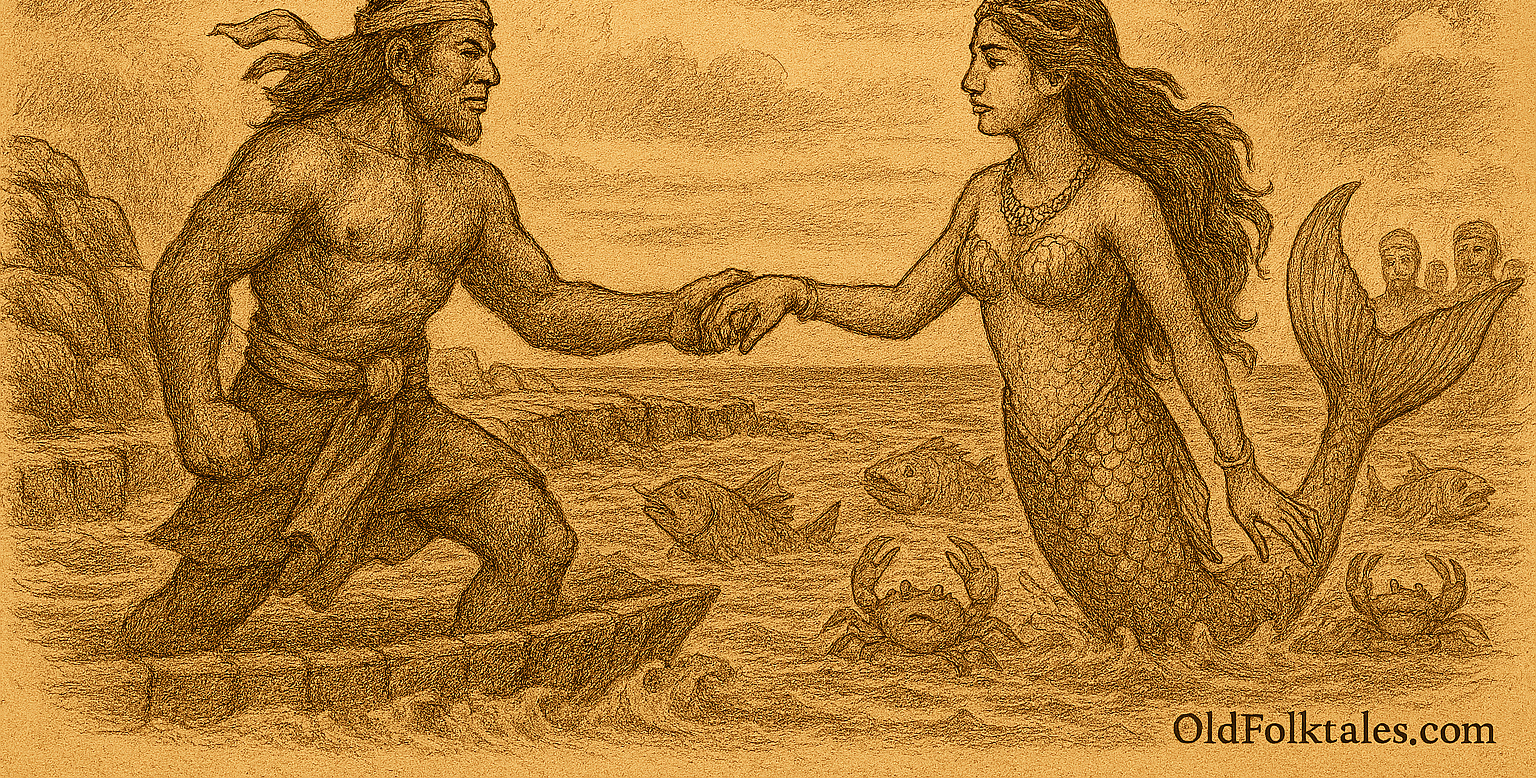
She rose from the depths like a vision from a dream Sovanna Maccha, the golden mermaid. Her scales glittered like coins of pure gold in the moonlight, each one catching and reflecting the celestial glow. Her long black hair floated around her like dark seaweed, and her eyes held the mysterious depth of the ocean itself. She moved through the water with a grace that defied description, more beautiful than any creature Hanuman had ever encountered in all his travels through heaven, earth, and the underworld.
But beauty was not her only attribute. As Hanuman watched, Sovanna Maccha gestured to the stones that formed the bridge, and at her command, an army of sea creatures emerged from the depths fish warriors with scales like armor, crab soldiers with claws like swords, and other inhabitants of the underwater realm. Together, they began removing the stones, carrying them down into the watery kingdom below.
Hanuman’s warrior spirit flared with righteous anger. Here was the saboteur! Without hesitation, he descended from his hiding place, landing on the bridge with such force that the very earth trembled. His voice boomed across the water like thunder, demanding to know why Sovanna Maccha dared interfere with Prince Rama’s divine mission.
The golden mermaid turned to face him without fear. Her voice, when she spoke, was like the sound of waves caressing the shore soft yet powerful, gentle yet unyielding. She explained that she was the daughter of Ravana, the demon king of Lanka, and that she commanded the underwater armies. It was her duty to protect her father’s kingdom, just as it was Hanuman’s duty to serve Prince Rama.
What followed was unlike any confrontation Hanuman had ever experienced. Instead of the clash of weapons and the fury of battle, there emerged a conversation a dialogue between duty and duty, loyalty and loyalty. Sovanna Maccha spoke of her devotion to her father with the same passion that burned in Hanuman’s heart for his prince. As they talked, standing between the worlds of air and water, something unexpected began to bloom.
The fierce monkey warrior found himself drawn not just to Sovanna Maccha’s beauty, but to her courage, her intelligence, her unwavering sense of honor. Here was someone who understood what it meant to serve a greater purpose, who knew the weight of divine duty. And Sovanna Maccha, in turn, saw in Hanuman not just an enemy, but a kindred spirit a warrior whose loyalty matched her own.
Their exchanges grew less hostile and more playful. Hanuman, for all his divine power, discovered a lighter side to himself, engaging in witty banter and gentle teasing. Sovanna Maccha responded with laughter that bubbled up like spring water, her earlier sternness melting away. The underwater army and Rama’s forces alike watched in amazement as combat transformed into courtship, as adversaries became companions.
In the Khmer telling of this tale, what happened next reflects the warmth and humor of Cambodian storytelling. Romance blossomed between the monkey hero and the golden mermaid, a love that transcended the boundaries between land and sea, between Rama’s forces and Ravana’s kin. Their union produced a son, a child who embodied both worlds the strength of the earth and the mystery of the deep.
Through this love, Sovanna Maccha’s heart changed. She could no longer bring herself to sabotage the bridge that Hanuman worked so diligently to build. Instead, she withdrew her underwater forces, allowing the causeway to grow stone by stone across the ocean. Her love for Hanuman had not diminished her loyalty to her father, but it had opened her eyes to a larger truth that dharma, righteous duty, sometimes asks us to step aside and allow destiny to unfold.
The bridge was completed, and Prince Rama’s army crossed to victory. But the tale of Hanuman and Sovanna Maccha remained, retold through generations, carved into the walls of Angkor Wat, danced in the royal courts, and whispered by the rivers of Cambodia. It became uniquely Khmer, a story that belonged to the people who had transformed an ancient Indian epic into something distinctly their own.
Click to read all Southeast Asian Folktales — featuring legends from Thailand, Indonesia, Vietnam, and the Philippines.
The Moral Lesson
The tale of Hanuman and Sovanna Maccha teaches that even in the midst of conflict, we can find unexpected connections that transcend our differences. True courage lies not only in unwavering devotion to duty but also in the wisdom to recognize when love and understanding can transform enemies into allies. The story reminds us that loyalty need not be blind, that opposing sides can both honor their duties while still respecting one another, and that sometimes the greatest victories come not through force but through the power of genuine human connection even between a monkey warrior and a golden mermaid.
Knowledge Check
Q1: Who is Sovanna Maccha in the Cambodian Reamker tradition?
A: Sovanna Maccha is the golden mermaid, daughter of the demon king Ravana, who commands an underwater army and initially sabotages the bridge to Lanka before falling in love with Hanuman.
Q2: How does the Hanuman and Sovanna Maccha episode differ from other Ramayana versions?
A: This episode is unique to the Cambodian Reamker and does not appear in Indian or Thai versions of the Ramayana. It blends romance, comedy, and heroism in a distinctly Khmer cultural interpretation.
Q3: What was Sovanna Maccha’s original mission and why did she stop?
A: Her original mission was to protect her father Ravana’s kingdom by sabotaging Prince Rama’s bridge using her underwater army. She stopped because her love for Hanuman changed her heart, causing her to withdraw her forces and allow the bridge’s completion.
Q4: What symbolic meaning does the union of Hanuman and Sovanna Maccha represent?
A: Their union symbolizes the bridging of different worlds land and sea, duty and love, opposing forces finding common ground. It represents how understanding and connection can transcend conflict while maintaining honor and loyalty.
Q5: Why is this story particularly significant to Khmer culture?
A: This episode represents Cambodia’s artistic reinterpretation of the Indian Ramayana epic, making it distinctly Khmer. It reflects Cambodian values of balance, romance, and humor while demonstrating how the culture adapted and transformed ancient Indic narratives into their own cultural heritage.
Q6: What does Hanuman’s behavior in this story reveal about his character beyond being a warrior?
A: The story reveals Hanuman’s capacity for humor, playfulness, and romantic love, showing him as a multi-dimensional character who can engage in witty banter and form genuine emotional connections while maintaining his core devotion to Prince Rama’s cause.
Cultural Origin: Kingdom of Cambodia, Southeast Asia