In a village where coconut palms swayed against the tropical sky and the call to prayer echoed across the rice paddies, there lived a girl whose kindness shone as pure and white as her name Bawang Putih, which means White Garlic. She had once known happiness when her mother was alive, and their small wooden house rang with laughter. But those golden days had faded like morning mist when her father remarried, bringing into their home a woman whose heart was as hard as stone, and her daughter, Bawang Merah Red Onion whose nature matched her mother’s cruelty.
After Bawang Putih’s father died, leaving his daughter in the care of her stepmother, the girl’s life transformed into an endless cycle of labor and suffering. From before dawn until well after the stars emerged, she worked without rest. While Bawang Merah lounged in the shade, fanning herself and admiring her reflection in polished brass mirrors, Bawang Putih scrubbed floors, carried water from the well, pounded rice, cooked meals, washed clothes in the river, and tended the vegetable garden until her hands were raw and her back ached with exhaustion.
Click to read all East Asian Folktales — including beloved stories from China, Japan, Korea, and Mongolia.
The stepmother’s tongue was as sharp as any blade. “Hurry, you lazy girl!” she would screech, though Bawang Putih never ceased moving. “Look how slowly you work! Bawang Merah could do twice as much in half the time!” This was a lie, of course Bawang Merah had never worked a day in her pampered life but the cruelty of the words cut deep nonetheless.
Bawang Putih endured it all with quiet grace. Though tears sometimes fell onto her work as she ground spices or stirred the cooking pot, she never complained. She remembered her mother’s gentle voice teaching her that kindness plants seeds that bloom in unexpected places, and that patience creates its own reward.
One morning, while washing clothes at the river’s edge where the water ran clear and cold over smooth stones, Bawang Putih’s hands numbed by cold and exhaustion let slip her stepmother’s finest sarong. The current seized the beautiful cloth and carried it downstream, the bright batik patterns swirling in the water like a dancer’s skirt before disappearing around the bend.
Terror gripped Bawang Putih’s heart. Her stepmother would be furious. She would likely be beaten or starved as punishment, or both. Without hesitation, the girl plunged into the river and followed the lost garment downstream, struggling against the current, calling out desperately for help from anyone who might hear.
She traveled far beyond the familiar boundaries of her village, into regions where the jungle pressed close to the riverbanks and strange bird calls echoed through the trees. Finally, exhausted and despairing, she emerged from the water onto an unfamiliar shore. There, sitting by a small fire beside a humble hut built on stilts, was an old woman whose face was creased with a thousand wrinkles, each one telling a story of years long past.
“Why do you cry, child?” the old woman asked, her voice surprisingly gentle.
Between sobs, Bawang Putih explained her plight the lost sarong, her cruel stepmother, the punishment that surely awaited her. The old woman listened with eyes that seemed to see far more than what was spoken aloud, perceiving the bruises hidden beneath the girl’s worn clothes and the deeper wounds invisible to the eye.
“I have your stepmother’s sarong,” the old woman said, gesturing toward the hut. “But I am old and weary, and my home needs tending. If you would help me for just a few days, I will return the garment to you.”
Bawang Putih agreed immediately, grateful beyond measure. She threw herself into the work with the same diligence she showed at home sweeping the hut until not a speck of dust remained, fetching fresh water from a distant spring, preparing meals with care, mending the old woman’s tattered clothes, and picking lice from her long gray hair with patient gentleness. More than this, she did what no one had done for her in years she listened. She sat with the old woman in the evenings and heard stories of times long past, laughing at the funny parts and gasping at the dramatic ones, treating the elder with genuine respect and affection.
The old woman, who was far more than she appeared, watched everything with knowing eyes.
After several days, when it came time for Bawang Putih to return home, the old woman presented her not only with the recovered sarong but also with a choice. “Take one of these pumpkins from my garden,” she said, pointing to two gourds. One was large and heavy, its skin smooth and unblemished. The other was small and misshapen, with rough patches marring its surface.
“Please, Nenek,” Bawang Putih said, using the respectful term for grandmother, “I will take the small one. The large one is too beautiful and too heavy for one such as me to carry. The small one is sufficient.”
The old woman’s eyes twinkled with secret knowledge. “A wise choice, child. Go now, and may blessings follow your path.”
Bawang Putih carried the small pumpkin home. Her stepmother, who had been preparing a tirade about the girl’s long absence, fell silent when she saw the recovered sarong. That night, when Bawang Putih cut open the pumpkin to prepare it for cooking, she gasped in wonder. Instead of seeds and flesh, the gourd was filled with treasures gold coins that caught the lamplight, precious jewels that sparkled like captured stars, lengths of silk so fine they felt like water between her fingers, and other riches beyond her wildest dreams.
The stepmother’s eyes grew wide with greed. Her mind, ever calculating, began to turn. If the wretched girl could return with such wealth, imagine what her beloved Bawang Merah might receive!
The very next day, she sent Bawang Merah to the river with strict instructions to lose a sarong in the current and find the old woman’s house. Bawang Merah, lazy and spoiled but obedient to her mother, did as she was told though she deliberately threw the garment into the water rather than losing it accidentally.
She found the old woman’s hut easily enough, for the spirits guide such journeys according to the heart’s intent. But when the old woman made the same request help for a few days in exchange for the sarong Bawang Merah’s true nature revealed itself. She swept carelessly, leaving dirt in the corners. She complained constantly about the work, claiming it was beneath her. She cooked with resentment, producing meals that tasted of her bitterness. When asked to pick lice from the old woman’s hair, she recoiled with disgust, declaring it too revolting a task.
The old woman said nothing, but her ancient eyes missed nothing.
When Bawang Merah prepared to leave, the old woman again offered a choice between two pumpkins. Bawang Merah’s greedy gaze immediately fixed on the largest, most beautiful gourd. “I’ll take that one!” she demanded, barely concealing her excitement at the riches she imagined inside.
“As you wish,” the old woman said quietly.
Bawang Merah could barely contain her anticipation on the journey home. She burst into the house and, with her mother hovering eagerly beside her, split open the magnificent pumpkin with a knife.
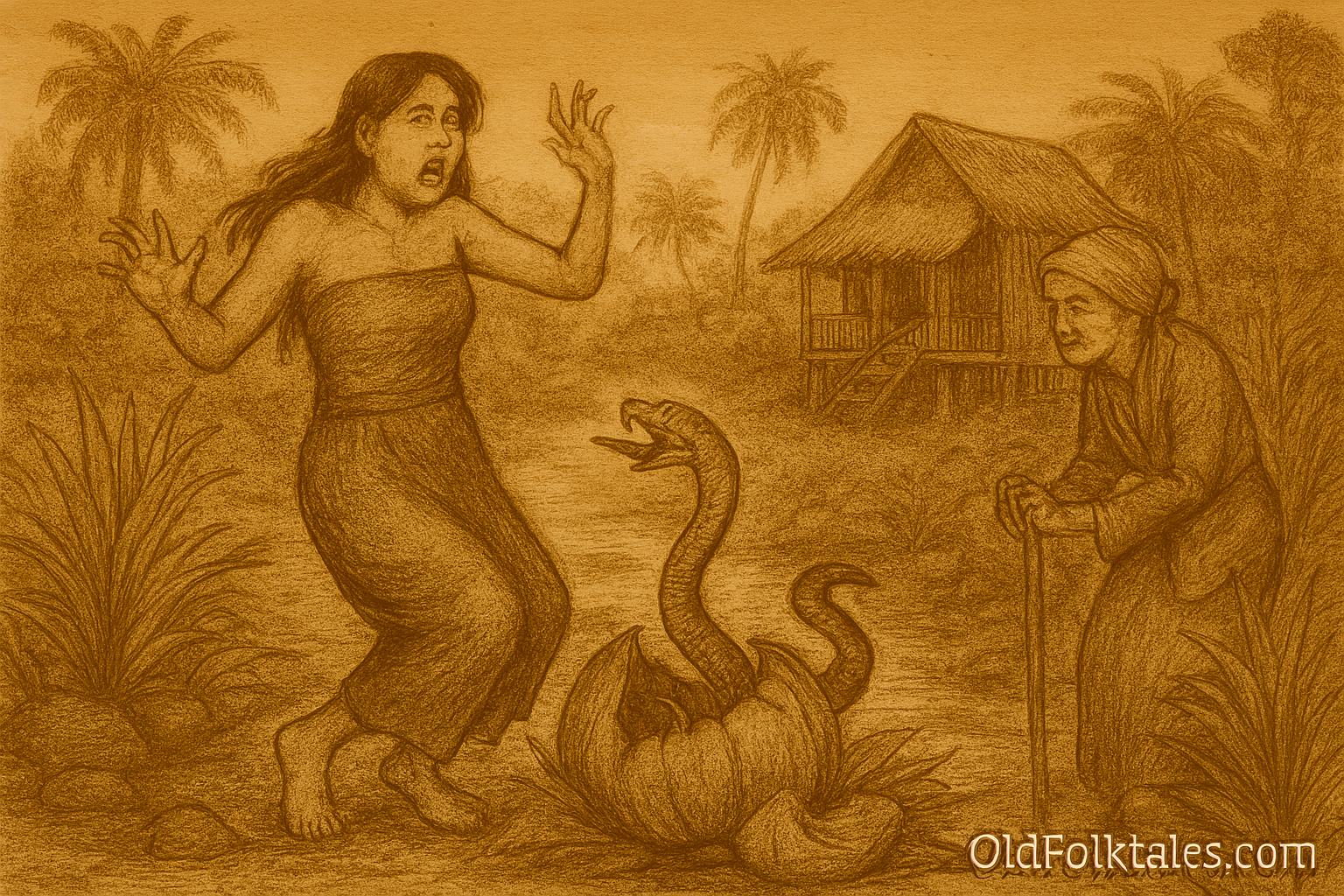
But instead of gold and jewels, out poured horrors venomous snakes that hissed and struck, scorpions with stingers raised, centipedes that scuttled across the floor, and an unbearable stench that filled the house. Mother and daughter shrieked and fled, but wherever they ran, misfortune followed them. Their cruelty had finally reaped its reward.
Bawang Putih, meanwhile, used her unexpected wealth with the same kindness that had earned it. She helped the poor in her village, donated to the mosque, and eventually married a good man who recognized the treasure of her gentle heart. She lived the rest of her days in peace and prosperity, never forgetting the lesson taught by a mysterious old woman beside a river that the universe sees all our actions and returns to us exactly what we have sown.
Click to read all Southeast Asian Folktales — featuring legends from Thailand, Indonesia, Vietnam, and the Philippines.
The Moral Lesson
The tale of Bawang Putih and Bawang Merah teaches that our character determines our destiny, and that divine justice ultimately prevails. Kindness, patience, and humility even in the face of cruelty and hardship plant seeds that bloom into blessings. Conversely, greed, laziness, and cruelty inevitably bring their own punishment. The story reminds us that how we treat others, especially those who seem powerless or appear to have nothing to offer us, reveals our true nature and determines the rewards we receive. True wealth comes not from taking the largest portion but from deserving any portion at all through the goodness of our hearts and actions.
Knowledge Check
Q1: What do the names Bawang Putih and Bawang Merah mean and what do they symbolize?
A: Bawang Putih means “White Garlic” and symbolizes purity, goodness, and humility. Bawang Merah means “Red Onion” and represents vanity, cruelty, and superficial beauty. The contrasting names reflect their opposing characters in this Malay moral tale.
Q2: Who was the old woman by the river and what was her true purpose?
A: The old woman was a mystical figure, likely a divine or magical being, who tested the true character of those who came to her. She observed how people treated her when they needed something, revealing their genuine nature through acts of kindness or cruelty.
Q3: Why did Bawang Putih choose the smaller pumpkin instead of the larger one?
A: Bawang Putih chose the smaller pumpkin because of her humble nature she didn’t feel entitled to take the most beautiful or valuable item. Her humility and contentment with less reflected her genuine character and earned her the greatest reward.
Q4: What lesson did the contrasting pumpkin contents teach about divine justice?
A: The pumpkins demonstrated that divine justice sees beyond appearances and rewards character, not greed. Bawang Putih’s small, rough pumpkin contained treasures because she earned them through kindness, while Bawang Merah’s beautiful pumpkin contained horrors because her cruelty and greed deserved punishment.
Q5: How does this Malaysian folktale reflect important values in Malay culture?
A: The story emphasizes core Malay values including respect for elders (hormat), patience in adversity (sabar), compassion for others, humility, the importance of good character over material wealth, and the belief that divine justice (keadilan) ultimately prevails regardless of earthly circumstances.
Q6: Why is Bawang Putih and Bawang Merah considered Malaysia’s Cinderella story?
A: Like Cinderella, it features a kind, mistreated stepdaughter who suffers under a cruel stepmother and stepsister, performs endless household labor, receives magical help, and ultimately triumphs while her tormentors are punished. However, it carries distinctly Malay cultural elements, moral teachings, and spiritual lessons unique to Southeast Asian tradition.
Source: Adapted from Malay Popular Tales by Ranjit Singh Malik
Cultural Origin: Malaysia, Southeast Asia (Malay Folk Literature and Oral Tradition)