
In the tranquil countryside of Nam Xương, where the Red River’s tributaries wound through emerald rice paddies and ancient villages, there lived a woman whose name would echo through generations as a symbol of virtue betrayed. Her name was Vũ Nương, and she was known throughout the village as a woman of exceptional character gentle in speech, diligent in her duties, and devoted to her family with a loyalty that seemed to shine from within her very spirit.
Vũ Nương had married a merchant from the neighboring province, a man of modest means but considerable pride. Their life together had been blessed with a child, a curious little one whose innocent eyes saw the world with wonder. The family lived simply but contentedly in a wooden house with paper-thin walls that allowed the moonlight to filter through on clear nights, casting dancing shadows across the floors.
Click to read all East Asian Folktales — including beloved stories from China, Japan, Korea, and Mongolia.
Each evening, after the day’s work was done and the oil lamps were lit, Vũ Nương would tend to her household with the same careful attention she gave to everything in her life. She would prepare the evening meal, mend clothes by lamplight, and rock her child to sleep with lullabies passed down from her own mother. Her husband, meanwhile, would often be away on trading journeys, returning home with stories of distant markets and the weariness of long roads.
But somewhere in the merchant’s heart, a seed of doubt had taken root. Perhaps it was the loneliness of his travels, or the whispered gossip of jealous neighbors, or simply the corrosive nature of insecurity itself. He began to watch his wife with suspicious eyes, searching for signs of betrayal where none existed. His once-warm demeanor grew cold, and his questions became interrogations cloaked in casual conversation.
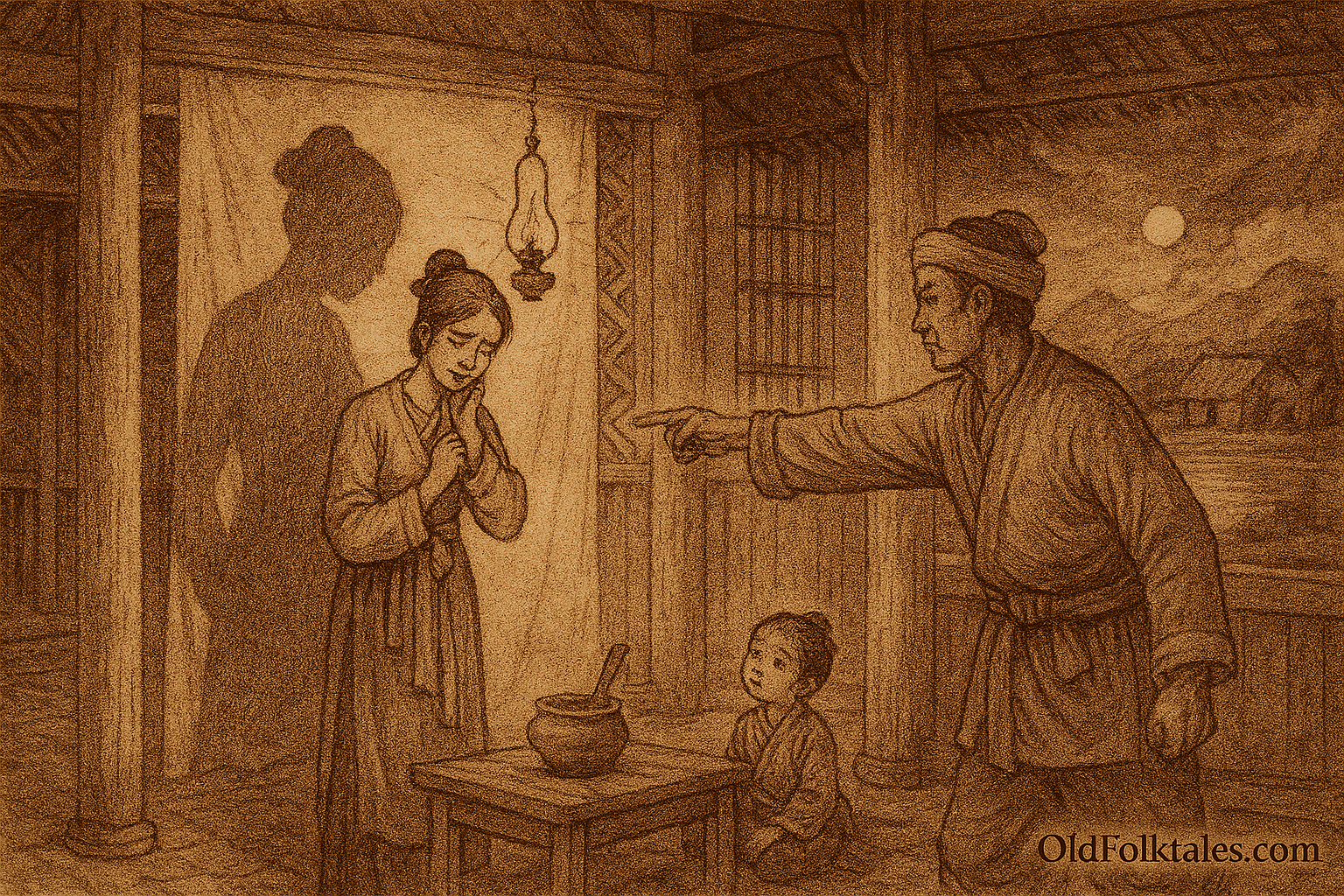
One fateful evening, after returning from yet another journey, the merchant sat with his child and asked seemingly innocent questions about home. The child, in that guileless way children have of speaking truth without understanding its weight, mentioned seeing another “man” in the house at night a tall figure that moved along the walls when mother was alone.
The merchant’s blood ran cold. His worst fears, he believed, had been confirmed. His face darkened with rage, and his hands trembled with the violence of his jealousy. He did not pause to question further. He did not seek understanding. Instead, he turned to Vũ Nương with eyes full of accusation and words sharp as knives, condemning her as unfaithful, calling her honor into question, and declaring her unworthy of his name.
Vũ Nương stood frozen, her face pale as winter moonlight. She tried to speak, to defend herself, to explain that there had been no other man, that she had remained faithful in thought and deed. But her husband would not listen. His accusations grew louder, more venomous, poisoning the air between them until there seemed no space left for truth to breathe.
The pain in Vũ Nương’s heart was unbearable not the pain of guilt, for she had none, but the agony of being so deeply misunderstood by the one person whose trust should have been unshakeable. To be called unfaithful when she had given everything to her marriage, to see disgust in eyes that once held love it was more than her gentle spirit could endure.
That night, with tears streaming down her face and her heart shattered beyond repair, Vũ Nương fled from her home. She ran through the darkness, past the sleeping houses of Nam Xương, past the fields she had known since childhood, until she reached the banks of the river. The water flowed dark and swift beneath the starless sky, and without hesitation, she threw herself into its cold embrace.
The river spirit, moved by the tragedy of such innocence destroyed, took pity on Vũ Nương. Rather than let her drown, the spirit carried her away to a realm beyond mortal reach, where she would be forever beyond the pain of false accusation and betrayed trust. She vanished into the depths, never to return to the world of the living.
When dawn broke and Vũ Nương did not return, the merchant began to search for her. As his anger cooled and reason returned, he questioned his child more carefully. With patient words and gentle prodding, the truth finally emerged: the “man” the child had seen was nothing more than Vũ Nương’s own shadow, cast large upon the wall by the lamplight as she moved about her evening tasks. There had been no betrayal, no infidelity only the innocent observation of a child who did not yet understand the difference between shadow and substance.
The realization struck the merchant like a thunderbolt. The magnitude of his error, the irreversible consequence of his suspicion, crashed down upon him with crushing weight. He ran to the river’s edge, calling his wife’s name until his voice grew hoarse, but only the water’s murmur answered him. He searched the banks for days, then weeks, but Vũ Nương was gone, claimed by the river and lost to him forever.
The merchant spent the rest of his days in mourning, a broken man haunted by the memory of his wife’s tearful face and the knowledge that his own jealousy had destroyed the most precious thing in his life. The people of Nam Xương spoke of Vũ Nương for generations, her story a reminder of virtue destroyed by suspicion, and of trust once broken that can never be restored.
Click to read all Southeast Asian Folktales — featuring legends from Thailand, Indonesia, Vietnam, and the Philippines.
The Moral Lesson
The tale of Vũ Nương teaches us that trust is the foundation of all relationships, and that suspicion, once given power, can destroy even the purest love. We must not let jealousy cloud our judgment or make accusations without seeking the full truth. Words spoken in anger can inflict wounds that never heal, and actions taken in haste can lead to losses that can never be recovered. In our relationships, we must choose understanding over doubt, patience over rush to judgment, and always remember that once trust is shattered and a person is driven away by false accusation, no amount of remorse can undo the harm.
Knowledge Check
Q1: Who was Vũ Nương in the Vietnamese legend of Nam Xương?
A1: Vũ Nương was a virtuous and devoted wife from Nam Xương, Vietnam, known throughout her village for her gentle character, diligence, and unwavering loyalty to her family. She became the tragic victim of her husband’s false accusations of infidelity.
Q2: What caused the husband to falsely accuse Vũ Nương of betrayal?
A2: The husband’s jealousy was triggered when his child innocently mentioned seeing another “man” in the house at night. In reality, the child had seen Vũ Nương’s shadow cast on the wall by lamplight, but the husband immediately assumed infidelity without investigating further.
Q3: What does Vũ Nương’s shadow symbolize in the story?
A3: Vũ Nương’s shadow symbolizes how easily truth can be misinterpreted and how innocent circumstances can be twisted by suspicion and jealousy. It represents the danger of jumping to conclusions without seeking proper understanding, as something harmless was perceived as evidence of betrayal.
Q4: Why did Vũ Nương throw herself into the river?
A4: Vũ Nương was devastated by her husband’s false accusations and his refusal to believe in her faithfulness. The unbearable pain of being so deeply misunderstood and unjustly condemned by the person whose trust should have been strongest drove her to take her own life in the river.
Q5: What is the cultural significance of the river spirit saving Vũ Nương?
A5: In Vietnamese folklore, the river spirit’s intervention represents divine recognition of Vũ Nương’s innocence and virtue. Rather than allowing her to simply die, the spirit preserved her by taking her to another realm, validating her purity and acknowledging the injustice done to her.
Q6: What is the main moral lesson of “The Woman from Nam Xương”?
A6: The story warns against the destructive power of jealousy, suspicion, and hasty judgment in relationships. It teaches that trust must be protected, that we should seek truth before making accusations, and that words and actions driven by unfounded suspicion can cause irreversible tragedy and lifelong regret.
Source: Adapted from “Truyền Kỳ Mạn Lục” (Collection of Strange Tales) by Nguyễn Dữ, 16th century
Cultural Origin: Vietnamese folklore, Nam Xương region, Vietnam








