In the rolling hills of Jordan, where stone houses overlooked winding fields of olive trees, lived a man known throughout the region for his sharp wit. His name was Abu Mahjouz, a poor villager whose laughter was as loud as his pockets were empty. Though he owned little more than a small house and a few goats, he possessed a mind that was quicker than any sword in the Sultan’s palace.
One warm afternoon, Abu Mahjouz walked through the bustling market of his village, humming a tune as he carried a small pouch of coins. The money was barely enough for bread and lentils, but he jingled it cheerfully as if it were gold. Nearby, a wealthy moneylender sat outside his shop, polishing his scales and watching the world with suspicious eyes.
As Abu Mahjouz passed, his pouch clinked loudly.
The moneylender frowned. “Stop that noise! You stand before my shop using the sound of your coins to enjoy what only the rich should feel, the pleasure of money.”
Abu Mahjouz blinked. “The sound of money belongs to no one.”
“Oh, it belongs to someone,” the moneylender snapped. “To me! If you enjoy the sound of your coins in front of my shop, then you must pay for it.”
A small crowd gathered, laughing and whispering, unable to believe what they were hearing. But the moneylender was serious. He grabbed Abu Mahjouz by the sleeve and dragged him to the palace, insisting that the Sultan himself settle the matter.
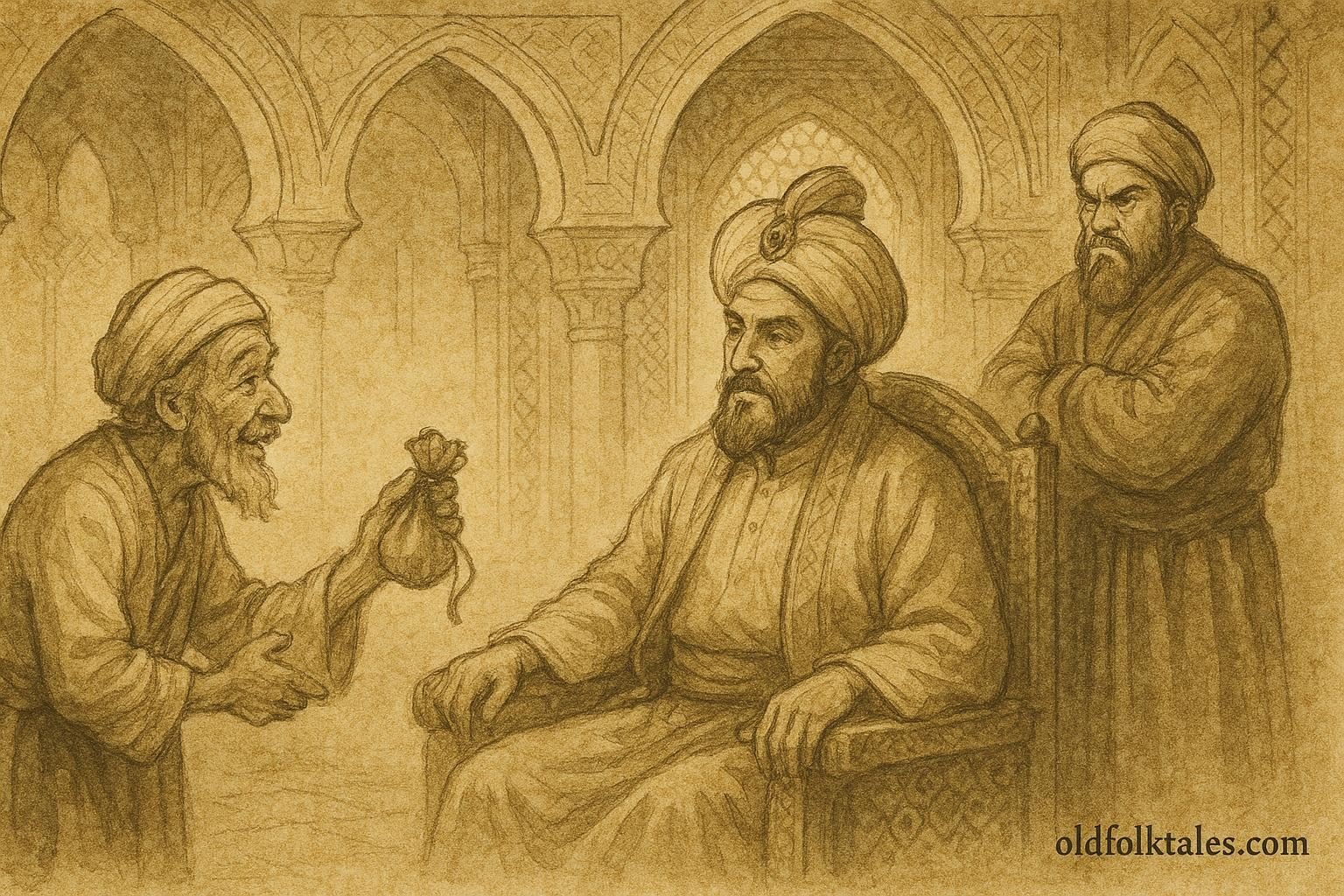
The Sultan, known for his impatience and love of wealth, sat upon a grand throne carved with intricate geometric patterns. He looked down at the two men and demanded an explanation.
“Your Majesty,” the moneylender began, bowing dramatically, “this man has used the sound of his coins before my shop. He enjoyed it, and I demand payment for the pleasure he took.”
The Sultan stroked his beard. “Is this true, Abu Mahjouz?”
Abu Mahjouz bowed respectfully. “I walked past his shop, yes. My pouch made a sound when I moved. But the sound came from my own coins.”
The Sultan leaned forward, intrigued by the absurdity but unwilling to dismiss the moneylender, who was one of his richest supporters. “Very well. If this man demands payment, the case must be judged.”
Abu Mahjouz smiled. “Then allow me, Your Majesty, to settle this matter in a way that satisfies justice.”
The Sultan nodded. “Proceed.”
Abu Mahjouz took out his small coin pouch. Slowly, deliberately, he held it up so all could see. The Sultan’s guards, the moneylender, and the marketplace spectators waited in silence.
He loosened the pouch and shook it gently.
Clink. Clink. Clink.
The sound of the coins echoed lightly across the marble hall.
Abu Mahjouz then looked at the moneylender. “Did you hear that?”
“I did,” the man replied cautiously.
“Good.” Abu Mahjouz tied the pouch closed and placed it back into his pocket.
“Your payment,” he announced, “has now been delivered.”
The Sultan raised an eyebrow. “How has he been paid?”
Abu Mahjouz bowed again. “He claimed I enjoyed the sound of my coins in front of his shop. So I have repaid him with the sound of my coins in your palace.”
The hall erupted in laughter. Even the guards struggled to keep their composure.
The Sultan, amused and embarrassed that he had been drawn into such foolishness, declared, “Abu Mahjouz is right. Payment has been made in equal measure. The sound for the sound.”
The moneylender’s face turned red with anger, but he could not challenge the Sultan’s decision. Abu Mahjouz stepped away proudly, having won the case with nothing more than a clever twist of logic.
News of the event spread through Jordan like wildfire. Villagers repeated the tale in tea houses, markets, and under shade trees. Mothers told it to teach their children fairness; elders told it to remind people that intelligence could triumph over greed.
As for Abu Mahjouz, he returned to his simple life. His home remained modest, his pockets light, but he walked with the contentment of a man who knew that wisdom, not wealth, was the greatest treasure a person could carry.
Moral of the Story
True justice requires fairness, not force. Through calm wit and clear reasoning, even the poorest person can stand equal to the powerful. Cleverness, when used with honesty, becomes a shield against greed.
Knowledge Check
1. Who is Abu Mahjouz in the Jordanian folktale?
Abu Mahjouz is a clever Jordanian villager known for using wit to outsmart powerful figures like the Sultan.
2. What was the central conflict in the story?
The conflict arises when a greedy moneylender demands payment from Abu Mahjouz for “enjoying the sound” of his own coins.
3. How does Abu Mahjouz resolve the dispute with the moneylender?
He shakes his coin pouch to “repay” the man with the sound of money, matching sound with sound.
4. What does the Sultan represent in the folktale?
The Sultan represents authority and the flawed justice system that can be influenced by wealth.
5. What is the main moral lesson of the story?
Wisdom and clever thinking can triumph over greed and unjust demands.
6. Why is this tale important in Jordanian culture?
It highlights the celebrated Jordanian value of al-fṭana, cleverness used to defend fairness and expose injustice.
Source
Adapted from traditional Jordanian oral folklore of the Abu Mahjouz cycle, collected in the Al-Balqa’ and Irbid regions.