Deep in the windswept highlands of Jordan, where the Badia desert blends into rugged forests, people whispered of a creature older than memory itself, the Ghoula. She was a monstrous female ogre who prowled the lonely paths, hiding among twisted acacia trees and rocky ravines. Travelers who wandered too far from the villages often vanished, their last echoes carried away by the evening winds. She fed on fear as much as flesh, and her presence cast a shadow across every household.
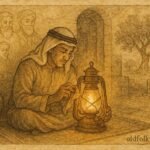
Among the villagers lived a poor woodcutter, known not for strength but for steady courage. Each morning, before the sun lifted the cold from the stones, he journeyed into the forest to gather firewood. He had little in life, only his tools, his honesty, and the companionship of a wise talking donkey who had been with him since youth. Some versions spoke of a fox guiding him instead, but in this tale, it was the donkey who shared his burdens and offered quiet advice.
One winter morning, the donkey tugged at the woodcutter’s sleeve as they approached the deeper part of the forest.
“Master,” the donkey murmured, “this path smells of danger. The Ghoula has walked here recently.”
The woodcutter froze. Everyone feared the Ghoula, but she had taken three villagers in the past month. If her terror was not ended, no one would be safe.
“We must be careful,” he whispered, “but I cannot stop working. My family needs this wood.”
As they pressed deeper into the forest, the air thickened. The trees grew crooked, their branches clawing at the sky. Suddenly, a scream split the silence—a traveler stumbling through the undergrowth, followed by a towering, twisted shape. The Ghoula’s eyes burned like coals, her teeth jagged as broken stone.
The woodcutter pulled the traveler behind him, shielding him with trembling arms. Just as the Ghoula lunged, the donkey brayed loudly and darted between them, distracting her long enough for the traveler to escape. Enraged, the Ghoula turned her gaze on the woodcutter.
“You,” she hissed, her voice thick as dust storms. “I will remember your scent.”
He knew she would strike again. That night, the donkey spoke softly under the moonlight.
“There is a secret,” he said. “The Ghoula’s body cannot be harmed, her strength is not in her flesh. Her soul is hidden far away, inside a bird that flies beyond these forests. Destroy that soul, and she will fall.”
“Where is this bird?” the woodcutter asked.
“Across the barren ridge,” the donkey replied. “Only cunning can reach it, not force.”
The next morning, the woodcutter prepared for the journey. They traveled across rocky valleys glittering with salt and through ancient wadis where water once flowed. After days of hardship, they reached a lonely cliff where the wind howled like spirits. There, perched on a jagged stone, was a small, black bird with strange, shimmering eyes, the vessel of the Ghoula’s soul.
The woodcutter approached carefully, but the bird flapped wildly, sensing danger. The donkey whispered, “Use wit, not strength.”
So the woodcutter scattered seeds he had carried in his pouch, pretending to turn away. When the bird hopped down to eat, he swiftly covered it with a woven net. The bird shrieked, beating its wings against the net, but it was trapped.
At that very moment, far across the land, the Ghoula felt her power weakening. Her limbs trembled, and the fire in her eyes dimmed. The woodcutter tightened the net and held the bird firmly.
“Release me,” it croaked, but the woodcutter shook his head.
“For the safety of my people,” he said, “I cannot.”
With one decisive motion, he ended the bird’s life. The wind grew still, as if the desert itself exhaled in relief. Far away in the forest, the Ghoula collapsed, her monstrous form crumbling like dust returning to the earth.
When the woodcutter returned to the village, the people gathered around him, astonished and grateful. For the first time in years, children could walk near the trees without trembling, and travelers could cross the highlands without fear.
He never boasted about his deed. Instead, he returned quietly to his work, his loyal donkey at his side, knowing that courage and cleverness—not strength, had freed the land from darkness.
Moral Lesson
True strength comes not from power or might, but from wisdom, bravery, and the ability to use one’s mind against overwhelming danger.
Knowledge Check
1. Who is the Ghoula in Jordanian folklore?
The Ghoula is a fearsome female ogre known for haunting forests and preying on travelers in Jordanian desert tales.
2. What made the woodcutter able to defeat the Ghoula?
He relied on intelligence and the donkey’s guidance, discovering her hidden soul and destroying it.
3. Why couldn’t the Ghoula be harmed physically?
Her strength did not lie in her body, her soul was concealed inside a distant bird.
4. What role does the talking donkey play in the story?
The donkey warns the woodcutter of danger and reveals the secret of the Ghoula’s hidden soul.
5. What is the central moral of this Jordanian folktale?
Cunning and bravery can triumph over powerful evil.
6. Where does this folktale originate?
The story comes from Bedouin and rural traditions in the Jordanian highlands and the Badia desert.
Source
Adapted from the Bedouin and rural Jordanian folktale “الغولة والحطاب (The Ghoula and the Woodcutter)” from the highlands and Badia traditions.