In the eastern highlands of Timor-Leste, where the mountains fold into valleys and the morning mist clings to the earth like a living thing, there lies a lake of such beauty that even the birds seem to hush when they fly over its surface. Lake Iralalaro stretches across the land, its waters sometimes calm and clear as polished glass, sometimes rising and swelling with a fury that no one can predict. The elders say the lake has a memory, and this is the story of how it came to be so changeable, so alive with ancient anger and sorrow.
Long ago, in a small village near the lake’s edge, there lived a young man known for his strength and kind heart. He worked the land with his family, tending crops and raising livestock, living the simple life that his ancestors had lived for generations. Each day at dawn, he would walk to the lake to fetch water, and each evening, he would return to watch the sun sink behind the distant peaks, painting the sky in shades of crimson and gold.
Click to read all East Asian Folktales — including beloved stories from China, Japan, Korea, and Mongolia.
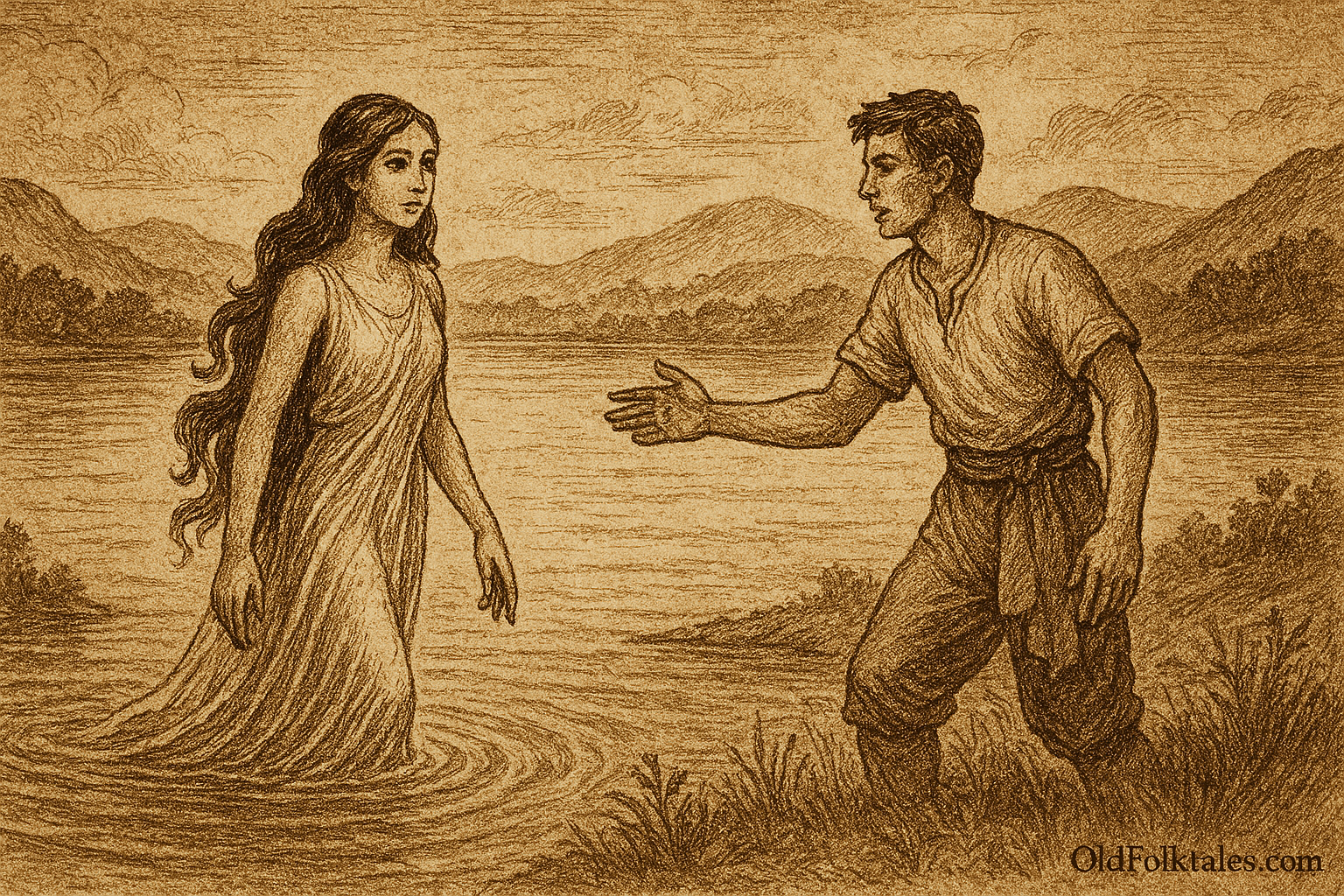
One morning, as the first light touched the water’s surface, he saw something that made him stop and catch his breath. A woman was emerging from the lake, rising from its depths as naturally as the mist itself. Her hair cascaded down her back like dark water, and her skin seemed to glow with an otherworldly light. She moved with a grace that was not quite human, each step leaving barely a ripple on the water’s surface.
The young man stood frozen, unable to look away. She turned toward him, and their eyes met. In that moment, something passed between them a recognition, a connection that defied explanation. She did not flee back into the depths as he expected. Instead, she smiled, a slow, knowing smile that suggested she had been waiting for him all along.
Day after day, he returned to the lake at dawn. And day after day, she was there, waiting. They spoke in whispers at first, sharing stories and dreams. She told him of the world beneath the waters, of cool currents and secret caves, of fish that glowed like stars and plants that swayed in rhythm with songs only water spirits could hear. He told her of life on the land, of planting and harvest, of village celebrations and family gatherings. With each passing day, his love for her grew deeper, until it became as much a part of him as his own heartbeat.
Finally, he gathered his courage and asked her to be his wife. She looked at him with eyes that held both joy and sadness, as if she could already see the end of their story written in the stars.
“I will marry you,” she said, her voice soft as lapping waves. “But you must make me a sacred promise. You must never, under any circumstances, reveal where I come from. You must never speak of my origins to anyone not to your family, not to the village elders, not even to our children, should we have them. My world and your world can exist together only in silence. Do you understand?”
The young man agreed without hesitation. What did it matter where she came from? She was here now, and she loved him. That was all that mattered.
They married in a quiet ceremony, and she came to live in his village. She was a dutiful wife, skilled at all the tasks required of her. She wove beautiful cloth, tended the garden with knowing hands, and moved through the village with quiet dignity. But there was always something about her that set her apart the way water seemed to cling to her skin even on the driest days, the way she would stare at the lake with longing in her eyes, the way she never seemed quite at home beneath the sun’s harsh light.
The villagers noticed. Of course they noticed. Whispers began to circulate like smoke through the houses. Where had she come from? Why did no one know her family? Why did she spend so many hours gazing at the lake? The questions grew louder, more insistent, until they reached the ears of the village elders.
One evening, the elders called the young man before them. They sat in a circle, their faces stern in the firelight, and demanded answers. Where was his wife from? What village did her family live in? Why had no one attended their wedding from her side?
The young man tried to deflect their questions, to offer vague answers and half-truths. But they pressed him harder, their voices growing sharp with suspicion. The weight of their scrutiny, the fear of being cast out as a man who consorted with spirits or demons, became too much to bear.
And so he broke his promise.
“She came from the lake,” he whispered, his voice barely audible. “She is a spirit of the waters.”
The words hung in the air like a curse. The elders recoiled, muttering prayers and protective chants. They demanded he send her away immediately, that he cleanse his home of this unnatural presence.
The young man returned home with a heavy heart, shame weighing down his every step. But his wife already knew. She stood at the doorway, her belongings gathered, tears streaming down her face like small rivers.
“You have broken your promise,” she said, her voice trembling with hurt and anger. “You have spoken the words that can never be unspoken. I gave you my heart, my life on the land, and you have thrown it all away for the approval of those who never knew me.”
“Please,” he begged, falling to his knees. “Forgive me. I was weak. I will never speak of it again. Stay with me.”
She shook her head slowly. “A broken promise cannot be mended like torn cloth. The damage is done. I must return to where I belong.”
She turned and walked toward the lake, her steps measured and deliberate. He followed, pleading, but she did not look back. When she reached the water’s edge, she paused for just a moment, then stepped into the shallows. The water seemed to welcome her, rising to meet her feet, her knees, her waist.
Just before she disappeared beneath the surface, she turned one last time.
“You have betrayed not just me, but the sacred trust between our worlds. The waters will remember this. When the rains come, when the lake swells and rises, remember that it is your broken promise that drives it forward.”
She slipped beneath the surface, and the lake began to churn. The waters rose higher and higher, spilling over the banks, flooding the plains where crops had grown and animals had grazed. The villagers fled to higher ground, watching in horror as the lake claimed the land, transforming the landscape forever.
From that day forward, Lake Iralalaro has been unpredictable, its waters rising and falling according to no pattern that humans can discern. Some say the spirit bride still lives beneath its surface, her anger and sorrow causing the waters to swell. Others say she weeps for the love she lost, and her tears add to the lake’s volume.
The young man lived out his days alone, returning each morning to the lake’s edge, hoping for just one more glimpse of the woman he had loved and lost. But the waters never again gave up their secret. And the village learned to respect the lake’s moods, to build their homes at a safe distance, and to remember that some promises are sacred precisely because they protect the delicate balance between worlds that were never meant to fully merge.
Click to read all Southeast Asian Folktales — featuring legends from Thailand, Indonesia, Vietnam, and the Philippines.
The Moral Lesson
This Timorese tale carries a profound warning about the sanctity of promises and the consequences of breaking trust. The young man’s betrayal was born not from malice but from weakness the inability to withstand social pressure and judgment from his community. Yet the story teaches us that the motivation behind breaking a promise does not diminish the harm it causes. Sacred oaths, especially those that bridge different worlds or ways of being, must be honored absolutely. When we give our word, particularly in matters of love and trust, we take on a responsibility that transcends our own comfort or social standing.
Knowledge Check
Q1: Who is the spirit bride in the Lake Iralalaro folktale from Timor-Leste?
A1: The spirit bride is a mysterious woman who emerges from Lake Iralalaro and possesses otherworldly qualities. She is a water spirit who agrees to marry a young man from a nearby village, representing the connection between the natural/spiritual world and the human realm. Her identity as a lake spirit makes her marriage to a human conditional upon maintaining the secrecy of her origins.
Q2: What was the sacred promise the young man made to his wife in the Lake Iralalaro story?
A2: The young man promised never to reveal his wife’s watery origins to anyone not to his family, village elders, or even future children. This sacred oath was the condition under which she agreed to leave her world beneath the waters and live with him on land. The promise represented a covenant of trust between the human and spirit worlds.
Q3: Why did the young man break his promise to the spirit bride?
A3: The young man broke his promise due to intense social pressure from the village elders and community members. They grew suspicious of his wife’s mysterious background and unknown family, demanding answers about her origins. Unable to withstand their scrutiny and fearing social ostracism, he revealed the truth that she came from the lake, betraying the sacred trust she had placed in him.
Q4: What happened when the spirit bride returned to Lake Iralalaro?
A4: When the spirit bride returned to the lake after her husband’s betrayal, the waters began to rise dramatically, flooding the surrounding plains and transforming the landscape. This event explains why Lake Iralalaro exhibits unpredictable seasonal behavior, with water levels that rise and fall according to no discernible human pattern. The flooding represents her anger and sorrow manifesting through nature.
Q5: What does Lake Iralalaro symbolize in Timorese culture?
A5: Lake Iralalaro symbolizes the unpredictable power of nature and the consequences of broken sacred promises. Its variable water levels serve as a physical manifestation of betrayed trust and the enduring impact of human choices on the natural world. The lake represents the boundary between the spirit realm and human world, reminding communities of the need to respect sacred covenants and maintain harmony between different realms of existence.
Q6: What is the cultural significance of the Lake Iralalaro legend in Timor-Leste?
A6: The Lake Iralalaro legend holds deep cultural significance in Timor-Leste, particularly in the Lospalos region, as it explains the lake’s unpredictable behavior while teaching important lessons about honoring promises, respecting the spirit world, and maintaining trust in relationships. The story reinforces traditional values about sacred oaths and serves as a cautionary tale about the far-reaching consequences of betrayal, affecting not just individuals but entire communities across generations.
Source: Adapted from Timor-Leste National Directorate of Culture (Lospalos region).
Cultural Origin: Timor-Leste (East Timor), Southeast Asia.