
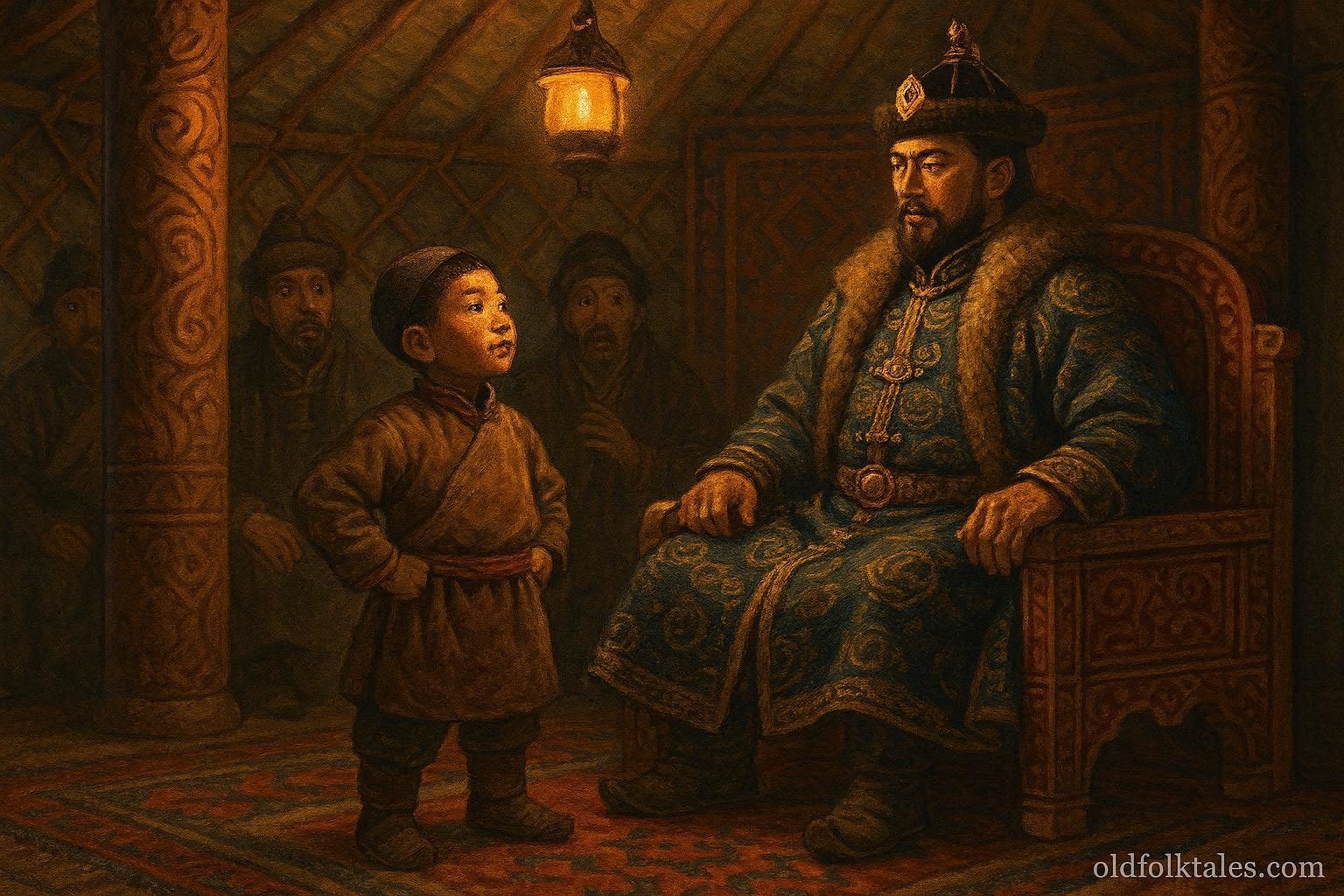
In the wide, open grasslands of central Mongolia, where the wind swept endlessly across the steppe and the sky seemed to touch the earth, there lived an orphan boy named Sukh. He had lost both his parents while still very young and had learned to survive by helping travelers, herders, and wandering merchants with small tasks. Though his clothes were patched and his boots worn, his eyes shone with keen understanding, and he listened more than he spoke. People often said that Sukh’s mind was sharper than most adults, even though he had no formal schooling or wealth.
One summer, when the rivers thawed and the grass grew tall, the regional khan decided to test the wisdom of his people. Proud of his own intelligence, he proclaimed a challenge: anyone who could answer three riddles correctly would earn a prized horse, a position of honor, and the khan’s respect. Anyone who failed would be required to work for the khan for a full year. Messengers rode across the plains carrying the news to every settlement, family, and caravan.
Scholars and monks, warriors and merchants, all attempted the challenge. They arrived in fine clothes, carrying scrolls and books, confident in their knowledge. But one by one, they failed. Some could not solve the first riddle, others became flustered by the second, and none could answer the final, most difficult question. The khan grew ever more proud, believing that no one in his domain could surpass him.
Journey through enchanted forests and islands in our Southeast Asian Folktales collection.
When Sukh heard of the challenge, he was neither motivated by the promise of a horse nor by recognition. He disliked arrogance and believed that intelligence should serve justice, not pride. After thinking quietly by a campfire one evening, he decided to travel to the khan’s ger.
Upon arriving at the khan’s camp, Sukh observed the grand tents and gers, adorned with bright banners and tapestries. Nobles and scholars watched him approach, whispering among themselves about the boy in simple patched clothing. Some laughed, imagining him foolish, while others felt curious about his quiet confidence. Sukh ignored the whispers and walked steadily to the main ger where the khan awaited.
The khan, seated on a cushion embroidered with gold thread, looked down at the boy and raised an eyebrow. “Child,” he said, “many bright minds have failed my challenge. Why do you come?”
Sukh bowed respectfully. “Great Khan,” he said, “wisdom does not wear silk or sit in fine robes. A clear mind can come from humble places.”
The khan smirked but decided to proceed. “Very well. Listen carefully to the first riddle. What belongs to each person but is used more by others?”
Nobles whispered guesses, but none were correct. Sukh paused only briefly and answered, “A name. Though it belongs to you, others speak it more often.”
Murmurs of surprise filled the ger. The khan’s smile faltered, but he continued. “Second riddle: What runs faster than a horse, grows though it drinks nothing, and dies though it was never alive?”
Sukh thought of the stories and news that traveled across the steppe faster than any rider. “A rumor,” he answered. “It spreads quickly, grows though it is fed by nothing, and disappears although it was never alive.”
The khan’s eyes widened slightly, but he maintained his composure. “Last riddle: What can a person give completely but never take back once it leaves them?”
Sukh closed his eyes, thinking of the words his mother had spoken to him before she died, which stayed in his heart. He opened his eyes and replied, “A spoken word. Once it leaves you, it cannot be retrieved.”
Silence fell. Nobles stared, servants whispered, and even the khan paused, realizing that the boy had solved all three riddles. Slowly, he stepped down and approached Sukh. “You have humbled me,” he said. “Your wisdom is beyond your years. You have earned my respect.”
The khan offered a fine chestnut horse, warm clothes, and a place in his court as a scholar. Sukh bowed again and politely declined the honors. “Great Khan, I am grateful, but my path lies on the steppe. I will travel and share what I know with those who need it.”
The khan respected his choice. From that day forward, Sukh traveled from camp to camp, sharing lessons in observation, patience, and humility. Stories of the clever orphan spread across the steppe, reminding all that true intelligence comes not from wealth or rank but from understanding, calm reflection, and a kind heart. Wherever he went, Sukh was welcomed, and people listened to his wisdom with respect.
Over the years, travelers, herders, and nobles alike retold the tale of the orphan who outwitted a proud khan. He became a symbol of how insight and humility can triumph over arrogance. Sukh’s story also taught that sometimes the simplest people, living quietly among the grass and wind, can hold the greatest understanding of the world.
Discover more East Asian Folktales from the lands of dragons, cherry blossoms, and mountain spirits.
Moral Lesson:
True wisdom comes from observation, patience, humility, and kindness. Rank, wealth, or pride cannot replace a clear mind. Even those from humble beginnings can achieve remarkable insight when guided by respect, reflection, and integrity.
Knowledge Check:
- Q: Why did the khan create the riddle challenge?
A: To prove his intelligence and test the people of the steppe. - Q: What motivated Sukh to participate in the challenge?
A: He disliked the khan’s arrogance and believed wisdom should be humble. - Q: What was the answer to the first riddle?
A: A name. - Q: What was the answer to the second riddle?
A: A rumor. - Q: What was the answer to the final riddle?
A: A spoken word. - Q: Why did Sukh refuse the palace position and gifts?
A: He preferred to travel and share wisdom with people across the steppe.
Source:
Adapted from Mongolian Academy of Sciences Folklore Manuscript Collection, 2012.
Cultural Origin:
Central Mongolian oral tradition.








