The desert plains between Farah and Herat were wide, wind-scraped, and silvered by dust. For centuries, traders had crossed these routes with long caravans, singing as the bells of their camels rang like gentle chimes through the night. But on this evening, one merchant traveled alone.
His name has been forgotten, Afghan folktales often leave such wanderers nameless, as if any listener might step into their footsteps. He carried satchels of cloth, spices, and small treasures packed tightly on his camel. The day had stretched longer than expected; a sandstorm had slowed him, and by dusk, he was still far from the nearest caravanserai.
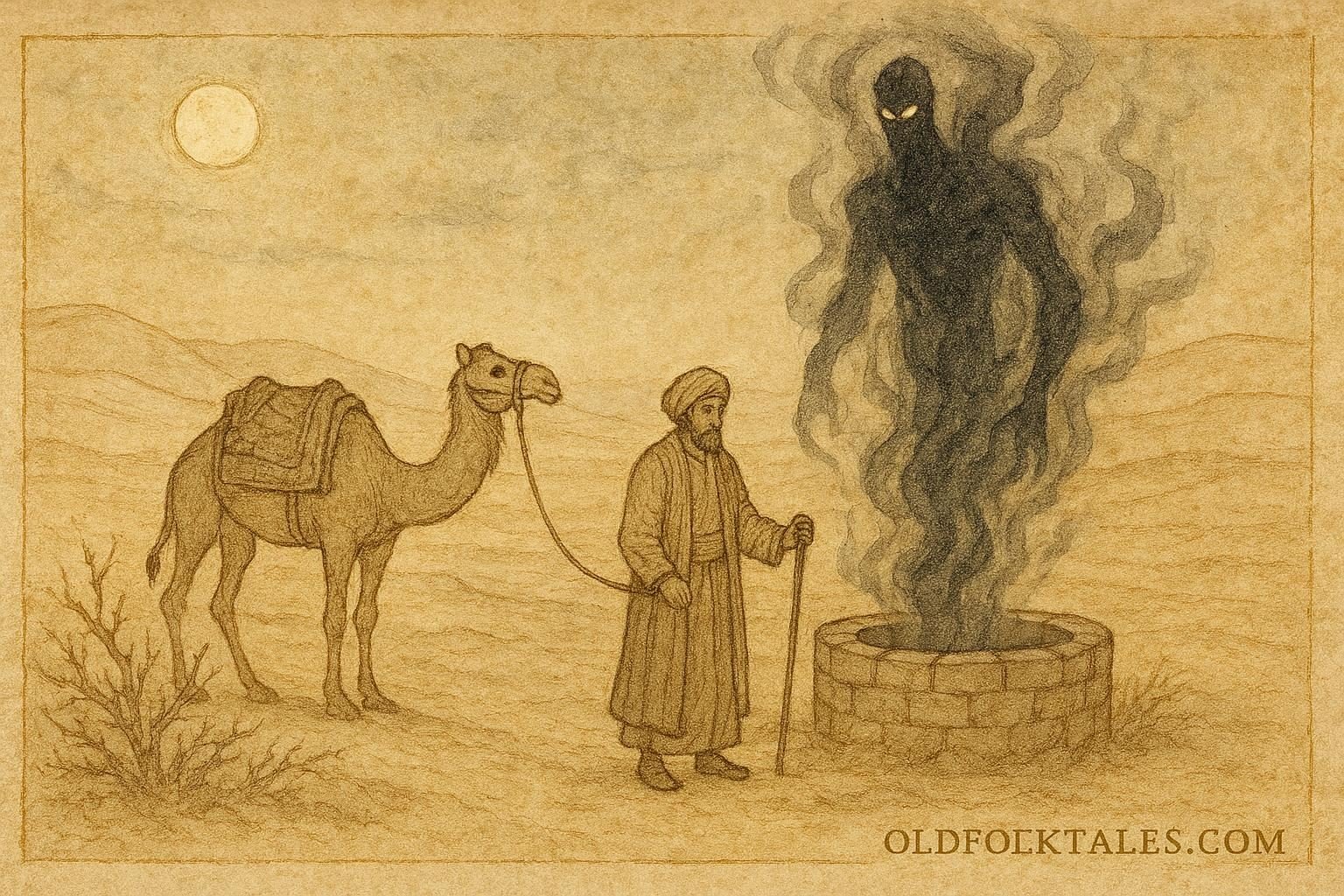
When the final glow of sunlight slipped behind the hills, he found an abandoned well beside the road. The stones had fallen inward, and thorn bushes curled around the rim like dark claws. Still, it offered a small patch of shelter from the wind. He tied his camel, spread a cloth on the ground, and prepared to rest.
Just as he poured a little water into a cup, he heard footsteps.
An old shepherd emerged from the dimness, leaning on a staff polished smooth by years of use. His goats rustled behind him like restless shadows.
“You should not stay here,” the shepherd said, his voice low. “This well is claimed by a midnight jinn. Leave before the moon rises.”
The merchant frowned. “Jinn? Here? There are no villages nearby for spirits to disturb.”
The shepherd shook his head firmly. “Not all jinn seek villages. Some keep lonely places. This one… has never forgotten he was abandoned.”
He tapped his staff once on the ground, as if to seal the warning.
“I must go. My goats wander.”
Before the merchant could ask more, the shepherd slipped into the darkness and disappeared, as though he had never been there at all.
The merchant tried to calm himself. Afghan travellers often met superstitious wanderers, but still, the warning settled uneasily in his heart.
He lit a small lantern.
He waited.
The air grew colder.
When the moon finally crept above the horizon, the first sign came.
A soft breathing rose from inside the well, not the wind, not an animal, but something slow, resonant, almost human. Pebbles rattled upward from the darkness, as if pulled by invisible fingers.
The merchant froze.
Then a shadow rose from the well, long, shapeless, stretching upward like dark smoke caught in moonlight. It climbed higher, taller, until it loomed over the desert like a pillar. Slowly, the shape condensed into something resembling a man, but far too tall, far too thin, its edges blurred like shifting sand.
“You rest in my place,” the figure said.
Its voice echoed like the howl of wind deep inside a cavern.
“Give me what you carry.”
The merchant trembled, but he remembered his father’s teaching:
Fear brings no honour. Courtesy brings no shame.
He bowed slightly, hands steadying. “Peace upon you, spirit of this place. I am but a traveller seeking rest. If I have offended, forgive me.”
The jinn tilted its head, a ripple passing down its smoky form.
“I want the finest cloth you carry,” it demanded.
The merchant reached for a modest bolt of fabric. “This is valuable,” he offered.
The jinn grew larger, its shadow stretching until it swallowed the moonlight.
“I said the finest.”
Fear clawed at the merchant’s chest. Instinctively, he remembered his grandmother’s gentle voice teaching him sacred verses during childhood, verses meant to calm the fearful heart. He began to recite them softly, his words steady though his hands shook.
At once, the jinn recoiled, its form flickering visibly.
“Stop,” it growled.
“This place was mine long before men walked here.”
But the verses continued, not shouted, not wielded like a weapon, simply spoken with sincerity and courage.
The jinn shrank further, its shadow collapsing inward until it stood the height of a man.
Its voice softened. “I was once a guardian of wells and springs. Travellers drank from these waters, families drew life from this place. But war came. Drought came. Humans moved their paths elsewhere. The well dried. I waited. I watched. Loneliness wears on the spirit… even on a jinn.”
The merchant lowered his hands. Fear gave way to understanding; even beings of flame had hearts that could ache.
“I meant no harm,” he said quietly. “I am a stranger. But if you wish for something to ease your bitterness… take a bolt of my finest cloth as a gift. And when I return to Herat, I will tell the caravans to keep this place clean. Let travelers honour it again.”
The jinn’s eyes, two pale embers, studied him.
Slowly, its form eased into something gentle, almost human.
“Your respect has cooled anger long kindled,” it murmured.
“Leave this cloth as an offering. And go with peace.”
The merchant placed the bolt by the rim of the well.
The jinn bowed its head once and sank downward, its form dissolving like mist until only silence remained.
By dawn, the merchant continued his journey, reaching Herat safely. Months later, caravans brought news: the abandoned well had begun to fill with cool, sweet water again. Travellers found shade there. Animals drank. The place lived once more.
The jinn, appeased by respect and sincerity, had returned to its old duty as guardian.
Journey through enchanted forests and islands in our Southeast Asian Folktales collection.
Moral of the Story
Respect, humility, and courage can soften even the harshest of forces. Fear provokes conflict, but sincere courtesy restores harmony between the seen and unseen worlds.
Knowledge Check
1. Who is the main character in “The Traveller and the Midnight Jinn”?
A lone Afghan merchant crossing the plains between Farah and Herat.
2. What cultural theme does the jinn represent?
He symbolizes forgotten guardianship of natural places and the fading of old spiritual roles.
3. Why does the jinn confront the merchant?
Because the merchant rests beside a well the jinn claims as its domain.
4. How does the merchant weaken the jinn’s power?
By respectfully reciting sacred verses taught by his grandmother.
5. What lesson does the merchant ultimately teach the jinn?
That courtesy and sincere intention can rebuild respect between humans and spirits.
6. What is the core moral message of this Afghan folktale?
Kindness and respect calm dangers that fear only worsens.
Source: Afghan folktale tradition, Western Afghanistan (Herat–Farah region).
Origin: Afghanistan