The Gobi Desert was once a place of open wind, wandering sand, and endless sky where caravans crossed in long lines. But long before travelers marked paths or placed stones to guide each other, there lived a mother named Saran. She was known throughout the desert settlements for her gentle voice and her devotion to her two young children, Tuya and Erden. The three of them lived in a small felt tent at the desert’s edge where life was harsh but bright with laughter.
One year, the winds changed earlier than usual. Great clouds of dust rose without warning, choking the sky and coating every tent in thick earth. The elders whispered that misfortune was brewing because the spirits of the desert had been unsettled by strangers cutting new paths across sacred ground. Saran did not understand these warnings. All she cared about was keeping her children safe.
One morning, while Saran was fetching water from a far spring, a violent dust storm rolled through the camp. The wind twisted the air into a roaring wall. People crouched inside their tents and prayed for safety. Saran rushed back, fighting against the swirling sand that tried to blind and swallow her. When she reached the camp, her tent was torn open and her children were gone.
Explore ancient tales from Thailand, Cambodia, and the Philippines in Southeast Asian Folktales.
Panic gripped her. She called out their names again and again. Only the storm answered. Neighbors searched with her until nightfall, but no footprints remained. The desert had swallowed all traces. Saran refused to rest. She believed the gods would not allow innocent children to vanish without hope. So she set out into the desert with nothing but a water skin, a single blanket, and the fierce love in her heart.
She walked for days, following the direction of the sand’s shifting patterns. She asked wandering herders if they had seen two small children. She searched rocky valleys, dry riverbeds, and ancient dunes shaped by winds older than any living memory. Her feet split and bled. Her lips cracked from the scorching sun. Yet she pressed onward.
At night, she dreamed of Tuya calling for her. During the day, she imagined Erden laughing in the wind. These visions kept her alive. But with each passing day, hope dimmed. The desert was merciless. Travelers often told her she should return home and accept fate, but she always replied the same words. A mother does not leave her children behind.
One evening near twilight, she reached a wide plain of pale sand. The sky glowed with a soft pink that deepened into violet. In that quiet light, Saran fell to her knees. Her strength had nearly vanished. She looked up at the heavens and cried until her tears dried on her cheeks. She begged the gods to bring her children back or to give her the strength to keep searching.
The desert gods, who rarely intervened in the affairs of humans, heard her cry. They had watched her wander for many seasons. They saw her love, pure and unbroken. They knew that the desert could take from the careless, but it also honored loyalty and sacrifice.
A warm wind curled around Saran, lifting her hair and brushing her face like gentle hands. The sand beneath her began to glow faintly. A voice echoed in the wind, neither male nor female, neither near nor far. Mother of unwavering spirit, your devotion is stronger than the shifting desert. Though your children walk now in the realm beyond, your love endures. Become a guardian to all who wander, so no soul will be lost as your children were.
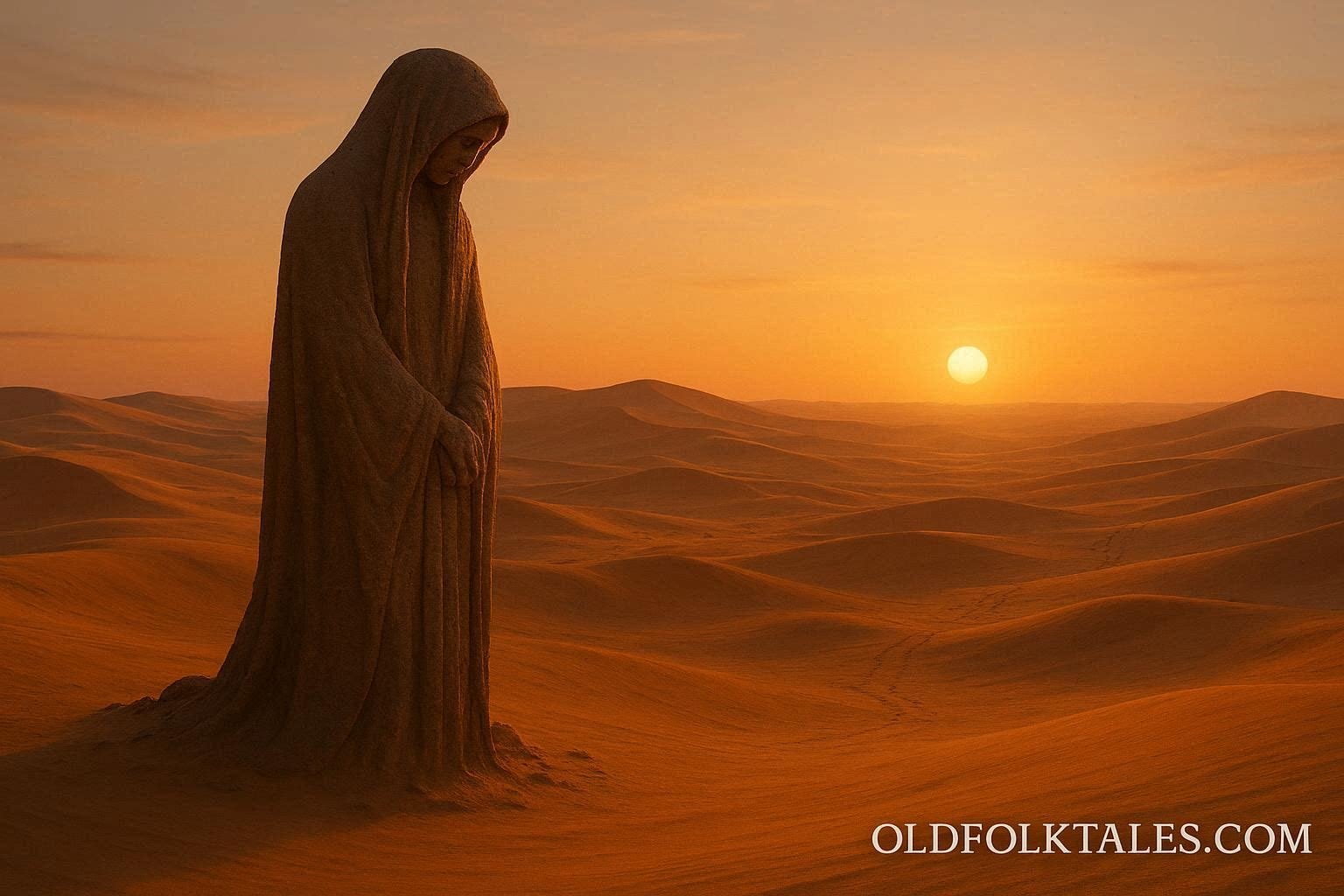
Saran did not understand fully, but she felt no fear. She felt only peace. She whispered that she would do anything to protect others from suffering. The wind swirled brighter and the light around her grew. Slowly, her body became still, her tears hardened into crystals, and her form rose taller and heavier. By dawn, the mother who had walked the desert became a stone figure shaped by divine hands.
Her face remained gentle. Her posture remained watchful. She stood facing the direction where lost travelers most often wandered. People who passed through the plain soon discovered the stone figure. They felt comfort in its presence, and many believed that resting in its shadow kept their hearts calm and their path clear.
Over generations, the Stone Mother became one of the most revered guardians of the Gobi. Travelers left small offerings at her feet. Some claimed they heard whispers guiding them when the wind grew dangerous. Others swore that during the worst sandstorms, a soft glow surrounded the statue like a shield.
Parents told their children that Saran’s spirit watched over them, ensuring they never walked alone on the shifting sands. And so her love, which had carried her across the desert in life, stretched across centuries in her transformed state. Though she never found Tuya and Erden in the world of the living, she found a new purpose. She became the guardian who prevented others from suffering the same heartbreak.
Thus the Stone Mother stands in the desert, eternal and unwavering, a monument not carved by human hands but born of sacrifice. When the sun rises and casts its first rays upon her form, it is said that her shadow stretches long across the desert floor like the embrace of a mother still protecting her children. And whenever travelers find their way safely across dangerous dunes, they whisper their gratitude to the guardian who once was a grieving mother but became a legend of compassion.
Explore timeless legends from China, Japan, and Korea in our East Asian Folktales collection.
Moral Lesson
Love that is selfless transforms into protection for others. True devotion has the power to guide and guard beyond the limits of a single lifetime.
Knowledge Check
- Why did Saran begin her long journey into the desert
Answer: She was searching for her missing children after a violent dust storm. - What made the gods decide to transform Saran into a guardian?
Answer: Her unwavering devotion and her willingness to protect others from suffering. - How did travelers in later generations honor the Stone Mother?
Answer: They left offerings and believed she guided them safely through the desert. - What does the Stone Mother represent in Mongolian tradition?
Answer: Maternal devotion, sacrifice, and eternal guardianship. - What is the main theme of this folktale?
Answer: Love and sacrifice that extend beyond human limits. - How does the myth connect people to the desert landscape?
Answer:It explains a real stone formation by linking it to a meaningful story, shaping cultural respect for the land.
Source
Adapted from Gobi Desert Cultural Landscape Folktale Files, 2017
Cultural Origin
Southern Mongolian desert folklore