Long ago on the open Mongolian steppe, where grasslands stretched farther than the eye could see and the wind carried the voices of ancestors, there lived a young herder named Sergen. His family had tended livestock for generations, yet in recent years hardship had fallen upon them. A long dry spell left the land brittle and the herds thin. Storms came without warning, scattering his animals and weakening his livelihood. Sergen carried the burden heavily, for he was the oldest of his siblings and felt responsible for their future. Even in his youth he believed that strength was measured by how much he could endure without complaint.
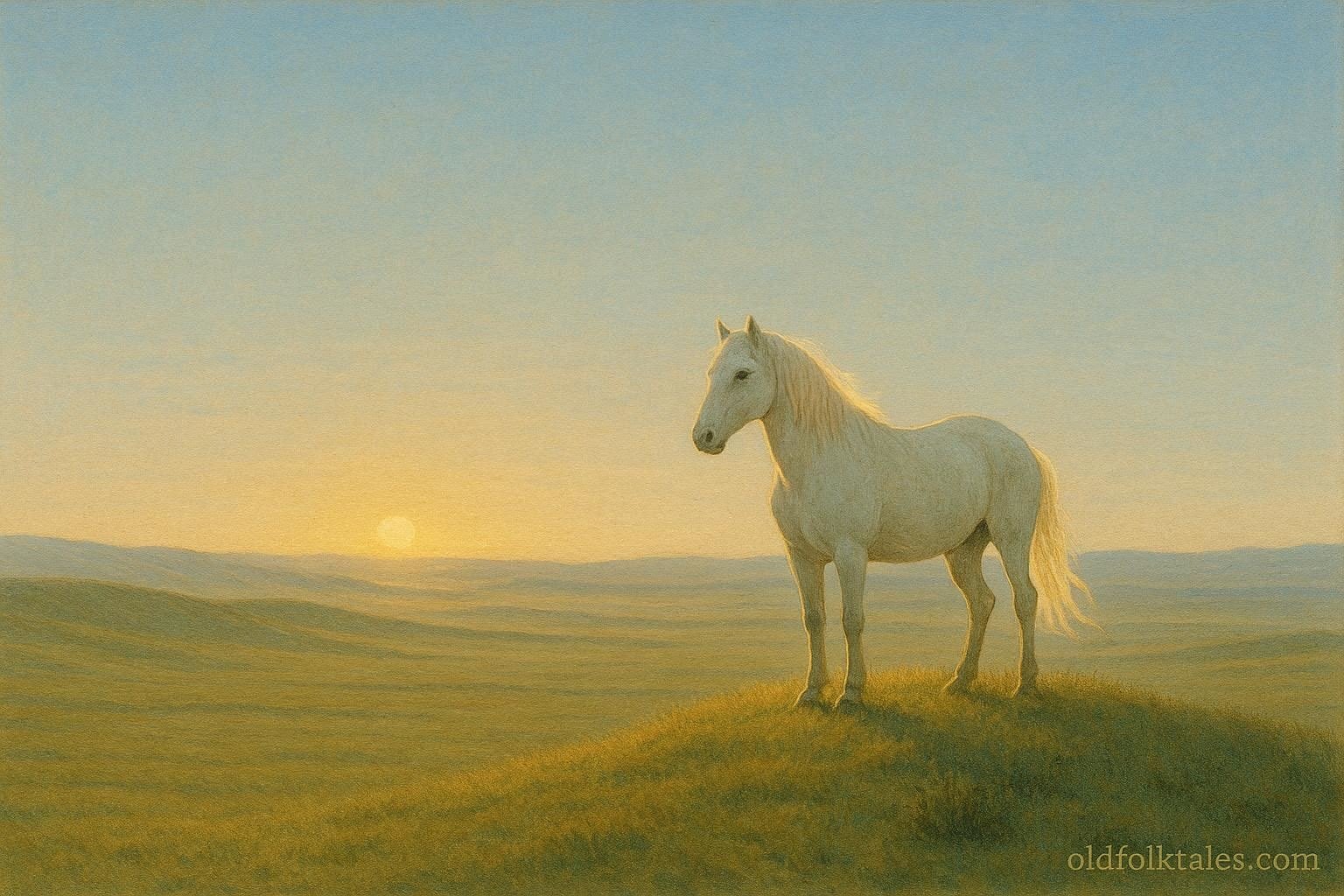
One evening, after a long day of searching for lost goats along the riverbed, Sergen returned home exhausted. The sky was painted with the last colors of sunset, a deep gold fading into violet. He lay down near the family tent and drifted into a troubled sleep. That night he dreamed of a vast sky filled with swirling clouds, and from the center of the heavens emerged a magnificent white horse. Its mane shimmered like falling snow. Its eyes held a calm wisdom older than the mountains. The horse approached Sergen gently and lowered its head, as if inviting him to a place beyond ordinary sight.
In the dream the horse did not speak with words, yet its presence was comforting. Sergen felt a warmth in his chest, a steady reassurance he had not known for many years. When dawn came he awoke with tears on his face, feeling both soothed and unsettled. He told no one about the dream, believing it was only a product of weariness.
Explore ancient tales from Thailand, Cambodia, and the Philippines in Southeast Asian Folktales.
But the dream returned the next night. And the one after that. Each time the horse guided him through a different landscape. One night it led him across a meadow glowing with starlight. Another night it brought him to a mountain ridge where the wind hummed like a distant chant. In every dream the horse urged him toward calmness, patience, and a deeper connection with the land.
After the third dream Sergen realized the visions were not mere illusions. Among the nomadic people of the steppe, such dreams were signs that heavenly spirits were near. A white horse, in particular, symbolized purity and celestial guidance. Remembering the elders’ teachings, Sergen understood that he was being called to listen.
The next morning he set out alone before sunrise. He carried no weapons, only a small pouch of dried meat and a waterskin. He walked to the highest hill overlooking his family’s pasture and waited, watching the world slowly brighten. As the first ray of light touched the grass, Sergen saw a shape appear on the horizon. It was a horse, pure white from mane to tail, moving with graceful steps toward him.
Sergen stood perfectly still, afraid that any sudden movement would break the fragile miracle. The horse stopped a few paces away and gazed at him with the same wise eyes he had seen in his dreams. Though the creature did not speak, Sergen understood its message. The land was not a burden to be conquered. It was a living partner. To find prosperity he must learn to work in harmony with the earth, the seasons, and the spirits who watched over the steppe.
As he listened to the unspoken wisdom, Sergen realized how often he had battled against nature. He had forced his animals to move when they needed rest. He had driven them toward pastures without considering the changing winds and patterns of growth. He had blamed himself for every loss instead of allowing patience to guide him. Now he felt as though the white horse was quietly showing him how to walk with the land rather than against it.
The horse stepped closer and touched its nose gently to Sergen’s forehead. In that instant he felt a surge of clarity. He knew which grazing lands would flourish in the coming weeks. He sensed where storms would gather and how to shield his herd. He felt a renewed strength within his spirit.
From that day forward Sergen tended his herds differently. Instead of relying on force or haste, he observed the patterns of the clouds, the behavior of the birds, and the feel of the wind on his skin. He moved the animals slowly, allowing them to rest and graze at the right times. The land, responding to his respect, began to yield abundance. His goats grew strong again, and the sheep produced thick wool. Even the horses seemed more spirited and healthy.
Word spread throughout the steppe of Sergen’s transformation. Other herders noticed the new harmony surrounding his pastures and sought his advice. Though they praised him, Sergen always credited the guidance of the celestial horse. He shared what he had learned with humility, reminding others that the land provides generously to those who treat it with reverence.
As seasons passed, the dreams of the white horse grew less frequent. Sergen understood that the spirit had given him what he needed and now watched from afar. Yet one final dream came many years later during a harsh winter. Sergen saw the horse once more, standing beneath a sky filled with swirling snow. It bowed its head in farewell, and Sergen woke with a sense of peaceful completion.
When he stepped outside the tent the next morning, he saw a single white star glowing brighter than all others in the sky. His heart knew this was the eternal spirit of the white horse watching over him and his descendants for all time.
Moral Lesson
The story teaches that true prosperity comes from harmony with nature, not force. When people act with humility, patience, and respect for the land, guidance arrives in unexpected forms. The spirit of the white horse reminds us that wisdom is given to those who listen deeply and act with reverence.
Knowledge Check
1. Why did the white horse appear to Sergen in dreams?
To guide him toward harmony with nature and teach him patience.
2. What did Sergen realize about his herding practices?
He had been working against the land instead of cooperating with it.
3. How did the white horse communicate its wisdom?
Through silent presence and symbolic guidance in dreams.
4. What changed once Sergen followed the horse’s teachings?
His herds flourished and the land responded with abundance.
5. What did Sergen do when others asked for his guidance?
He shared what he learned with humility, crediting the spirit horse.
6. What symbol remained in the sky after the horse’s final farewell?
A single bright white star representing the eternal spirit of the celestial horse.
Source
Adapted from Ulaanbaatar National Library Folk Heritage Archive, 2015.
Cultural Origin
Khalkha Mongolian folklore.