In the high, terraced mountains of Jebel Akhdar, where the breeze carries the scent of figs and earth, stood the ancient mud-brick village of Al Hamra. Its houses, the color of warm clay, clung to the slope like old memories refusing to fade. For generations, its people depended on the falaj, a narrow, stone-lined water channel that carried life from a spring hidden deep in the mountains. Without its steady trickle, the groves, the animals, and the people would wither.
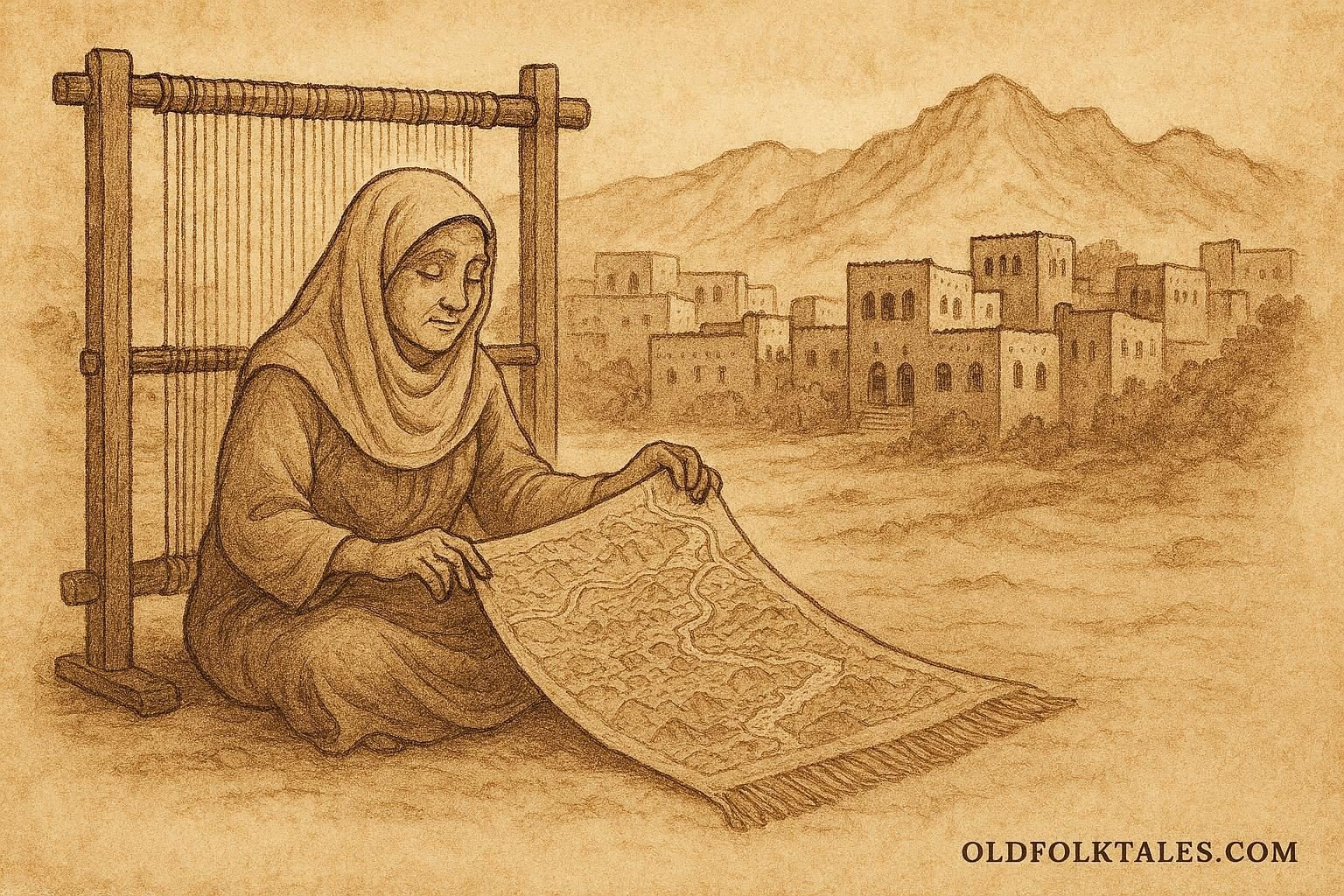
In this village lived an elderly woman named Zaynab, known to all as the blind weaver. Her blindness had come slowly with age, but it never diminished her place in the community. Though her eyes no longer saw the bright patterns of a finished rug, her fingers still danced with practiced certainty, reading the texture and tension of every thread. While other weavers crafted geometric patterns or repeating designs, Zaynab wove stories, mountains, valleys, flowers, and memories, all bound into wool.
Her home was small, but it always smelled of dyed yarns and warm goat wool. Children visited often, sitting quietly at her feet as she worked, listening to the soft rhythm of her loom. “A rug,” she once told them, “is like a road. Every line leads somewhere.”
One dry year, the sky withheld its mercy, and the mountains grew parched. The people of Al Hamra waited for the usual meltwater trickling from above, but instead the falaj slowed, then thinned, and eventually fell silent. The villagers stared in disbelief at the empty channel, the exposed stones looking like the bones of a forgotten creature.
Panic murmured through the village. Without water, the crops failed, the goats wandered restlessly, and the wells sank lower each day. The village headman gathered the elders. “The spring upstream must be lost,” he said. “Perhaps blocked by an earthquake. If we cannot find the old source, we will not survive this season.”
Someone spoke up quietly: “There is one who once walked every path in these mountains, Zaynab.”
The headman hesitated. “But she has not seen the mountains in many years.”
“Her feet remember,” the villagers replied. “Her hands remember.”
So the headman went to her modest home, where Zaynab sat weaving by the door, her fingers moving with calm familiarity.
“Zaynab,” he said gently, “you spent your youth exploring every path of Jebel Akhdar. Do you remember where the old spring lies? The one our forefathers spoke of?”
She paused, her hands resting on the loom. After a moment she replied, “My eyes are dark, yes. But my hands hold what they learned. Bring me wool—good wool, and leave me to my weaving.”
Word spread quickly. The villagers gathered all the softest wool they had and brought it to her. Zaynab touched it thoughtfully, then set to work.
She wove day and night, the steady clack of her loom echoing through the quiet house. For seven days and seven nights, she neither rushed nor faltered. Her fingers moved with the certainty of memory, twisting, knotting, raising, and flattening the threads in deliberate patterns only she understood.
At dawn on the eighth day, she finally stopped. Before her lay the finished rug.
To the sighted villagers, the rug was beautiful: mountain peaks rising like brown triangles, tiny flowers scattered like stars, and pathways curling between the shapes. It looked like one of her usual story-rugs, artistic, imaginative, a woven image of Al Hamra’s world.
But when Zaynab rested her palms upon the rug and traced its raised knots, her movements were slow and purposeful. “This is no picture,” she said softly. “This is a map. The path is not drawn with color, it is drawn with feeling.”
The headman, puzzled, asked, “How will we understand it when we cannot read it by touch as you do?”
Zaynab smiled faintly. “There is someone in this village who can.”
A young boy, known for his remarkable sense of touch, stepped forward. He had often helped her gather yarn and learned her weaving textures by heart. Zaynab invited him to place his hands on the rug.
“Follow the path with your fingers,” she instructed. “Tell the men where the knots lead.”
Slowly, the boy traced the raised ridges and dips. “It begins at the old fig tree outside the village,” he said. His fingers moved again. “Then seven steps to the east.” A little further. “Turn where the rock looks like an eagle… And dig where you find… three white stones.”
The men exchanged glances. The instructions were exact, too exact to be coincidence.
They left at once, the boy guiding them from the rug’s memory. They found the fig tree, counted the steps, identified the eagle-shaped rock, and finally reached a patch of earth where three small, pale stones rested as if waiting for them.
They dug. After a few moments, one man shouted, “Stone channel! The old falaj!”
A great boulder had fallen during a mountain tremor, blocking the hidden source. Working together, the villagers forced it aside. The moment the rock rolled free, a surge of clear, cold water rushed through the channel, filling the falaj once more.
Shouts and prayers rose into the mountain air. The lifeline of Al Hamra had returned.
When they carried the news to Zaynab, she simply nodded, her hands folded in her lap. “Knowledge,” she said quietly, “does not live only in eyes that see. It lives in the hands that create and in the hearts that remember.”
Her rug was placed in the village meeting house, protected like a sacred heirloom. Generations later, people still retell the story of Zaynab, the blind weaver, whose memory saved an entire village.
Moral Lesson
The story teaches that wisdom is not limited by age or sight. True knowledge can come from memory, intuition, and quiet skill, and even those society may overlook can hold answers essential to survival.
Knowledge Check
1. Who was Zaynab in the Omani folktale “The Weaver of Al Hamra”?
Zaynab was a blind master weaver whose skilled hands and memory helped save her village.
2. What problem threatened the village of Al Hamra?
The village’s falaj water channel stopped flowing after the spring was blocked, endangering the community.
3. How did Zaynab create the map to the lost spring?
She wove the map into a rug using raised knots that revealed the path by touch rather than sight.
4. Who interpreted the tactile map for the villagers?
A young boy with a strong sense of touch traced the rug’s knots to guide the men.
5. What message does the folktale emphasize about knowledge and ability?
It teaches that wisdom can exist beyond physical sight, found in memory, skill, and experience.
6. What cultural element of Oman appears prominently in the story?
The falaj irrigation system, a traditional lifeline of Omani mountain communities, is central to the narrative.
Source
Adapted from the Omani folktale “The Weaver of Al Hamra” in Tales from the Sultan’s Sea Chest by Joan M. S. Kelly.