In the high grasslands of Eastern Tibet, where the wind whispers across the mountains like the voices of ancestors, there lived a young shepherd named Tsering. His flock grazed across vast, rolling meadows, dotted with clusters of wildflowers that nodded under the gentle breeze. Life in the highlands was harsh, but Tsering knew how to survive. He moved with patience and care, guiding his sheep through rocky passes and rushing streams, singing softly to calm both the flock and his own heart.
The elders often spoke in hushed tones about the northern ridge. They said spirits of many kinds wandered there, some protective, some mischievous, and some so dangerous that even adults rarely dared approach. The most feared of all was a shape-shifting demoness who preyed on lonely travelers and wandering shepherds. Tsering had always listened carefully to these warnings, but as a boy who spent most of his life among animals and open skies, he felt confident that as long as he respected the land, no spirit would trouble him.
One late afternoon, when the sun painted the peaks with red and gold, Tsering noticed that one of his youngest sheep had wandered off. Its little bell, which jingled with each step, had gone silent. He followed the tracks, which led directly toward the northern ridge. His heart thumped with unease. The elders’ warnings flooded his mind, yet he could not abandon the young sheep to the dangers of cliffs, predators, or worse. Taking a deep breath, he adjusted his staff and started climbing toward the ridge.
Journey through enchanted forests and islands in our Southeast Asian Folktales collection.
The wind grew stronger as he ascended, carrying sharp scents of moss and stone. Ravens circled above, their cries warning him to turn back. As the path narrowed between jagged rocks, a soft voice floated through the air.
Tsering… Come here, Tsering…
The voice was strangely familiar, almost like his mother calling him to dinner, yet he knew she was far down in the valley. His pulse quickened. The elders had said spirits often mimic the voices of loved ones to lure travelers into danger. Tsering pressed his palms together and whispered a protective chant he had learned from his grandmother, feeling the words weave strength into his chest.
He moved carefully toward a cluster of large boulders and spotted his sheep lying motionless. Its eyes reflected the fading sunlight in an unnatural glint. He took another cautious step forward. Suddenly, the sheep’s body rippled and stretched unnaturally. Its legs lengthened, its wool bristled unnaturally, and a pair of gleaming eyes emerged where the sheep’s face had been.
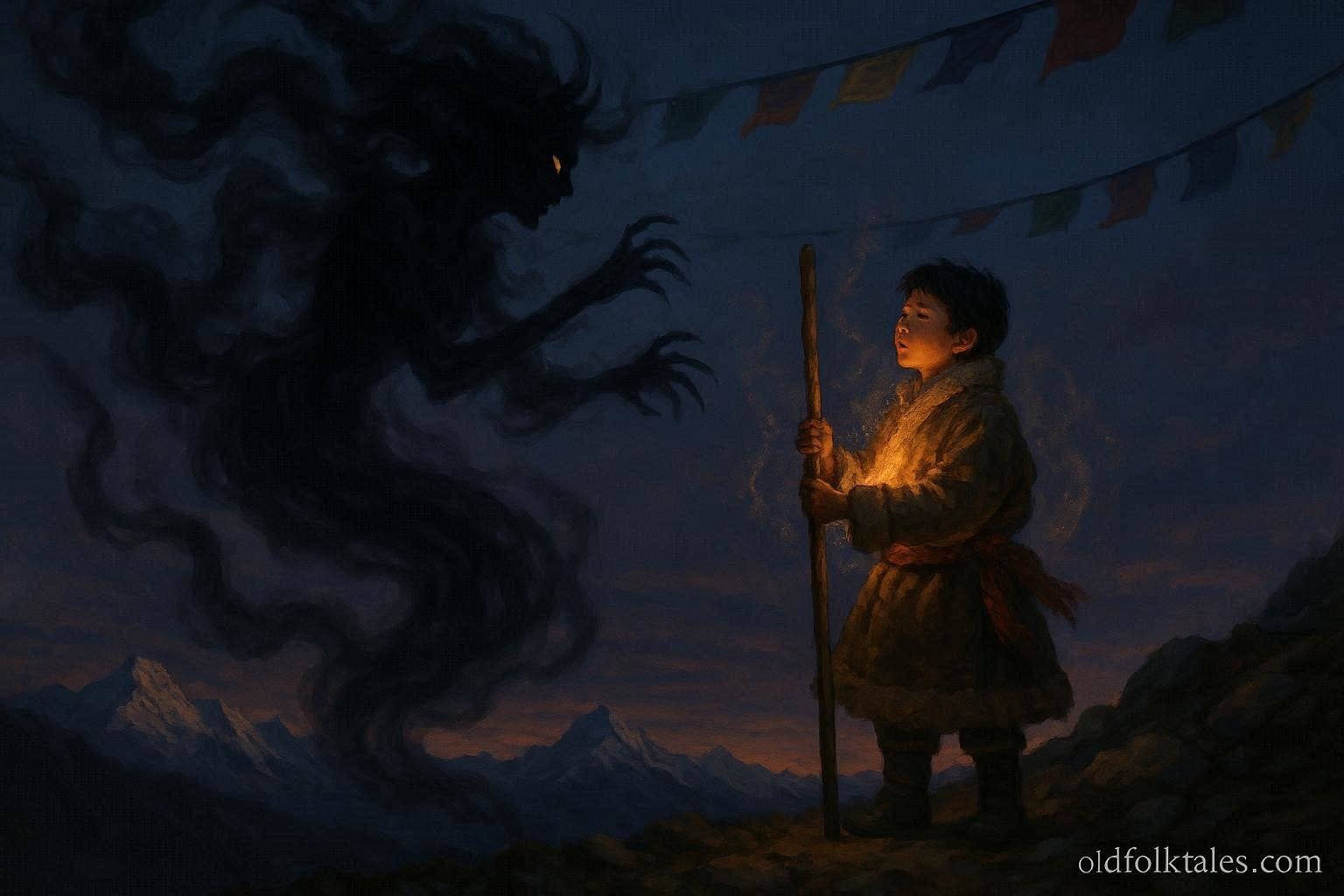
The creature rose before him, towering and shifting, a mixture of smoke and shadow. Hair flowed like storm clouds, and claws extended from long fingers that could tear through stone. Her voice, once soft and inviting, now rumbled like distant thunder.
Welcome, shepherd boy, she hissed. I have been waiting.
Tsering felt a chill, but he stood his ground. He remembered that running from spirits often strengthened them. Instead, he took a step back, raised his staff, and recited another line from the sacred chants taught to him by the monks in the monastery.
The demoness laughed, a sound that echoed through the ridge like rolling boulders. She lunged forward, but Tsering’s staff passed through her as if she were made of smoke. Circling him like a whirlwind, she whispered threats and promises. Fear rose in his chest, yet he remembered his grandmother’s words: when fear arises, let the sacred chant strengthen your spirit.
He closed his eyes and began reciting the verses with steady breath. At first, his voice trembled, but the mountains themselves seemed to echo and amplify the words. Light shimmered faintly around him. The demoness screamed as the chant began to constrict her power, her form flickering and shrinking.
Stop. Enough. You are only a boy, she snarled.
Tsering continued chanting, pouring every ounce of his courage, every memory of his ancestors, into the sacred syllables. The demoness twisted and writhed, but the net of the chant held firm. Her form dissolved gradually into smoke, which the wind carried away over the ridges. Finally, with a last shriek, she vanished completely. Silence fell across the highlands, broken only by the sound of the sheep bleating softly nearby.
Tsering returned to the village with his flock intact. The elders listened in awe as he recounted his encounter. They bowed their heads, recognizing that he had not only saved himself and the sheep, but had also restored balance to the sacred lands of the ridge. From that day forward, Tsering was no longer seen merely as a shepherd. He became a guardian of the highlands, someone who understood the land, the unseen spirits, and the power of courage paired with spiritual wisdom. Even the mountains seemed to remember his voice.
Discover more East Asian Folktales from the lands of dragons, cherry blossoms, and mountain spirits.
Moral Lesson
True strength comes from courage, wisdom, and respect for sacred teachings. Bravery is not merely the absence of fear but the willingness to face danger with preparation, discipline, and moral understanding. Even a young person can protect both self and community through spiritual awareness and calmness in adversity.
Knowledge Check
- Why did Tsering walk toward the northern ridge?
Answer: To find his missing sheep that had strayed toward the ridge despite the elders’ warnings. - What was unusual about the voice calling Tsering?
Answer: It sounded like his mother even though she was far away, which is a sign of a deceptive spirit. - How did the demoness first disguise herself?
Answer: She disguised herself as Tsering’s missing sheep. - Why did Tsering begin chanting instead of running away?
Answer: He remembered the sacred chants taught by his grandmother, which could protect him and repel harmful spirits. - What effect did the sacred chant have on the demoness?
Answer: The chant weakened her, prevented her attacks, and eventually caused her to dissolve into smoke. - How did the villagers react when Tsering returned?
Answer: They listened in awe, respected him for his courage, and recognized him as a guardian of the highlands.
Source
Adapted from Digital Himalaya Folklore Recordings, 2012.
Cultural Origin
Eastern Tibetan highland communities.