In the district of Phra Khanong, along the banks of a canal that winds through what is now the heart of Bangkok, there once lived a young couple whose love seemed blessed by the heavens themselves. Her name was Nak, though everyone called her Mae Nak, Mother Nak, with the affection that comes from knowing someone since childhood. His name was Mak, a simple man with kind eyes and strong hands, the sort of husband who worked hard and loved deeply. They had grown up together in the village, their affection blooming naturally from childhood friendship into the profound bond of marriage.
Their small wooden house stood on stilts above the water, like all the homes in Phra Khanong. In the mornings, the canal would shimmer with the first light of dawn, and Mae Nak would stand on their veranda, her hand resting on her swelling belly, watching the boats pass by laden with vegetables and flowers bound for the markets. She was pregnant with their first child, and both she and Mak could barely contain their joy at the prospect of becoming parents.
Click to read all East Asian Folktales — including beloved stories from China, Japan, Korea, and Mongolia.
But these were troubled times. War had come to the kingdom, and the king’s officers arrived in Phra Khanong one morning with drums and proclamations, conscripting able-bodied men to join the army. Mak received his orders with a heavy heart. He had to leave his pregnant wife, had to march away to fight in a conflict that seemed distant and abstract compared to the very real life growing in Mae Nak’s womb.
“I will wait for you,” Mae Nak whispered as she clung to him on the day of his departure, her tears soaking into his shirt. “I will be here with our child when you return. Come back to us safely.”
“I promise I will return,” Mak replied, holding her as if he could press the promise into her very soul. “Wait for me. Take care of yourself and our baby.”
He left with the other conscripts, looking back again and again until the village disappeared behind the trees and the curve of the canal. Mae Nak stood on their veranda until she could no longer see even the dust from the road, one hand on her belly, the other raised in a final, desperate wave.
The months that followed were difficult for Mae Nak. As her pregnancy advanced, she struggled with the daily tasks of survival fetching water, preparing food, maintaining the house. The other village women helped when they could, but everyone had their own burdens. Mae Nak’s loneliness grew as heavy as the child in her womb. She spoke to her unborn baby constantly, telling it stories about its father, promising that Mak would return, that they would be a family.
When her labor pains began one sweltering night, the midwife was summoned. The old woman arrived quickly, but from the moment she examined Mae Nak, her face creased with worry. The baby was positioned wrong. The delivery would be difficult, perhaps impossible. As the night wore on and Mae Nak’s screams echoed across the dark water of the canal, the midwife did everything she knew, but her skills were no match for the complications that arose.
By dawn, both Mae Nak and her baby were dead.
The villagers buried them together according to custom, wrapping mother and child in white cloth, placing them in the earth near the canal where Mae Nak had spent her life. They made offerings to ease their journey to the next world, spoke prayers for their spirits, and mourned the tragedy of a young mother and infant lost. Then, as life always does, the village moved forward. Days became weeks, weeks became months.
And then Mak came home.
He had survived the war, though he carried its scars a slight limp from an injury, a haunted look in his eyes from things he had seen. But all of that fell away when he saw his house still standing, smoke rising from the cooking fire, and there, on the veranda, his beloved wife waiting for him with a baby in her arms.
Mae Nak’s face lit up with radiant joy when she saw him. She rushed down to embrace him, the baby held carefully against her shoulder, and Mak felt his world become whole again. She was as beautiful as he remembered, perhaps even more so with motherhood softening her features. The baby was healthy and perfect, its tiny fingers curling around his when he offered them.
“You came back,” Mae Nak whispered, tears of happiness streaming down her face. “You came back to us.”
Mak settled back into domestic life with relief and contentment. In the evenings, he would sit with Mae Nak on their veranda, the baby sleeping between them, watching the boats drift by on the canal. She cooked his favorite meals, kept their home immaculate, and seemed entirely devoted to making him comfortable after his ordeal at war. Everything seemed perfect, as if the war had been merely a bad dream and he had awakened to the life he had always wanted.
The villagers noticed something was wrong.
They saw Mae Nak and the baby, but there was something unnatural about them, something that made skin prickle and breath catch. Mae Nak never left the house during daylight hours. She never attended the market or the temple. The baby never cried, never made any sound at all. And there were other things, strange things, that people glimpsed from the corners of their eyes: Mae Nak’s arm stretching impossibly long to reach something on the ground below their house, her shadow moving independently of her body, a coldness in the air that surrounded her even on the hottest days.
The bravest among the neighbors tried to warn Mak. An old woman who had known Mae Nak since childhood approached him one evening when his wife was inside the house.
“Mak,” she said urgently, her voice low, “you must listen to me. Your wife died in childbirth. We buried her months ago. That woman in your house she is not truly Mae Nak. She is a phi, a ghost. You are living with the dead.”
Mak’s face darkened with anger. “How dare you speak such lies about my wife! She is alive and well. I see her, I touch her, I speak with her every day. Leave us alone with your cruel rumors!”
But that night, as Mae Nak prepared dinner, Mak watched her more carefully. She dropped a lime while cutting ingredients, and it fell through the gaps in their raised floor toward the ground below. Without thinking, without even looking, Mae Nak’s arm extended downward, stretching far longer than any human arm could stretch, reaching all the way to the earth below their house, and plucked up the lime as casually as if this were perfectly normal.
The blood froze in Mak’s veins. He tried to tell himself he had imagined it, that the shadows had played tricks on his eyes. But he knew. Deep in his soul, he knew the truth that his heart had refused to accept. His beloved wife was dead. What sat beside him each night was her spirit, her ghost, held in the world by love so powerful it had transcended death itself.
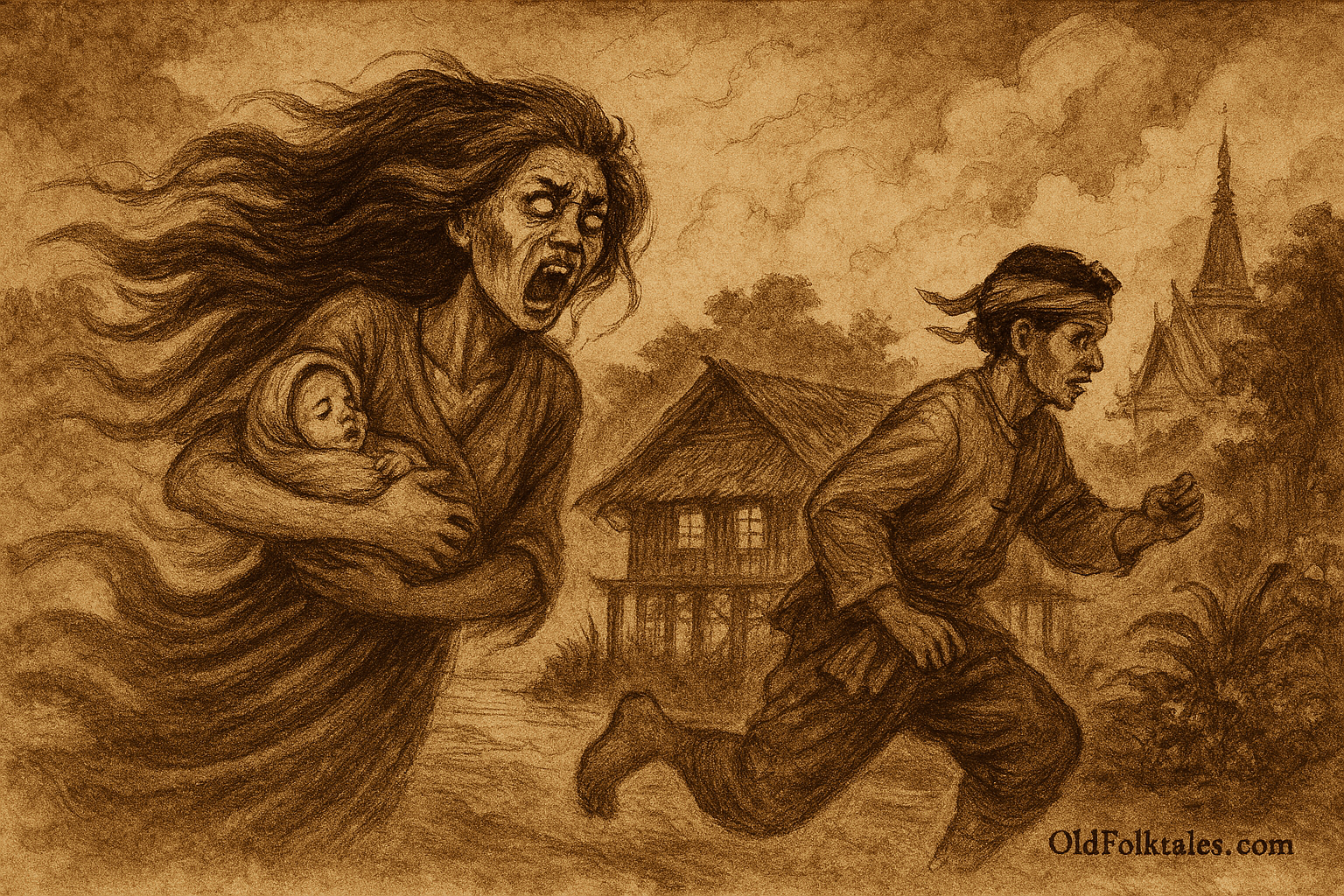
Terror gripped him, but he forced himself to remain calm. He told Mae Nak he needed to step outside for a moment, his voice steady despite the panic racing through his chest. The moment he was out of the house, he ran, ran through the village, ran until his injured leg screamed in protest, ran toward the temple where the monks might protect him.
Mae Nak realized immediately that he had discovered her secret. Her beautiful face contorted with anguish and rage. She pursued him through the darkness, her form shifting between the woman he had loved and something far more terrible, her hair wild and floating as if underwater, her eyes glowing with an unnatural light, her mouth opening in a wail that was both heartbreak and fury.
The neighbors who had tried to warn Mak, those who had whispered about Mae Nak’s true nature she turned her wrath upon them. Her ghostly power, fueled by the intensity of her love and her desperation to keep her husband, became something monstrous. Those who had interfered, who had tried to separate her from Mak, met terrible fates. Some were found dead in their homes with expressions of pure terror frozen on their faces. Others simply disappeared, their boats found empty on the canal.
Mak reached the temple just ahead of her, throwing himself through the gates and into the sanctuary where Mae Nak’s spirit could not follow. The monks had sensed the supernatural disturbance and were already preparing consecrated barriers. For days, Mae Nak’s ghost raged outside the temple, calling to Mak, begging him to come back to her, promising that everything could return to how it had been.
“I love you,” her voice echoed through the night, breaking the hearts of all who heard it. “I waited for you. I kept my promise. Please don’t leave me. Please don’t abandon us.”
But the monks knew that her presence endangered the entire village. A ghost this powerful, driven by love that had twisted into obsession, could destroy everything. They performed powerful rituals, chanting sacred verses, wielding blessed objects. The most skilled exorcist monk confronted Mae Nak’s spirit with compassion but firmness.
“Your love was pure,” he told her gently, “but your time in this world has passed. You must release your attachment and move forward to your next life. Holding onto this existence causes suffering for yourself, for your husband, for everyone.”
After days of ritual and prayer, the monks finally subdued Mae Nak’s spirit. They sealed her remains, her bones and the baby’s bones, dug up from their grave, in a sacred ceramic urn, blessed it with holy verses, and placed it in a shrine where it would be honored and contained. The urn would keep her spirit from manifesting again, would allow her to finally find peace.
Mak lived the rest of his life alone, never remarrying. He visited the shrine often, leaving offerings of flowers and incense, speaking to Mae Nak’s spirit, telling her about his days, promising he had never stopped loving her. The villagers came to see Mae Nak not merely as a terrifying ghost but as a tragic figure, a woman whose love had been so powerful that not even death could break it, whose devotion had been both beautiful and terrible.
To this day, Mae Nak’s shrine in Phra Khanong receives countless visitors. Pregnant women pray to her for safe deliveries. Those seeking powerful love make offerings. The story of Mae Nak has been retold in plays, films, and songs, each generation finding new meaning in this tale of love that transcended mortality itself. And on quiet nights along the canal, some say you can still feel her presence, not threatening now, but sad and eternal, a reminder that the deepest love carries its own form of immortality.
Click to read all Southeast Asian Folktales — featuring legends from Thailand, Indonesia, Vietnam, and the Philippines.
The Moral Lesson
The legend of Mae Nak Phra Khanong teaches us about the complex nature of love and attachment. Mae Nak’s devotion to her husband was genuine and profound, yet when it extended beyond death, it transformed into something that caused suffering for everyone, including herself. The story illustrates that love, however pure in its origins, can become destructive when it refuses to respect natural boundaries and transitions. Mae Nak’s inability to let go, to accept that her time with Mak had ended, turned her from a devoted wife into a dangerous spirit. This Thai legend reminds us that true love sometimes means releasing what we cherish most, accepting loss and change as part of existence.
Knowledge Check
Q1: Who was Mae Nak and what happened to her while her husband was away at war?
A1: Mae Nak was a young woman from Phra Khanong district in Bangkok who was pregnant with her first child when her husband Mak was conscripted to fight in a war. While he was away, she went into labor with complications the baby was positioned wrong and the delivery proved impossible for the midwife. Tragically, both Mae Nak and her baby died during childbirth. The villagers buried mother and child together according to custom, mourning the loss of the young family.
Q2: What happened when Mak returned home from war in the Mae Nak story?
A2: When Mak returned home, he found what appeared to be his wife Mae Nak waiting for him on their veranda with a healthy baby in her arms. Overjoyed and relieved to find his family alive and well, he settled back into domestic life. Mae Nak seemed devoted and loving, cooking his meals and caring for him after his war ordeal. Mak did not initially realize that his wife had died months earlier and that he was actually living with her ghost, whose love had been so powerful it transcended death.
Q3: How did the neighbors try to help Mak discover the truth about Mae Nak?
A3: The neighbors noticed disturbing signs that Mae Nak was not truly alive. She never left the house during daylight, never attended market or temple, the baby never cried, and strange supernatural phenomena occurred around her. The bravest neighbors, including an old woman who had known Mae Nak since childhood, tried to warn Mak directly that his wife had died in childbirth and was buried months ago, and that he was living with a phi (ghost). However, Mak angrily refused to believe them, defending his wife against what he saw as cruel rumors.
Q4: How did Mak finally realize Mae Nak was a ghost?
A4: Mak discovered the truth when he observed Mae Nak closely during dinner preparation. She dropped a lime through the gaps in their raised floor, and her arm stretched impossibly long, extending far beyond human capability all the way to the ground below their house, to retrieve it. This supernatural display made the truth undeniable. Though his heart resisted accepting it, Mak could no longer deny that his wife was a spirit, not a living woman.
Q5: What did Mae Nak’s ghost do to those who tried to separate her from Mak?
A5: When Mae Nak realized Mak had discovered her true nature and fled, her grief and rage transformed her into a dangerous spirit. She turned her supernatural wrath upon the neighbors who had warned Mak or interfered with their reunion. Some were found dead in their homes with expressions of pure terror on their faces, while others simply disappeared, their boats found empty on the canal. Her love-driven fury made her a threat to the entire village.
Q6: How did the monks finally deal with Mae Nak’s ghost and what is her legacy in Thailand?
A6: Buddhist monks performed powerful exorcism rituals over several days, combining sacred chants, blessed objects, and spiritual authority. They explained to Mae Nak’s spirit with compassion that she needed to release her attachment and move forward to her next life. Eventually, they sealed her remains and her baby’s bones in a consecrated ceramic urn placed in a shrine to contain her spirit and help her find peace. Today, Mae Nak’s shrine in Phra Khanong receives countless visitors. Pregnant women pray for safe deliveries, and those seeking powerful love make offerings. She is remembered not just as a terrifying ghost but as a tragic figure whose love transcended death, making her story one of Thailand’s most famous and enduring legends.
Source: Adapted from Thai Studies Journal documentation and Bangkok National Museum folklore records on the Mae Nak Phra Khanong legend.
Cultural Origin: Thailand