In a quiet German town, where the streets were lined with autumn-browned trees and the wind carried the scent of baked bread, a grandmother sat on a worn wooden chair. Her grandchild, Hamid, a boy who recently arrived from Kabul, hugged his knees and stared at her. She leaned close, her voice shifting between Dari and soft German: “Yaki bood, yaki na bood, once there was, once there wasn’t…”
Hamid listened, homesick for a place that now felt both near and impossibly distant. The sound of her voice wove colors into his memory, bright Kabul rooftops, the clamor of market stalls, the smell of spices and pomegranates. Yet here, surrounded by a language he understood only partially and trees that did not bend like the mulberry trees back home, he felt untethered.
Explore timeless legends from China, Japan, and Korea in our East Asian Folktales collection.
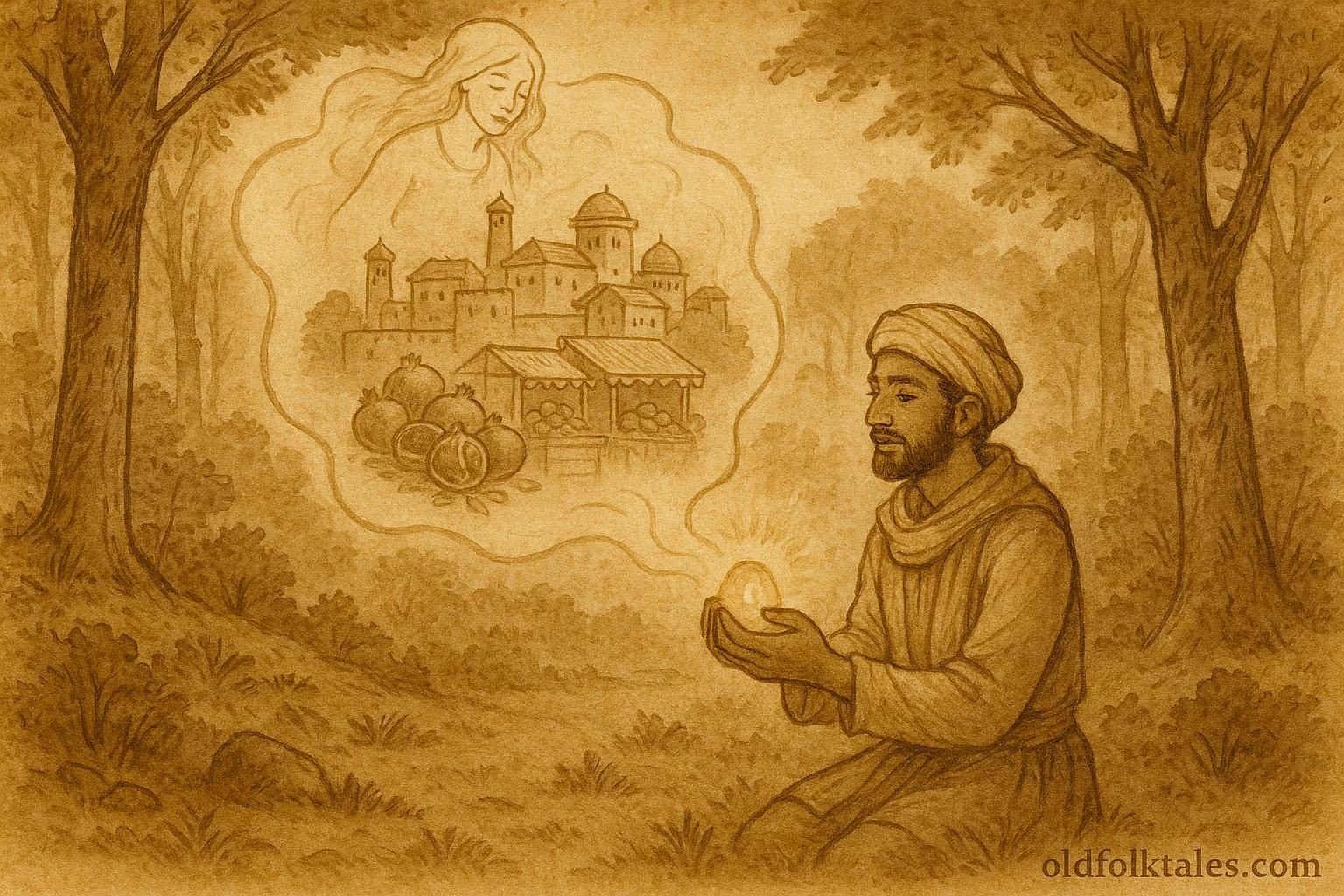
One afternoon, wandering along the edge of a small European forest, Hamid stumbled upon a smooth, warm stone partially buried under leaves. As he lifted it, a faint hum rose from its surface, like a melody drifting on wind. The tune was achingly familiar, the lullabies his mother used to sing. He held the stone close, and the world seemed to soften.
From the stone rose a small, translucent figure, delicate as mist but bright as memory itself. Its shape shifted with Hamid’s heartbeat, neither jinn nor ghost, but something else: a memory spirit. It spoke in a whisper that felt like both a promise and a warning.
“You have left echoes of yourself behind,” it said. “Every child who misses home leaves traces that cannot be walked over.”
The spirit beckoned him to follow. As they moved, Hamid found himself stepping through a living mosaic of memory. He flew across Kabul’s rooftops at dusk, where the sun gilded the city in gold and shadow. He passed by pomegranate stalls, the air rich with tangy sweetness. He ran across his schoolyard, hearing the laughter of friends now scattered. And finally, he saw the mountains glowing with morning light, the peaks that cradled his childhood.
Yet even in this beauty, the spirit’s tone remained firm.
“You may linger here, and the memories will warm you,” it said, “but you risk forgetting the path to your life beyond them. Courage is leaving even what you love.”
Hamid felt the weight of choice. Part of him wanted to stay, forever wandering through streets and moments that were familiar, comforting, perfect. But another part remembered his grandmother’s voice, her gentle insistence that life must continue, even when home is far away.
With a deep breath, he stepped away from the visions. He returned to the forest clearing, where the stone now lay cool and silent, its melody stilled. The spirit hovered for a moment, nodding as though pleased.
“Your home is carried in your heart,” it said. “Memories will guide you, but you must build new ones.”
Hamid tucked the stone into his pocket and ran home. That evening, he told his grandmother about the journey, the singing stone, and the figure that led him through his past. She smiled knowingly, her eyes glinting with both pride and understanding.
“Every exile has a singing stone,” she said softly. “Some just haven’t found theirs yet.”
From that day onward, Hamid carried the lessons of memory, courage, and belonging. He made friends, learned the rhythms of his new town, and kept alive the heart of Kabul in stories, song, and quiet remembrances. Though the streets were foreign and the trees unfamiliar, he discovered that home was not a place to return to, it was a heart to carry forward.
Explore ancient tales from Thailand, Cambodia, and the Philippines in Southeast Asian Folktales.
Moral Lesson
Memory is a home that travels with you, but life must be lived forward. Courage and belonging come not from clinging to the past, but from carrying it wisely as you create your present.
Knowledge Check
1. Who is the main character of the story?
Hamid, a young boy recently moved from Kabul, Afghanistan.
2. What magical element guides Hamid?
A singing stone that emits memories and a translucent memory spirit.
3. What does the memory spirit symbolize?
The persistence of home, culture, and childhood memories.
4. What choice must Hamid make?
Whether to linger in memories or return to real life and build new experiences.
5. What lesson does the tale highlight about courage?
True courage is stepping away from comfort and memory to engage with life fully.
6. What is the cultural origin of this tale?
Afghan diaspora storytelling tradition, connecting Kabul childhood to migration experiences.
Source: Adapted from oral recordings of Afghan diaspora storytelling: “Yaki Bood, Yaki Na Bood” series.
Cultural Origin: Afghanistan–Diaspora (Kabul/Germany)