In the bustling heart of Ta’izz, where vendors called out their prices and spices perfumed the air, lived a poor boy who carried the weight of his family’s survival on his thin shoulders. His parents owned nothing of value except a single aging donkey, gentle, patient, and essential for hauling their small loads. But hardship had tightened its grip on the household, and one scorching morning, the boy’s father told him, with a heavy sigh, that the donkey must be sold to buy food.
Carrying the rope in one hand and hope in the other, the boy walked to the great souq of Ta’izz. The sun glared harshly on the stone paths, and the air shimmered with heat. Merchants shouted from their stalls, their voices echoing between stands of cloth, baskets of fruit, copper vessels, and fragrant incense rising in tendrils.
The boy found a place near the center of the marketplace, tied the donkey to a post, and waited. Hours passed. People glanced at the donkey but moved on. Some admired its calm nature, others joked about its old age, but no one offered a price, not even a low one.
Tired and discouraged, the boy wiped sweat from his brow. That was when a wealthy merchant, known in the souq for his sharp tongue and sharper ego, approached with a smirk pulling at his lips.
“O boy,” he scoffed loudly, drawing attention, “your donkey is worthless! But at least his shadow is long and cool.” His companions laughed, and shoppers nearby chuckled at the insult.
Yet the boy, quick of mind and trained by life to sharpen every word like a blade, instantly grasped the merchant’s gibe. In Yemeni storytelling and speech, wordplay—jinas, clever twisting of meaning, is an art form, and the boy wielded it beautifully.
He leapt to his feet, cupped his hands around his mouth, and shouted:
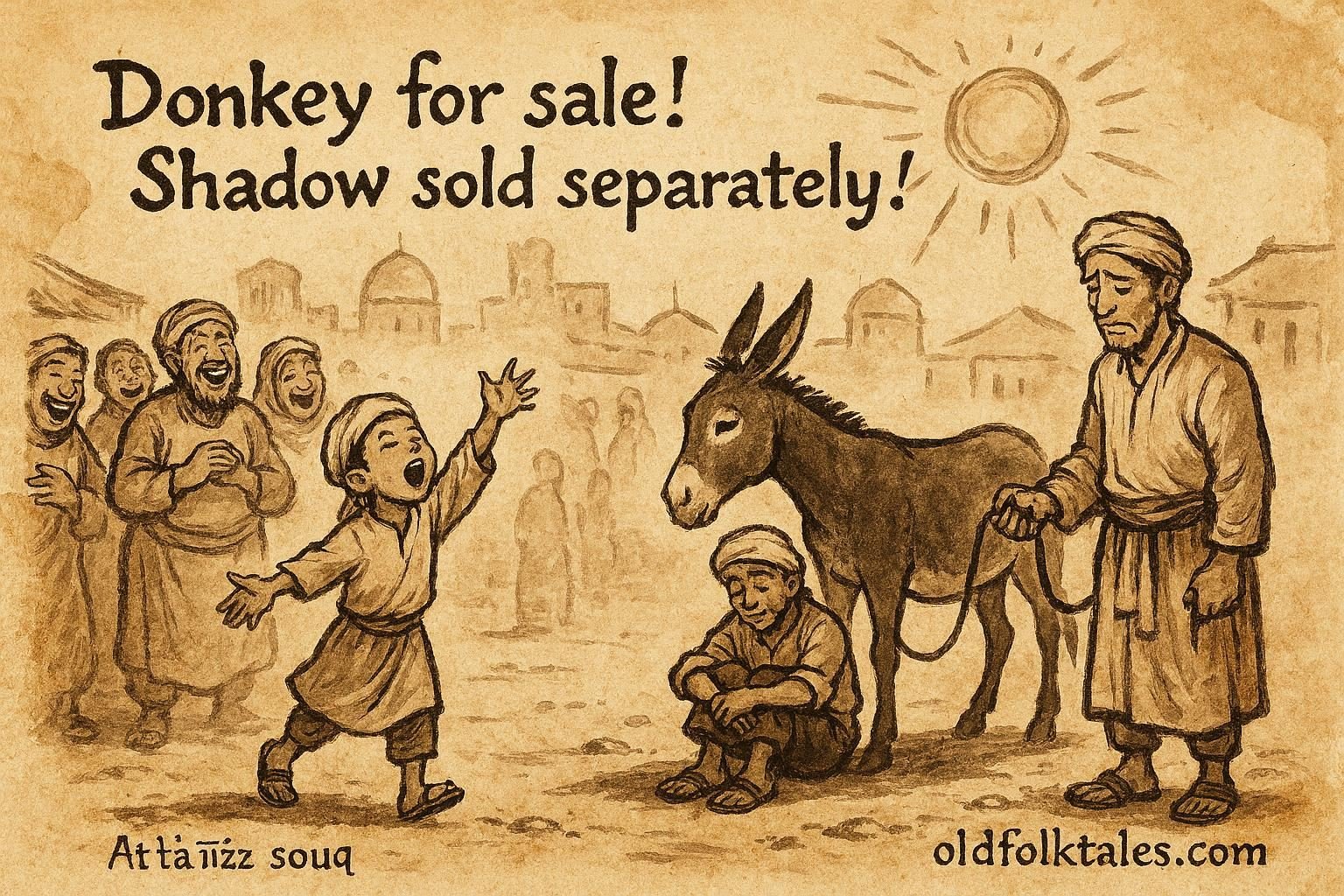
“Donkey for sale! Shadow sold separately to the highest bidder!”
The marketplace erupted with laughter. People gathered, curious and entertained. The merchant’s smirk faltered, his own words had become the boy’s weapon.
Among the crowd was a weary porter who had spent the entire morning carrying heavy loads across the sun-baked market streets. Sweat drenched his clothes, and he had longed for shade in the relentless heat.
Hearing the boy’s call, and amused by the idea, the porter raised his hand and said:
“I’ll buy the shadow! Anything for a moment of coolness.”
Cheers rose around him.
The boy nodded seriously, as though conducting a formal transaction. He handed the porter a flat stone to serve as a “receipt,” then instructed the mocking merchant to hold the donkey’s rope firmly and stand with the animal, under the blazing sun.
The flustered merchant hesitated, but the crowd was watching, laughing, judging. He could not retreat without losing face. Reluctantly, he took the rope.
Meanwhile, the porter happily settled himself in the donkey’s shade, sighing with relief. Whenever the merchant tugged at the donkey to move away, the porter protested loudly:
“Keep the donkey still! I bought the shadow, it is my rightful property!”
The situation grew more ridiculous by the minute. Spectators laughed until tears rolled down their cheeks. Some clapped the boy on the back, praising his cleverness. Others teased the merchant, who now stood sweating, humiliated, and trapped by his own mockery.
Finally, unable to endure the scene, or the laughter, any longer, the merchant barked:
“Fine! Enough of this! I will buy the donkey. Name your price.”
The crowd hushed. The boy named a price far higher than any buyer had offered that day. The merchant, desperate to end his public embarrassment, agreed and paid the full amount on the spot.
The boy thanked him politely, released him from his awkward duty, and returned home with money enough to support his family for months.
Word of the tale spread through Ta’izz, retold in teahouses, at family gatherings, and in the souq itself. People admired the boy who understood the value of wit as much as wealth.
And so the market learned a timeless lesson:
In Yemen, even a shadow has value when one understands the marketplace of words.
Moral Lesson
Cleverness, quick thinking, and mastery of language can transform misfortune into opportunity. Wisdom often triumphs over wealth, especially in a world where wit is respected as a tool for survival.
Knowledge Check
1. What is the main lesson of “The Boy and the Donkey’s Shadow”?
It teaches that wit and quick thinking can turn difficult situations into profitable outcomes.
2. Why did the porter buy the donkey’s shadow in the Yemeni folktale?
He was exhausted from the sun and wanted relief in the animal’s shade.
3. How did the boy cleverly use wordplay in the marketplace?
He separated the donkey from its shadow, turning a merchant’s insult into an opportunity.
4. Why did the wealthy merchant end up buying the donkey?
He was embarrassed by the public spectacle and paid to end the situation.
5. What cultural element is highlighted in this Yemeni folktale?
The tradition of jinas, or clever wordplay, central to Yemeni storytelling.
6. Where does the folktale “The Boy and the Donkey’s Shadow” originate?
It originates from Ta’izz marketplace lore in Yemen.
Source
Adapted from the Yemeni folktale “The Boy Who Sold the Donkey’s Shadow,” Yemeniat.com – Audio Story #047, from Ta’izz marketplace lore.