In the ancient mud-brick city of Shibam, often called the “Manhattan of the Desert,” the people of Wadi Hadramawt lived between towering homes and deep wells that sustained life in the arid valley. Generations had drawn their water from the same underground springs, understanding that every drop mattered in a land where rain came only a few times a year.
One season, when a new house was being built at the edge of Shibam, the builders dug a fresh well. They worked under the fierce Hadrami sun, chiseling through layers of sand and stone until cold water finally surged up to meet them. Their hearts lifted; a new well meant security, blessings, and a promise that the home would thrive.
But their relief did not last.
Each morning, when the workers returned, they found the well mysteriously dry. The bucket scraped against empty stone, and not a glimmer of water remained. Confusion spread among them. They knew they had struck a strong spring, yet every new day brought the same baffling emptiness.
Suspecting mischief, the construction overseer posted a watchman to guard the site through the night. The watchman, an older man who knew the stories of the desert far better than the younger laborers, suspected something unusual. The Hadramawt valley, after all, was a place of stories—tales whispered in the evenings about jinn who lived in caves, dunes, and ancient wells.
That night, he stayed awake beside the half-built house as the city settled into silence. Only the distant rustling of date palms and the soft breathing of the desert surrounded him. Hours passed. The moon slid across the sky. Then, shortly before dawn, he heard the faint splash of water.
He froze.
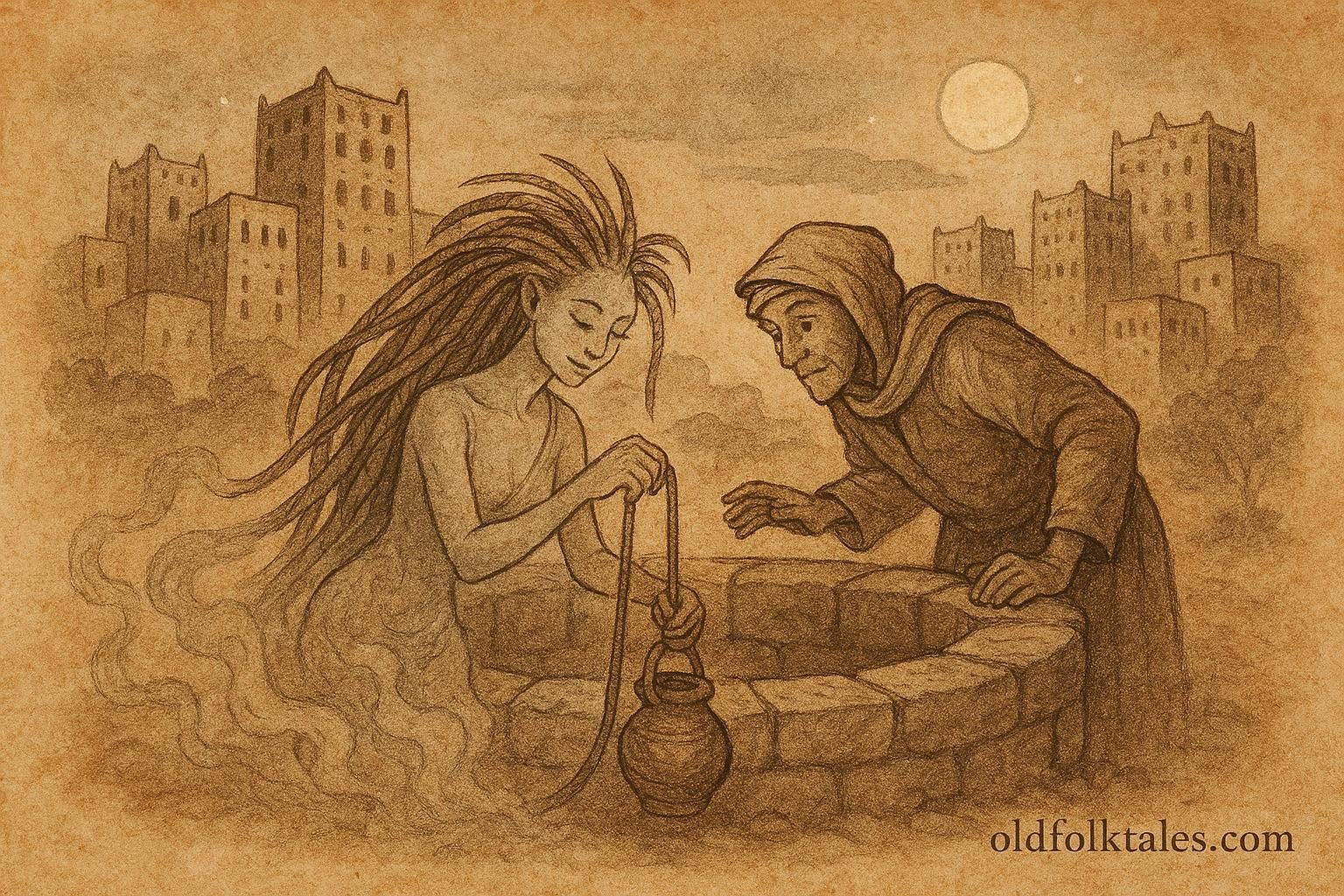
Peering cautiously over the edge of the well, he saw a figure unlike any human. A female jinni, an ʿāmira, one of the spirits believed to inhabit places beneath the earth—was drawing water from the well. Her long hair, pale and fibrous like the strands from a date-palm trunk, fell across her back. Her face shone faintly, neither frightening nor gentle, but ancient, as though carved from the valley’s oldest stories.
Summoning courage, the watchman spoke.
“Why do you steal the water from our well?”
The jinni turned her luminous eyes toward him. Her voice flowed like wind through deep caverns as she answered:
“This was my spring long before your city rose here. You build your towers upward toward God, but you forget what lies below. You forget us, the keepers of the old waters.”
The watchman bowed his head humbly, for he knew the desert was vast, and humans were only one part of its history. He asked how they might restore balance.
The jinni replied simply, “Seek the sage who remembers the old treaties. Only then will water return.”
At dawn, the watchman hurried into Shibam and sought out the city’s sage, an elderly scholar respected for his knowledge of ancestral customs. The people often turned to him when matters crossed the boundary between the seen and unseen.
After listening quietly, the sage nodded. “What you saw is an ʿāmira, the guardian spirit of a place. Her claim is old, and our city indeed builds higher and higher, forgetting the foundation beneath us. If she has spoken, she seeks not conflict but a treaty.”
The sage gathered three symbolic items:
salt, to purify and seal agreements;
honey, to sweeten relations and show goodwill;
silver needles, offerings of respect and tokens of value in local tradition.
“These must be lowered in a basket into the well,” he instructed, “as an offering and acknowledgment of her ancient right. If she accepts it, the spring will flow again.”
That evening, under the guidance of the sage, the builders carried out the ritual. They tied a woven basket with rope, placed the salt, honey, and silver needles inside, and slowly lowered it into the silent well. When it reached the bottom, they left it there and withdrew their hands, trusting the unseen to do its part.
The night passed without disturbance.
At sunrise, the workers returned to check the well. To their astonishment, the bucket splashed into clear, full water. When they pulled it up, floating atop the surface was a single silver needle, embedded in a fresh, ripe fig.
The builders murmured among themselves, the desert figs did not grow near that well, and the fruit was a symbol with meaning clear even without words.
The spirit had returned one needle, pairing it with the fig to convey her message:
“Your world and mine can coexist. Respect the old ways beneath your towers.”
From that day forward, the well never ran dry again. The people of Shibam shared the tale whenever disputes arose over water rights. It reminded them that their valley had a long memory. Beneath the tallest mud-brick homes and beyond the reach of human ambition existed histories, spirits, and agreements older than the city itself.
Thus the story became a lesson passed down through families, reinforcing the ancient water-sharing laws that kept peace in the desert: that no one owned water, not entirely, and that harmony required humility, respect, and acknowledgment of those who came before.
Moral Lesson
Respect for the unseen, the ancient, and the natural world ensures balance in human life. Cooperation, not dominance, maintains peace between old forces and new ambitions.
Knowledge Check
1. Why did the builders’ well in Shibam go dry each morning?
A female jinni, the ancient guardian of the spring, was drawing water before dawn.
2. Who witnessed the jinni taking water from the well?
The watchman who stayed overnight to uncover the mystery.
3. What message did the jinni give to the watchman?
That the spring belonged to her long before the city existed, and humans had forgotten what lay beneath.
4. What ritual did the sage prescribe to restore the water?
Lowering a basket containing salt, honey, and silver needles as a treaty offering.
5. What sign showed that the jinni had accepted the offering?
The next morning, the well was full, and a silver needle returned in a fresh fig.
6. What cultural value does this Yemeni folktale highlight?
Ancient respect for natural resources and the belief in coexistence between humans and unseen spirits.
Source
Adapted from the Yemeni folktale “The Jinni of the Well in Shibam,” ASIATIC Archive – Hadramawt Oral Narratives, Tape 3.