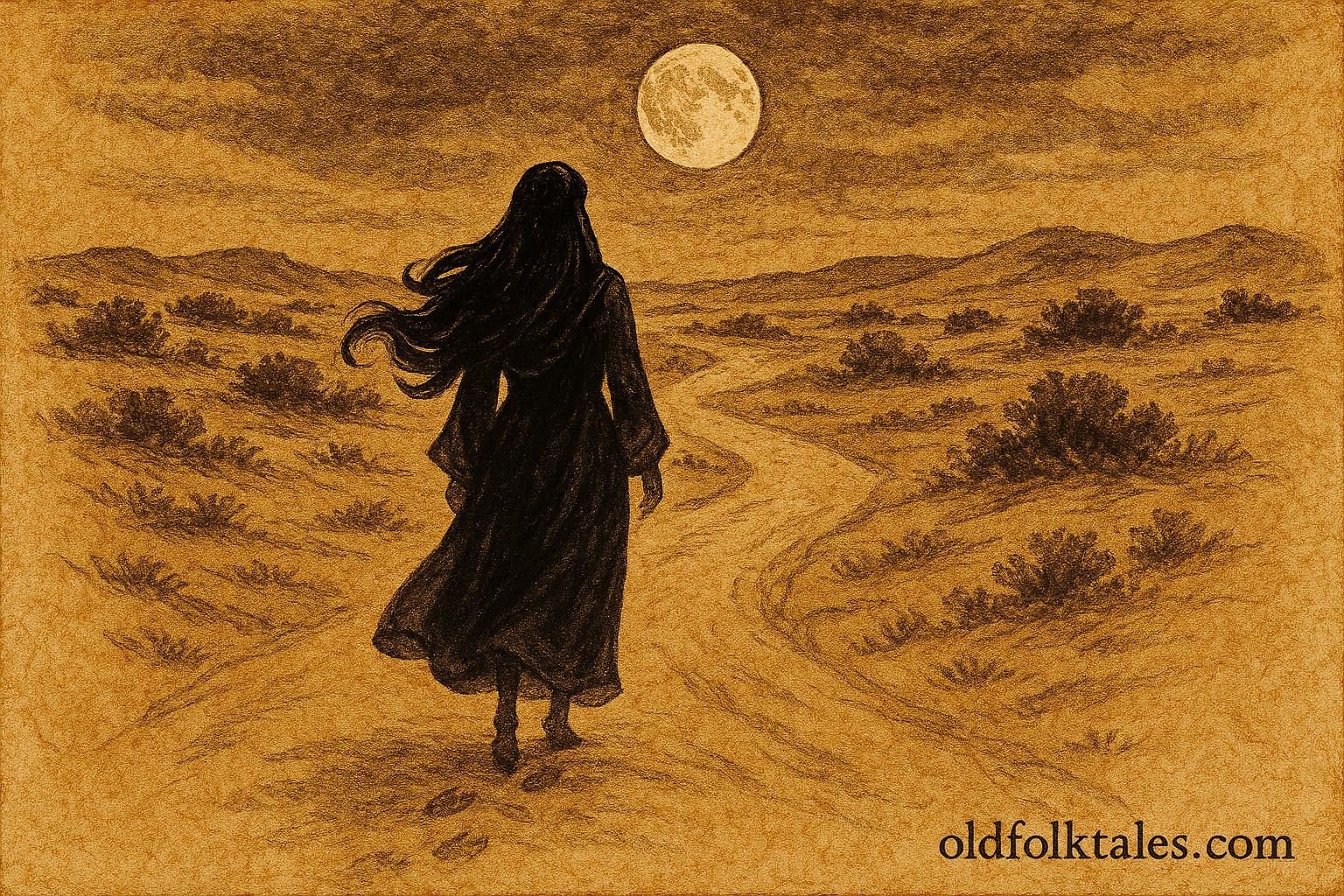
Across the windswept deserts and moonlit coastal paths of Qatar, elders long told a chilling tale that echoed through tents and majlis gatherings. It warned travelers, hunters, and especially wandering men to guard their hearts and steps when the night grew quiet. For that was when Umm Al Duwais, the beautiful deceiver, the jinniyah of deadly charm,was known to roam.
Her story lived in the shadowed spaces between the dunes, carried from Bedouin camps to coastal villages along the Gulf. By tradition, she appeared only when the veil between the seen and unseen grew thin: near wedding celebrations, solitary paths, or places where men drifted away from their companions. Her presence served as a reminder that not all beauty was a blessing, and not all desire led toward life.
The Alluring Shadow
Villagers described how Umm Al Duwais appeared from behind as a woman of breathtaking grace. Her black hair, they said, flowed like soft silk down her back, and the sway of her steps was gentle and rhythmic, enough to draw the gaze of even the most disciplined man. She wore traditional Gulf garments, shimmering faintly in the dim desert light, as if reflecting the glow of the moon itself.
From a distance, she seemed shy, almost fragile. She never spoke at first. Instead, she allowed curiosity to do her work. Many men, after glimpsing her silhouette, followed her without a moment’s hesitation, believing they were approaching a lone woman in distress or an alluring stranger seeking company.
In a conservative society where modesty governed every social interaction, such encounters were unthinkably rare. That rarity made them all the more irresistible.
The danger began the moment a man stepped out of the safety of the communal path and followed her into silence.
The Desert Reveals Her True Form
Survivors, those who escaped only through divine mercy or the desperate intervention of loved ones, described the same horrifying transformation.
When her victim drew close enough to see her face, Umm Al Duwais would finally turn.
What looked human from behind was a nightmare from the front.
Her beautiful hair remained, but it framed a face twisted and unnatural, eyes reflecting a predatory gleam, teeth sharp as blades, and a voice like wind scraping through dry stone. Her delicate human feet dissolved into the unmistakable hooves of a donkey, stamping the sand with a jarring mix of beauty and monstrosity. Some versions spoke of claws, others of scorched footprints left behind as she advanced.
By then, the victim could neither run nor call for help. Some she attacked immediately, driving them to madness or death. Others she tormented first, circling them, whispering, laughing, a cruel mockery of the attraction that had lured them moments earlier.
Villagers believed that her victims were chosen not at random but as a punishment for wandering after forbidden temptations. Men who boasted of their charm, who prided themselves on secret flirtations, or who let desire guide their feet were said to be especially vulnerable. It was not merely fear that the elders taught, it was restraint, humility, and the awareness that unseen forces watched every action.
A Tale Told to Protect
In the old coastal communities of Qatar, where fishermen spent long nights on the shore and travelers crossed silent dunes between tribal settlements, Umm Al Duwais became more than a monster, she became a guardian symbol. Her story warned young men to avoid isolated paths, to honor social boundaries, and to respect the hidden world acknowledged in Islamic and Bedouin tradition.
Mothers recounted the tale to sons, not out of cruelty, but out of love. The desert was a place of immense beauty, but it was also a place where loneliness, temptation, and illusion could lead one astray. And in those empty stretches, a single misstep could mean never returning home.
The Lesson of Umm Al Duwais
The tale of Umm Al Duwais endures because it expresses an ancient truth: not everything that dazzles is good, and not every desire is safe to follow. Her story reflects the Gulf’s understanding of jinn as beings capable of both deception and destruction. It also mirrors a cultural emphasis on caution, modesty, and the importance of staying close to one’s community.
To follow beauty blindly is to risk losing oneself. And in the whispering deserts of Qatar, that risk once had a name, Umm Al Duwais.
Moral of the Story
The tale teaches that temptation can disguise itself in beautiful forms, but true wisdom lies in recognizing what leads to harm. In moments of isolation or desire, one must choose caution and self-control, for not everything alluring brings safety or peace.
Knowledge Check
1. Who is Umm Al Duwais in Qatari folklore?
She is a deceptive female jinn who appears beautiful from behind but reveals a monstrous form when approached.
2. What is the primary symbolism of Umm Al Duwais?
She symbolizes the danger of temptation and the cultural warning against following desire into isolation.
3. Why does she appear near weddings or lonely paths?
These locations represent moments of heightened emotion or separation from community, making individuals vulnerable.
4. What physical feature reveals her true nature as a jinn?
Her donkey hooves, which replace human feet when she turns to face her victim.
5. What cultural values does this tale reinforce in Qatari society?
Modesty, restraint, community awareness, and respect for the unseen world of jinn.
6. What typically happens to the men who follow her?
She attacks them, leading to madness or death according to the folktale tradition.
Source
Adapted from oral accounts of the Qatari folktale “Umm Al Duwais,” referenced in Mythology.net, Qatar National Library Oral History Archive, and Gulf folklore studies.