Across the wide Kazakh steppe, where the winds sweep over endless grasslands and yurts dot the horizon like white pearls, there lived a man known far and wide: Aldar Köse, the trickster whose sharp mind and sharper tongue could topple the pride of any greedy bey or merchant. His name carried both laughter and warning. The poor greeted it with hope. The rich swallowed uneasily when they heard it.
Aldar Köse was not a wealthy man. His clothes were simple, worn by travel and sun, and his boots carried more dust than leather. But what he lacked in possessions, he more than made up for in wit. His cleverness was his weapon, his shield, and his greatest treasure. It was said that if Aldar Köse appeared at your door, you should check your purse, your pantry, and, most importantly, your conscience.
One day, Aldar Köse arrived at the residence of a greedy bey, a man feared by the people for his endless hunger for wealth. The bey had grown rich by squeezing every coin from the families under his rule. His servants trembled when he raised his voice; the poor trembled whenever he raised a tax.
Aldar Köse greeted him cheerfully.
“Bey, I have heard of your wisdom and generosity. I wish to see it for myself.”
The bey, instantly flattered, puffed his chest with pride. “Indeed, my generosity is known throughout the steppe,” he lied smoothly. “What brings you here, traveler?”
Aldar Köse bowed politely. “I seek to trade with a man of virtue.”
The bey grinned. “A trade? What do you offer?”
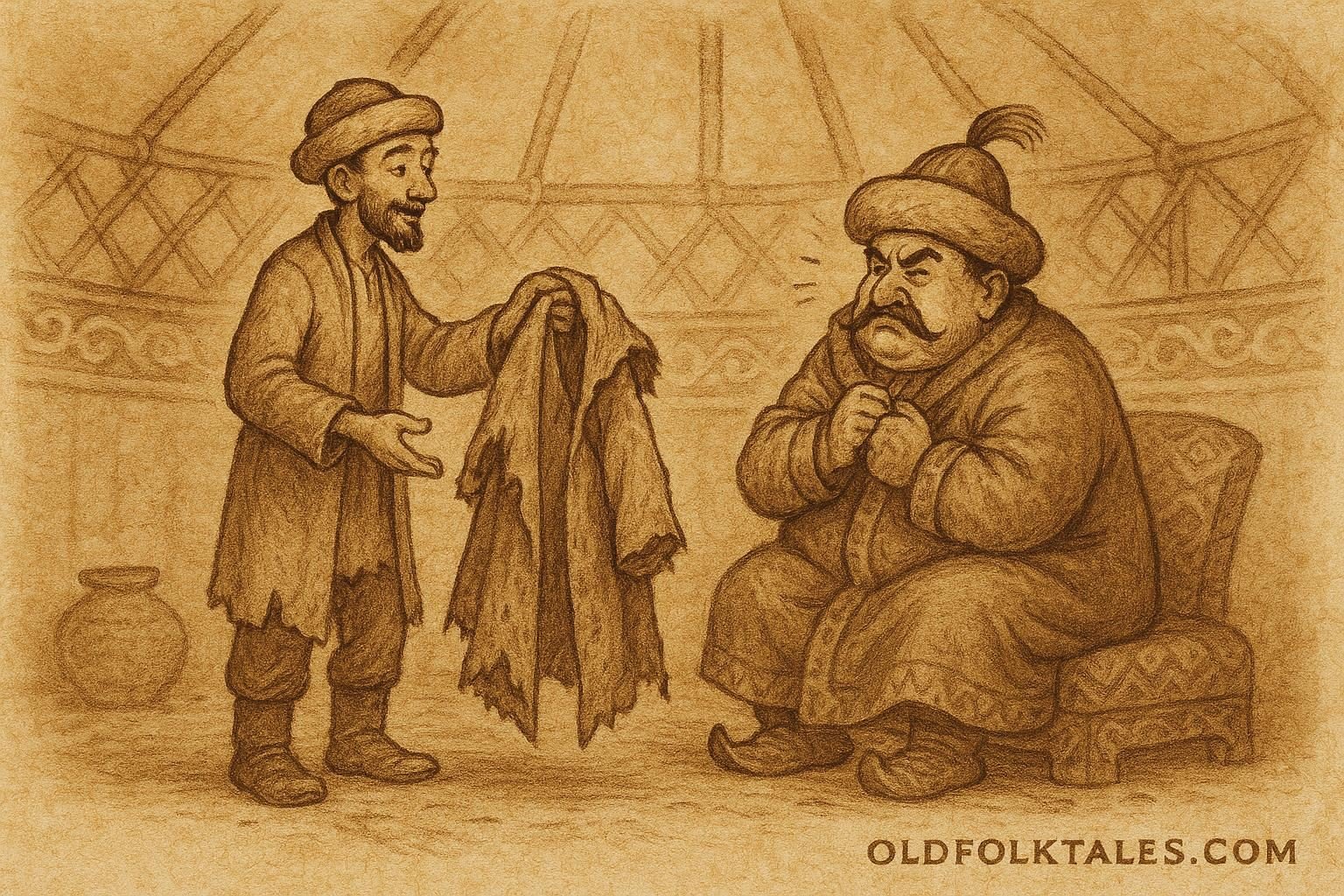
Aldar Köse held up a worn coat. “This coat can warm even the coldest heart.”
The bey frowned. “It is torn.”
“But it has magic,” Aldar Köse insisted. “It senses the true nature of men. If you put it on and feel warm, it means you are pure of heart. If you feel cold… well… you know what that means.”
The bey, eager to prove his “virtue,” threw the coat over his shoulders. A shiver ran instantly through him. Aldar Köse gasped theatrically.
“Oh no! It seems your heart is too cold for even magic to warm!”
The bey, embarrassed and furious, demanded, “What nonsense! Take your coat and go!”
Aldar Köse shrugged. “Very well. But word travels quickly. Some might say the bey’s heart is colder than winter.”
The bey, now terrified that his reputation for “virtue” would be ruined, thrust a bag of coins into Aldar Köse’s hands. “Take this,” he snapped, “and tell people nothing!”
Aldar Köse politely bowed again and left with the bey’s own money, which the bey gave willingly, all to protect a false reputation.
On another occasion, Aldar Köse met a greedy merchant traveling the steppe with a camel overloaded with goods. The merchant refused to lend or trade fairly with the poor, always taking advantage of their desperation.
Aldar Köse approached him with a bright smile.
“Friend, I hear you are a master of bargains.”
The merchant smirked. “Only the best.”
“Well,” Aldar Köse said, “I have a rare item. A talking camel.”
“A talking camel?” the merchant scoffed, yet greed glinted in his eyes.
“Indeed,” Aldar Köse replied. “I will sell it to you for a fair price… only twenty coins.”
The merchant laughed. “A talking camel for twenty coins? Impossible!”
Aldar Köse shrugged. “Suit yourself.”
But as he turned to leave, he whispered something into the camel’s ear. The camel let out a loud, unusual bray, almost like a word. The merchant’s jaw dropped.
“It speaks!” he cried.
“For twenty coins,” Aldar Köse reminded him.
The merchant paid immediately.
Aldar Köse waved happily and walked away, calling over his shoulder: “It will talk whenever it has something worth saying.”
Only later did the merchant realize that camels, being camels, had nothing to say at all.
Through such encounters, Aldar Köse became a quiet protector of the poor. He did not fight with force or wealth, but with intelligence. Whenever greedy men tried to exploit the vulnerable, Aldar Köse found a way, through humor, riddles, or playful deception, to expose their selfishness and restore balance.
And so his legend grew. Around campfires, families told of how Aldar Köse lightened the burdens of the poor, humbled the arrogant, and proved again and again that wit is sometimes the sharpest of all weapons. Though he owned little, he gave much: laughter, justice, and hope.
Moral Lesson
Aldar Köse teaches that intelligence and humor can defeat greed and tyranny. True strength lies not in wealth or power but in wisdom, honesty, and the courage to stand against injustice.
Knowledge Check
1. Who is Aldar Köse in Kazakh folklore?
Aldar Köse is a witty Kazakh trickster known for outsmarting greedy rulers and merchants to help ordinary people.
2. What is the main theme of the Aldar Köse folktale?
The story focuses on justice, where cleverness triumphs over greed and dishonesty.
3. Why does Aldar Köse trick the bey and the merchant?
He exposes their selfishness and protects the poor from exploitation, reflecting Kazakh cultural values.
4. What cultural values are highlighted in this Kazakh folktale?
Humility, fairness, social justice, and wisdom over wealth are central themes.
5. What genre does the Aldar Köse story belong to?
It belongs to the Central Asian trickster-hero cycle within Kazakh folklore.
6. What does Aldar Köse symbolize in Kazakhstan?
He symbolizes courage, wit, and resistance against corruption and oppression.
Source: Kazakh oral tradition; widely collected in 19th–20th century folklore archives.
Cultural Origin: Kazakhstan (Kazakh folklore)