
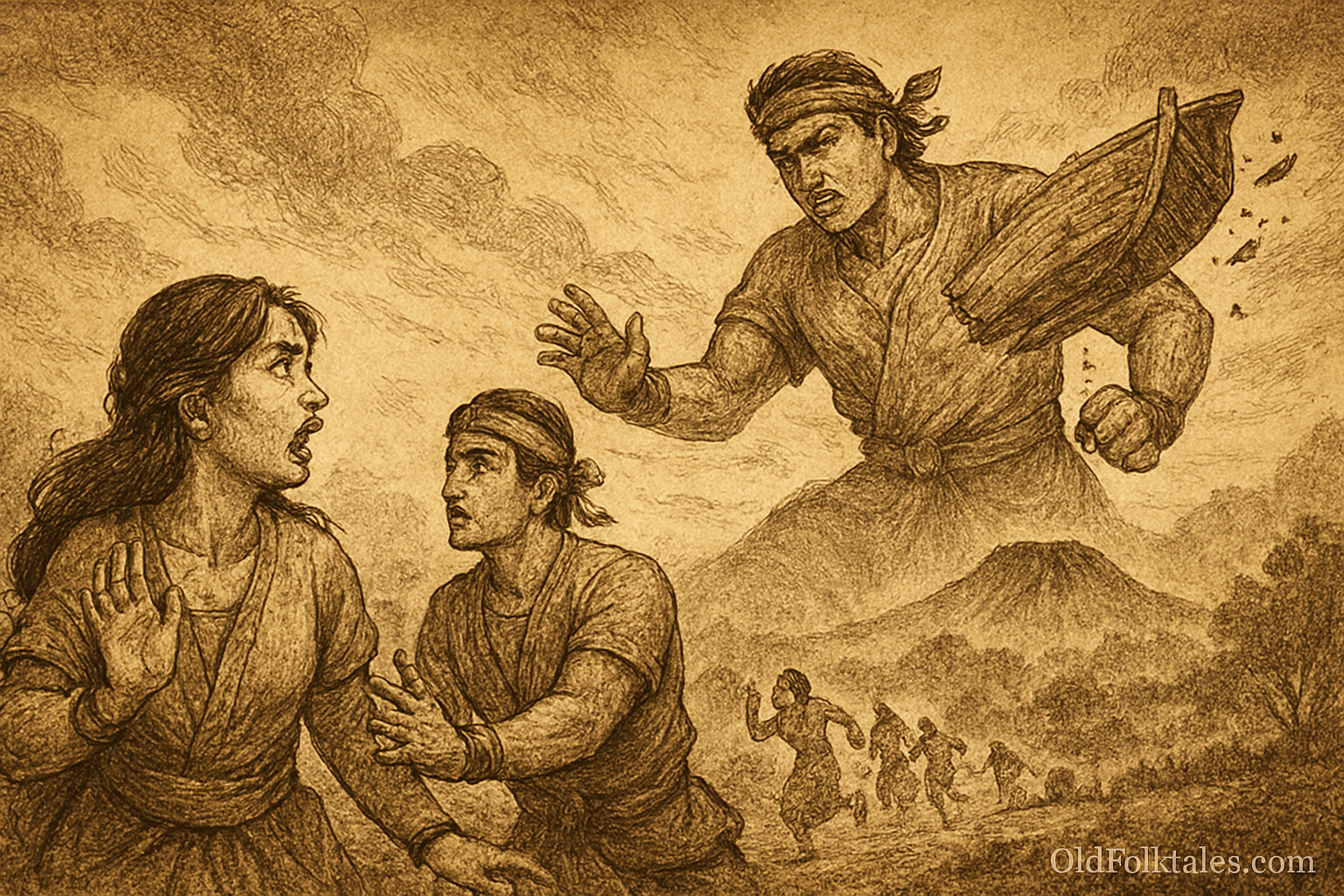
In the lush highlands of West Java, where mist clings to volcanic peaks and rice terraces cascade down hillsides like green staircases, there stands a mountain with an unusual shape. Mount Tangkuban Perahu looks exactly like an overturned boat, its ridges forming the outline of a hull pointing toward the sky. The local Sundanese people have known for generations that this is no accident of geology, but rather the remnant of a tragic story about forbidden love, impossible tasks, and a mother’s desperate deception.
Long ago, in a village nestled among these same hills, there lived a woman of such extraordinary beauty that she seemed touched by divine grace. Her name was Dayang Sumbi, and she was known not only for her lovely face but also for her skill at weaving. She could create cloth so fine and patterns so intricate that nobles from distant kingdoms sought her work. She lived simply with her faithful dog, Tumang, a creature with intelligent eyes and unusual devotion who seemed almost human in his understanding.
Click to read all East Asian Folktales — including beloved stories from China, Japan, Korea, and Mongolia.
One day, while working at her loom, Dayang Sumbi dropped her weaving shuttle. It rolled across the floor and disappeared into the corner of her house. She was in the middle of a complex pattern and did not want to interrupt her rhythm, so she called out playfully, “Whoever returns my shuttle to me, if it is a woman, I will make her my sister. If it is a man, I will make him my husband!”
It was Tumang who retrieved the shuttle, carrying it gently in his mouth and placing it at her feet. Dayang Sumbi laughed at first, thinking nothing of her careless vow. But the words had been spoken, and in the world where spirits and humans intertwined, oaths carried weight beyond human intention. That very night, Tumang transformed into a handsome man and came to Dayang Sumbi. She was startled but recognized something in his eyes, something familiar and devoted. Bound by her promise and moved by something she could not name, she accepted him.
From this supernatural union, Dayang Sumbi conceived and bore a son. She named him Sangkuriang. The boy grew strong and handsome, inheriting his mother’s beauty and an otherworldly quality from his father. Tumang returned to his dog form after that single night, remaining as Dayang Sumbi’s faithful companion, and only she knew the truth of Sangkuriang’s parentage.
Sangkuriang grew into a spirited young man who loved to hunt in the forests surrounding their village. Tumang always accompanied him on these expeditions, and the boy never suspected that his hunting companion was actually his father. The dog seemed to understand everything, often guiding Sangkuriang away from danger, leading him to game, protecting him as any father would protect his son.
One day, Sangkuriang returned from hunting empty-handed and frustrated. His mother had requested deer meat, but hours in the forest had yielded nothing. As the sun began to set and his frustration mounted, Sangkuriang looked at Tumang and made a terrible decision. In his anger and shame at failing his mother’s request, he took his bow and shot the faithful dog. He brought Tumang’s body home and prepared it as if it were deer meat, serving it to his mother.
Dayang Sumbi knew immediately what she was being served. A mother recognizes the truth in ways that transcend explanation. When she realized that her son had killed his own father, grief and rage overwhelmed her. She struck Sangkuriang across the head with a rice ladle, leaving a permanent scar on his forehead. Then, overcome with sorrow and unable to bear looking at him, she banished Sangkuriang from the village, sending him away into the world with nothing but the clothes on his back and the scar that marked his terrible deed.
Sangkuriang wandered for years, traveling across Java and beyond, learning skills and gathering knowledge. He trained in martial arts, studied with wise teachers, worked as a craftsman and a warrior. The years flowed by like water, and he grew from a boy into a powerful and accomplished man. But he never forgot his home in the highlands, and eventually, his feet carried him back toward the village of his birth.
What Sangkuriang did not know was that Dayang Sumbi had been granted an unusual blessing by the gods. In recognition of her suffering and her piety, she had been given the gift of eternal youth. While decades had passed and Sangkuriang had aged from boy to man, Dayang Sumbi remained exactly as she had been on the day she sent him away, still appearing to be a young woman in the prime of life.
When Sangkuriang returned to his home village, he did not recognize it at first. Everything seemed smaller, more familiar in feeling than in appearance. And then he saw her, a beautiful woman standing near the house that stirred some deep memory within him. Dayang Sumbi’s heart nearly stopped when she saw the young man approaching. He looked so much like his father, so much like the supernatural being who had come to her that night long ago. But it was the scar on his forehead that confirmed her worst fear. This handsome stranger who looked at her with such obvious admiration was her own son.
Sangkuriang had no idea. To him, she was simply the most beautiful woman he had ever seen, and something about her presence felt like coming home. He courted her with all the skill and charm he had acquired during his years of wandering. He brought her gifts, spoke to her with poetry, demonstrated his strength and abilities. And Dayang Sumbi, trapped in this nightmare, found herself the object of her own son’s romantic attention.
She tried to discourage him gently at first, suggesting she was too old for him, that he should seek a younger bride. But he insisted she looked youthful and perfect. She tried to send him away, but he persisted. Finally, Sangkuriang asked for her hand in marriage, and Dayang Sumbi knew she had to act decisively to prevent this catastrophic union.
She agreed to marry him, but only if he could complete an impossible task. “Build me a lake and a grand boat large enough to sail upon it,” she said. “And you must complete both before the sun rises tomorrow. If you succeed, I will be your wife. If you fail, you must leave and never return.”
Sangkuriang agreed immediately, confident in his supernatural strength and the skills he had learned over the years. He possessed knowledge of magic and could command spirits to aid him. As night fell, he began his work with terrifying efficiency.
He called upon the spirits of the forest and mountain to help him. Trees were uprooted and transformed. The earth was moved by supernatural force. A vast lake began to form in the valley, filling with water from springs Sangkuriang opened with his power. Simultaneously, he began constructing an enormous boat, working with speed that no ordinary human could match. His hands moved in a blur, his voice chanted spells that made the wood shape itself, and the spirits he commanded carried out his will.
Dayang Sumbi watched in growing horror from her house as the impossible task neared completion. The night was still dark, but the lake was nearly full, and the boat was taking magnificent form. If dawn came and found the task complete, she would have no choice but to marry her own son. The thought filled her with desperation.
She called upon the village women to help her. Together, they built fires on the eastern hills and began pounding rice with their mortars, creating the sounds of morning activity. They unfurled red cloth to mimic the colors of dawn. They made the sounds of roosters crowing. They created an illusion of sunrise while the night was still deep.
The spirits helping Sangkuriang saw the false dawn and fled, believing their time was over. Sangkuriang himself looked up from his nearly completed work and saw the red glow on the eastern hills, heard the sounds of morning, and realized he had been deceived. The boat was not quite finished. The lake was not quite full. He had failed.
Rage consumed him, rage at the deception, rage at the impossible task, rage at losing the woman he loved. In his fury, Sangkuriang kicked the unfinished boat with all his supernatural strength. The massive vessel flew through the air, tumbling end over end, before crashing down upside-down on the earth. Where it landed, it became stone and earth, forming a mountain in the shape of an overturned boat.
Sangkuriang fled into the wilderness, his heart broken, never knowing that the woman he had loved was the mother who had sent him away so many years before. Dayang Sumbi remained in her village, living with the weight of secrets and sorrows that no mortal should have to bear. The lake Sangkuriang had created remained, and the overturned boat became Mount Tangkuban Perahu, which in Sundanese means “upturned boat.”
To this day, visitors to West Java can see the mountain that looks exactly like an overturned vessel. The lake, though changed over centuries, still exists in altered form. And the Sundanese people tell this story to explain not just the landscape, but the importance of knowing one’s family, the dangers of broken relationships, and the tragic consequences when the natural order of things is disrupted.
Click to read all Southeast Asian Folktales — featuring legends from Thailand, Indonesia, Vietnam, and the Philippines.
The Moral Lesson
The legend of Sangkuriang teaches us profound lessons about the devastating consequences of broken family bonds and the importance of maintaining proper relationships. Sangkuriang’s initial crime, killing his father Tumang out of frustration and serving him as food, set in motion a cascade of tragedy that spanned decades. His mother’s violent reaction, while understandable, created a rupture that left her son without knowledge of his own identity. The story illustrates how unresolved family trauma can echo through time, creating situations where the natural order is threatened. Dayang Sumbi’s desperate deception to prevent the incestuous marriage was necessary, yet it too involved trickery that led to more violence and sorrow. This Sundanese legend reminds us that family relationships require respect, honesty, and proper boundaries.
Knowledge Check
Q1: Who was Dayang Sumbi and how did she become Sangkuriang’s mother?
A1: Dayang Sumbi was a beautiful and skilled weaver living in the highlands of West Java. She became Sangkuriang’s mother through an unusual circumstance. After carelessly vowing that whoever returned her dropped shuttle would become her sister (if female) or husband (if male), her faithful dog Tumang retrieved it. Bound by her oath, and after Tumang transformed into a handsome man for one night, she conceived Sangkuriang through this supernatural union. Tumang then returned to his dog form and remained as her companion, with only Dayang Sumbi knowing the truth of her son’s parentage.
Q2: What terrible act did Sangkuriang commit that led to his banishment?
A2: After returning empty-handed from hunting when his mother had requested deer meat, Sangkuriang became frustrated and angry. In his shame at failing his mother’s request, he shot and killed Tumang, his faithful dog companion who was actually his father, though he did not know this. He then prepared Tumang’s body as if it were deer meat and served it to his mother. When Dayang Sumbi realized she had been served her son’s father, she was overcome with grief and rage, struck Sangkuriang with a rice ladle (leaving a scar on his forehead), and banished him from the village.
Q3: Why didn’t Sangkuriang recognize his own mother when he returned years later?
A3: Sangkuriang did not recognize Dayang Sumbi because the gods had granted her the gift of eternal youth in recognition of her suffering and piety. While decades had passed and Sangkuriang had aged from a boy into a grown man, Dayang Sumbi remained exactly as she had been on the day she banished him, still appearing to be a young woman in the prime of life. To Sangkuriang, she simply appeared to be a beautiful woman, not the mother he had left behind so many years before.
Q4: What impossible tasks did Dayang Sumbi demand from Sangkuriang?
A4: When Sangkuriang asked to marry her, Dayang Sumbi knew she had to prevent this catastrophic union with her own son. She agreed to marry him only if he could complete an impossible task before sunrise the next morning: build a massive lake and construct a grand boat large enough to sail upon it, both in a single night. She believed this task was truly impossible and would force Sangkuriang to leave. However, using his supernatural strength, magical knowledge, and command over spirits, Sangkuriang nearly succeeded in completing both the lake and the boat before dawn.
Q5: How did Dayang Sumbi prevent Sangkuriang from completing his tasks?
A5: When Dayang Sumbi saw that Sangkuriang was nearly completing the impossible tasks before dawn, she devised a desperate deception. She called upon village women to help create an illusion of sunrise while night was still deep. They built fires on the eastern hills, unfurled red cloth to mimic dawn colors, pounded rice mortars to create morning activity sounds, and made rooster crowing noises. The spirits helping Sangkuriang believed morning had come and fled. Sangkuriang himself saw the false dawn and realized he had been deceived, failing to complete the tasks just before actual sunrise.
Q6: How did Mount Tangkuban Perahu get its distinctive shape according to the legend?
A6: Mount Tangkuban Perahu, which means “upturned boat” in Sundanese, got its distinctive boat-like shape from Sangkuriang’s rage after discovering Dayang Sumbi’s deception. When he realized he had failed to complete the tasks due to the false dawn, fury consumed him. In his anger, he kicked the nearly completed boat with all his supernatural strength. The massive vessel flew through the air, tumbling end over end, before crashing down upside-down and becoming stone and earth, forming the mountain that looks exactly like an overturned boat. This explains why the mountain’s ridges form the outline of a hull pointing toward the sky.
Source: Adapted from H. Danadibrata’s Kamus Basa Sunda and Sundanese cultural references documenting West Java folklore.
Cultural Origin: Indonesia, specifically the Sundanese people of West Java.








