Deep within the shadowed forests of Batangas and Bicol, where the trees grew so thick that sunlight barely kissed the forest floor, there lived a creature of frightening appearance and peculiar nature. His name was Bungisngis, and he was unlike any being the farmers and villagers had ever encountered.
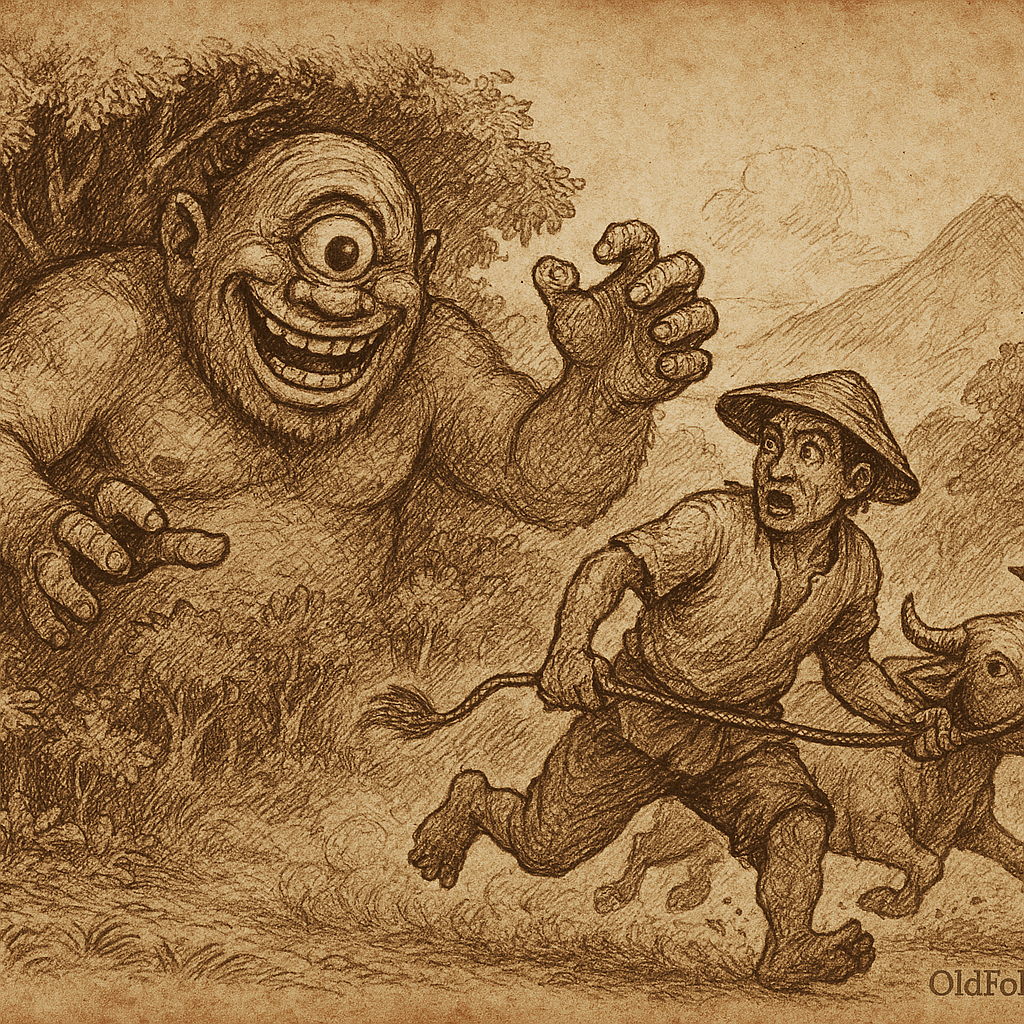
Bungisngis was a giant of tremendous size, his body as broad as three carabaos standing side by side, and his arms thick as ancient tree trunks. But it was his face that struck fear and bewilderment into the hearts of those who glimpsed him through the jungle undergrowth. Set in the center of his massive forehead was a single, enormous eye that could spot a field mouse from across a clearing. And stretched across his face, from one ear to the other, was a permanent grin a wide, toothy smile that never faded, whether he was pleased or angry, hungry or content.
Click to read all East Asian Folktales — including beloved stories from China, Japan, Korea, and Mongolia.
The villagers whispered stories about Bungisngis around their cooking fires at night. Some said his laughter echoed through the mountains like rolling thunder. Others claimed his single eye could see in complete darkness. But one thing everyone agreed upon: despite his monstrous appearance and terrible strength, Bungisngis was not blessed with cleverness. His mind was as simple as a child’s, easily confused and even more easily fooled.
One morning, as the mist still clung to the rice paddies like gossamer cloth, a farmer named Mang Pedro drove his cow along the forest path toward his fields. The cow was his most precious possession, strong and healthy, with a coat the color of rich earth after rain. As they walked, Mang Pedro sang quietly to himself, completely unaware that a single enormous eye was watching him from behind a cluster of banana trees.
Bungisngis had been hungry for days, and the sight of the fat cow made his mouth water beneath his endless grin. With surprising stealth for such a massive creature, he stepped out onto the path, blocking it completely with his towering form. His shadow fell across Mang Pedro like nightfall at noon.
“That cow is mine now, little man!” Bungisngis declared, his voice booming through the trees and sending birds scattering into the sky. “And perhaps I’ll take you as well for my cooking pot!”
But Mang Pedro, though his heart hammered against his ribs like a trapped bird, kept his wits about him. He had heard the stories of Bungisngis and his foolishness, and he knew that a quick mind could defeat even the strongest body.
“Oh mighty Bungisngis!” Mang Pedro said, bowing low. “Before you take us, would you like to see an amazing trick? This cow can speak and tell fortunes, but she’s very shy. She’ll only do it if you cover your eye and count to fifty.”
The giant’s permanent smile somehow seemed to widen with delight. “A talking cow? Count to fifty, you say?” He loved games and tricks, even when they were played upon him. Eagerly, Bungisngis pressed both massive hands over his single eye and began to count in his thunderous voice: “One… two… three…”
Quick as lightning, Mang Pedro led his cow off the path and into the thick brush. They scrambled through thorny vines and ducked under low branches, the sounds of their escape masked by the giant’s loud counting. By the time Bungisngis reached fifty and uncovered his eye, farmer and cow had vanished completely.
The giant roared with frustration, a sound that shook leaves from the trees. He crashed through the forest, his enormous feet leaving craters in the soft earth, following what he believed was the farmer’s trail. But in his rage and haste, he failed to notice that he was chasing mere shadows cast by swaying branches and dancing leaves.
Day after day, the pattern repeated. Bungisngis would spot Mang Pedro or another villager, and his simple mind would fall for yet another trick. Once, he was convinced to carry a “magical rock” that would reveal hidden treasures it was merely a boulder that grew heavier with each step, causing him to trip and tumble down a hillside. Another time, he was told to catch his own reflection in a stream, and he spent hours splashing and grasping at the water until he collapsed in exhaustion.
The final trick proved to be Bungisngis’s undoing. Convinced that a great feast awaited him on the other side of a deep ravine, the giant ran at full speed toward what he believed was the smell of roasting meat. In truth, it was only smoke from a farmer’s fire carried on the wind. So focused was he on his imagined prize that he failed to see the ground disappear beneath his feet.
With a tremendous crash that echoed through the mountains and valleys, Bungisngis tumbled into the ravine. His roar of surprise turned into a long, fading wail as he fell. The villagers, hearing the sound, came to the edge and peered down. Far below, they could see the giant, bruised and battered, climbing slowly out of the rocky gorge, his permanent grin now looking decidedly foolish.
From that day forward, Bungisngis was more cautious, though no wiser. He remained in the deep forest, occasionally glimpsed by travelers, his single eye watching from a safer distance. And the farmers and villagers returned to their work, grateful that cleverness and quick thinking had protected them from brute strength.
The forest returned to its peaceful rhythms, and though Bungisngis still wandered its shadowed paths, he never again threatened the villages. His laughter still echoed sometimes through the trees but now it sounded less menacing and more like the chuckle of someone who had finally learned, albeit the hard way, to think before he leaped.
Click to read all Southeast Asian Folktales — featuring legends from Thailand, Indonesia, Vietnam, and the Philippines.
The Moral Lesson
The legend of Bungisngis teaches us that physical strength and imposing appearance mean nothing without intelligence and wisdom. Brute force can be easily overcome by wit, patience, and clever thinking. The story reminds us that true power lies not in our muscles or our size, but in our ability to think clearly, plan carefully, and use our minds to solve problems. It also warns against acting rashly without considering consequences as Bungisngis learned through his painful fall into the ravine.
Knowledge Check
Q1: Who is Bungisngis in Filipino folklore and what makes him unique?
A: Bungisngis is a giant from Bicol and Batangas folklore who has a single eye in the center of his forehead and a permanent grin that never leaves his face. Despite his monstrous appearance and tremendous strength, he is known for being comically foolish and easily tricked.
Q2: How did Mang Pedro escape from Bungisngis the first time?
A: Mang Pedro tricked Bungisngis by telling him that his cow could speak and tell fortunes, but would only do so if the giant covered his eye and counted to fifty. While Bungisngis counted with his eye covered, Mang Pedro and his cow escaped into the forest.
Q3: What does Bungisngis’s single eye symbolize in the legend?
A: Bungisngis’s single eye symbolizes limited perspective and narrow vision, representing how someone can be physically powerful yet lack the wisdom to see the full picture or understand when they are being deceived.
Q4: What caused Bungisngis to fall into the ravine?
A: Bungisngis fell into the ravine because he ran at full speed while chasing what he believed was the smell of a great feast, without looking where he was going. He was actually following smoke from a farmer’s fire carried on the wind, demonstrating his foolishness and lack of caution.
Q5: What is the cultural significance of Bungisngis in Philippine mythology?
A: Bungisngis represents the Filipino value placed on intelligence and wit over brute strength. The creature serves as a cautionary figure in Bicol folklore, teaching communities that physical power without wisdom leads to defeat, and that clever thinking can overcome seemingly impossible challenges.
Q6: Where does the legend of Bungisngis originate in the Philippines?
A: The legend of Bungisngis originates from the Bicol region and Batangas province in the Philippines. The creature is said to dwell in the dense forests of these areas, making him a prominent figure in the folklore of southern Luzon.
Source: Adapted from Philippine Folk Literature: The Myths by Damiana L. Eugenio
Cultural Origin: Bicol Region and Batangas Province, Philippines