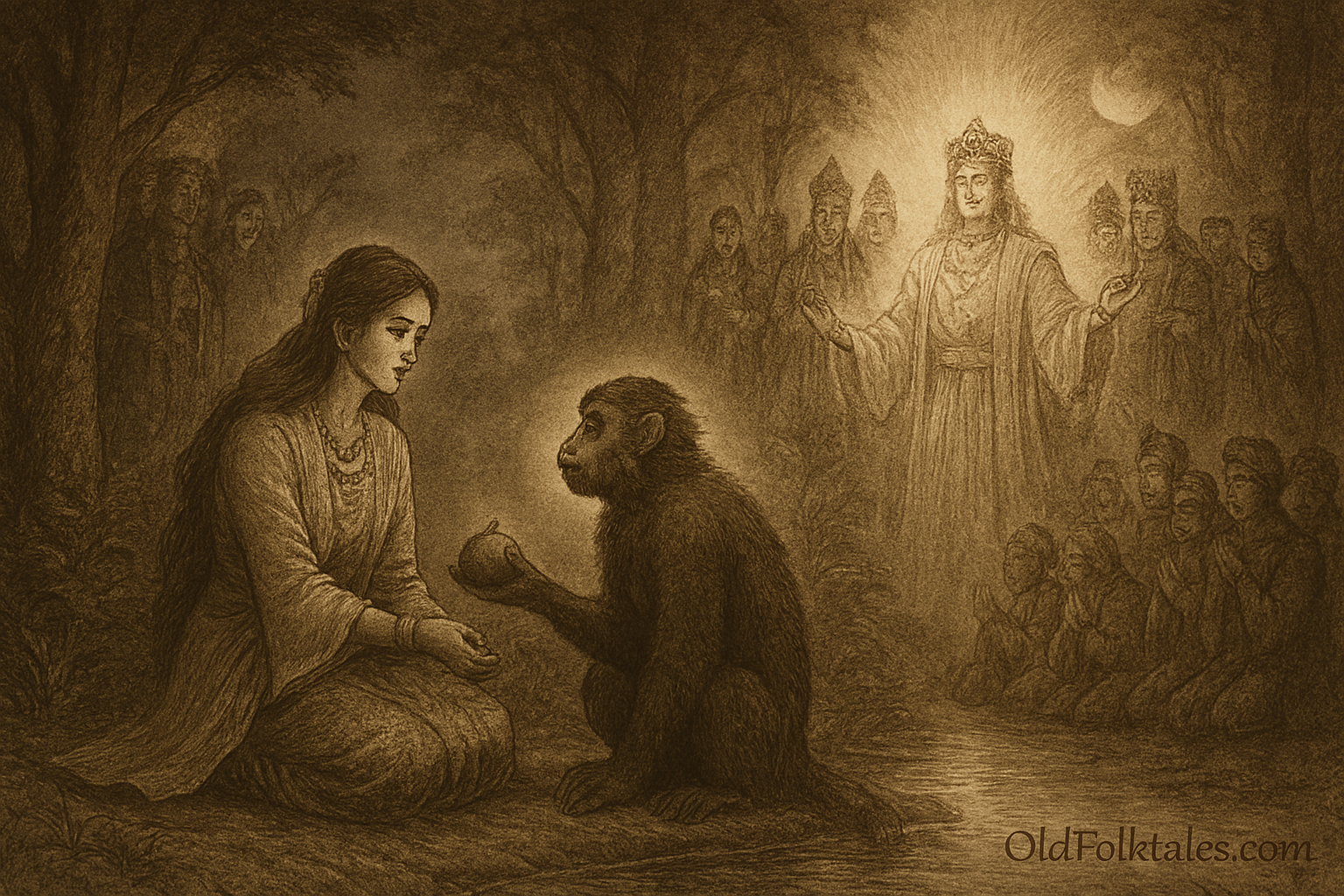
In the ancient kingdom of Pasir Batang, where the mountains touched the clouds and the rivers sang songs of old wisdom, there lived a king who ruled with justice and compassion. He had seven daughters, each more beautiful than the last, but none possessed a heart as pure as his youngest, Princess Purbasari. Her kindness flowed like clear spring water, her words carried the gentleness of morning dew, and her smile could ease the heaviest of hearts.
But beauty and goodness often breed envy, and Purbasari’s eldest sister, Princess Purbararang, harbored a darkness in her soul. Purbararang was proud and vain, her beauty celebrated throughout the land, yet it was never enough. She craved not just admiration but absolute supremacy, and the thought that her youngest sister might be more beloved than she festered like a wound that would not heal.
Click to read all East Asian Folktales — including beloved stories from China, Japan, Korea, and Mongolia.
When their father, the aging king, announced that Purbasari would inherit the throne (for he saw in her the wisdom and compassion needed to rule), Purbararang’s jealousy transformed into venomous rage. Under the cover of night, she consulted with a dark witch who dwelt in the shadow of the volcano, trading gold and promises for a terrible curse.
The next morning, when Purbasari awoke, her smooth skin had transformed. Black spots covered her body like shadows cast by storm clouds, and a terrible illness seemed to have seized her limbs. The court gasped in horror. Purbararang, feigning concern while her eyes glittered with triumph, declared that such affliction was surely a sign of divine displeasure. She convinced the court that Purbasari must be banished to the wilderness until the gods showed mercy.
And so, with a heart heavy as stone but still unbroken, Princess Purbasari was led deep into the forest and left alone. The towering trees blocked out the sun, and the calls of unknown creatures echoed through the darkness. She wept, not for her lost throne or her stolen beauty, but for the injustice that had befallen her father’s kingdom.
Days turned to weeks, and Purbasari learned to survive in the wild. She drank from clear streams, ate fruits that grew wild on vines, and found shelter in the hollow of an ancient tree. Despite her suffering, her heart remained pure, and she spoke kindly even to the birds and insects that kept her company.
It was during one of her loneliest moments, as she sat by a moonlit stream singing a sad melody, that she first heard the rustling in the branches above. A langur monkey appeared, no ordinary creature, but one with eyes that seemed to hold the wisdom of ages. His fur was dark as midnight, and he moved with an unusual grace and dignity. This was Lutung Kasarung.
The langur did not flee or chatter mindlessly as other monkeys did. Instead, he approached Purbasari with reverence, as though recognizing something sacred in her presence. From that day forward, Lutung Kasarung became her constant companion and protector. He brought her the sweetest fruits from the highest branches, showed her which plants could heal, and stood guard while she slept.
But Lutung Kasarung was no ordinary monkey. He was, in truth, a heavenly prince named Guru Minda, cursed by the gods to live in animal form until he could find a soul of absolute purity who would accept him without judgment. In Purbasari, he had found that soul.
As the seasons changed, Lutung Kasarung used his divine powers to help Purbasari. With his supernatural abilities, he caused the spots on her skin to fade like morning mist under the sun. Her beauty returned, but now it was enhanced by the strength she had gained through suffering. Her eyes held deeper wisdom, and her spirit shone with unshakeable grace.
Meanwhile, in the palace, Purbararang had crowned herself queen, ruling with cruelty and vanity. But whispers reached her ears, whispers of a woman in the forest whose beauty surpassed even the stars, attended by a miraculous creature. Fear gripped her heart, and she journeyed with her courtiers to see for herself.
When Purbararang arrived at the forest clearing where Purbasari dwelt, she found her sister transformed, radiant with an inner light that no curse could dim. Rage and disbelief warred in Purbararang’s face. She challenged Purbasari, claiming she could not possibly be fit to rule without proving herself.
“Let us see whose companion is truly noble,” Purbararang declared, gesturing to her own betrothed, a proud prince who stood at her side.
But then Lutung Kasarung stepped forward, and before the gathered crowd, a transformation began. Divine light surrounded the langur, growing brighter and brighter until all had to shield their eyes. When the light faded, standing where the monkey had been was a prince of extraordinary beauty and majesty, Guru Minda in his true form, dressed in celestial robes that shimmered like starlight.
The crowd fell to their knees. Even Purbararang trembled, her schemes and cruelty laid bare before divine justice. Guru Minda spoke with a voice like rolling thunder softened by compassion, exposing every betrayal, every lie, every act of malice that Purbararang had committed.
The false queen’s power crumbled like sandcastles before the tide. The true nature of the curse was revealed, and Purbararang was banished from the kingdom, sent to live in exile where she might learn humility. The people rejoiced, for their true princess had returned.
Purbasari was crowned queen, and Guru Minda, having fulfilled his heavenly trial, asked for her hand in marriage. Their wedding was blessed by both earthly and celestial realms, a union of two pure souls who had each proven their worth through suffering and steadfast loyalty.
Under Purbasari’s rule, the kingdom flourished. She governed with the wisdom gained from hardship and the compassion that had never left her heart. And beside her always stood Guru Minda, no longer Lutung Kasarung, but forever grateful for the woman who had seen worth in him even when he wore the form of a humble monkey.
Click to read all Southeast Asian Folktales — featuring legends from Thailand, Indonesia, Vietnam, and the Philippines.
The Moral Lesson
The tale of Lutung Kasarung teaches us that purity of heart and unwavering goodness will ultimately triumph over jealousy and deceit. True nobility comes not from outward appearance or worldly power, but from the strength of one’s character and the compassion shown to all beings, regardless of their form. The story also reminds us that divine justice may be slow, but it is certain: those who act with cruelty will face consequences, while those who maintain their integrity through suffering will be rewarded. Finally, it teaches that we should never judge others by their appearance alone, for the greatest souls may be hidden in the humblest forms.
Knowledge Check
Q1: Who is Lutung Kasarung and what is his true identity?
A: Lutung Kasarung is a divine langur monkey who serves as Princess Purbasari’s companion in the wilderness. His true identity is Guru Minda, a heavenly prince who was cursed by the gods to live in animal form until he could find a soul of absolute purity who would accept him without judgment.
Q2: Why was Princess Purbasari banished from the kingdom?
A: Princess Purbasari was banished because her jealous eldest sister, Purbararang, cursed her with a dark witch’s magic. The curse caused black spots to appear all over Purbasari’s body, and Purbararang convinced the court that this affliction was a sign of divine displeasure, leading to Purbasari’s exile to the wilderness.
Q3: What qualities made Princess Purbasari worthy of Guru Minda’s help and love?
A: Princess Purbasari possessed a pure heart, unwavering kindness, and compassion that remained intact even through suffering and betrayal. She maintained her gentle spirit in exile, treating all creatures with respect and never allowing hardship to corrupt her goodness. These qualities of true nobility made her worthy of divine assistance.
Q4: How did Lutung Kasarung help Princess Purbasari during her exile?
A: Lutung Kasarung protected Purbasari in the wilderness by bringing her the finest fruits, showing her healing plants, and standing guard while she slept. Using his supernatural powers, he eventually healed the curse that had caused the spots on her skin, restoring her physical beauty while her inner strength had already grown through her trials.
Q5: What is the cultural significance of the Lutung Kasarung story in Sundanese tradition?
A: Lutung Kasarung is a foundational epic in Sundanese culture from West Java, Indonesia, teaching values central to Sundanese philosophy: the triumph of inner purity over outward appearances, the importance of humility and compassion, and the belief in divine justice. The story reinforces that true nobility comes from character rather than status or beauty.
Q6: What happened to Princess Purbararang at the end of the story?
A: Princess Purbararang’s treachery and cruelty were exposed when Guru Minda revealed his true form and disclosed all her evil deeds. Her false claim to the throne crumbled, and she was banished from the kingdom to live in exile, where she would have the opportunity to learn humility and reflect on her actions.
Source: Adapted from De Roman van Lutung Kasarung by C.M. Pleyte (Leiden Oriental Studies Collection, Dutch ethnographic records on Indonesian folklore).
Cultural Origin: Sundanese People, West Java, Indonesia