
In the days before Ko Gyi Kyaw became one of the nats, the spirit beings who dwell between the mortal world and the realm of the divine, he was simply a fisherman living along the winding waters of the Irrawaddy River. His name was known in every riverside village, though not always spoken with admiration. Ko Gyi Kyaw possessed a reputation for two things: his uncanny success at catching fish and his equally impressive talent for losing his earnings at the gambling dens that lined the waterfront.
The river in those times teemed with life. Silver fish flickered beneath the surface like living coins, and the waters flowed with the generous abundance that had fed generations of Myanmar’s people. Ko Gyi Kyaw knew every bend and eddy, every place where the fish gathered during the changing seasons. But unlike other fishermen who relied on skill, patience, and prayer, Ko Gyi Kyaw possessed something extraordinary: an enchanted drum.
Click to read all East Asian Folktales — including beloved stories from China, Japan, Korea, and Mongolia.
No one knew exactly where the drum had come from. Some whispered that he had found it floating in the river after a great storm, wrapped in lotus leaves and glowing faintly in the moonlight. Others claimed he had won it in a game of dice from a wandering monk who was not truly a monk at all but a forest spirit in disguise. Ko Gyi Kyaw himself would smile mysteriously when asked and say only that the drum had chosen him, not the other way around.
The drum itself was beautiful and strange. Its body was carved from dark wood that seemed almost black in shadow but revealed deep crimson tones in sunlight. Ancient symbols spiraled across its surface, characters from a language older than any the village scholars could read. The drumhead was made from the hide of some unknown creature, stretched taut and smooth as silk. When struck, it produced a sound unlike any ordinary drum: a low, resonant tone that seemed to travel not through the air but through the water itself, rippling outward in invisible waves.
This was the drum’s magic. When Ko Gyi Kyaw paddled his boat into the deep waters and beat the drum with clear eyes and steady hands, the fish would come. Not just a few, but schools of them, rising from the depths as if summoned by an irresistible call. They would swim directly into his nets, filling them until the ropes groaned with the weight. Other fishermen would labor all day and return with half-empty baskets, while Ko Gyi Kyaw would be home by midday with more fish than three families could eat.
But the drum’s magic came with a condition, one that Ko Gyi Kyaw learned through painful experience. The enchantment worked only when he approached it with respect and clarity. When his mind was unclouded, when his hands were steady and his intentions pure, the drum sang out and the river answered. But there was one thing that broke the spell entirely: drink. When Ko Gyi Kyaw consumed the strong rice wine that flowed freely in the gambling houses, when his eyes grew glazed and his words slurred, the drum fell silent. Or worse, it produced only discordant sounds that scattered the fish rather than summoning them.
For a time, Ko Gyi Kyaw maintained a careful balance. He would fish in the mornings when his head was clear, filling his boat with the river’s bounty. Then, with his earnings secured, he would spend his afternoons and evenings in the gambling dens, wagering on dice games and card tricks, matching wits and luck with merchants and travelers. Sometimes he won, sometimes he lost, but there was always tomorrow’s fishing to replenish his purse.
His fellow gamblers both envied and mocked him. They knew about his enchanted drum, and many had tried to discover its secrets or steal it outright. But the drum remained loyal to Ko Gyi Kyaw alone. When others tried to play it, it produced nothing but dull thuds, as lifeless as any ordinary instrument. This only increased Ko Gyi Kyaw’s pride, feeding the dangerous belief that he was somehow chosen, somehow special, somehow beyond the consequences that bound ordinary men.
It was this pride that led to his downfall.
One evening, deep in his cups and flush with gambling winnings, Ko Gyi Kyaw made a boastful wager. A wealthy merchant from downstream had challenged him, sneering that the drum’s magic was nothing but fisherman’s tales and sleight of hand. Stung by the insult and emboldened by wine, Ko Gyi Kyaw declared he would prove the drum’s power right then and there, in the middle of the night, drunk as he was. He bet everything he had won that night, a sum large enough to buy a new boat and feed his family for a year.
The other gamblers, sensing disaster or entertainment or both, followed him down to the riverside. The moon hung low and swollen in the sky, casting an eerie light across the water. Ko Gyi Kyaw stumbled into his boat, nearly capsizing it, and grabbed the enchanted drum. His companions on the shore called out warnings, urging him to wait until morning, but he was too far gone in drink and pride to listen.
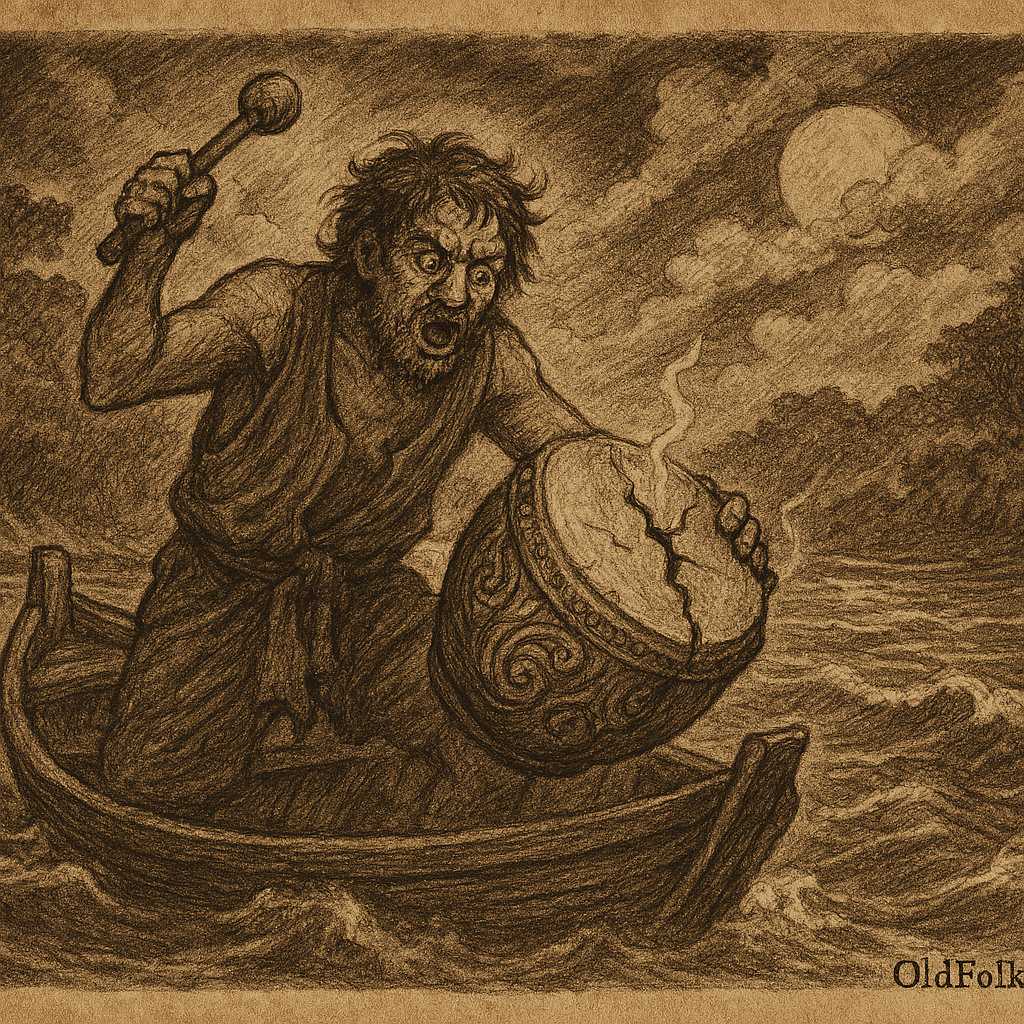
He struck the drum. But instead of the pure, resonant tone that called the fish, a harsh, discordant sound echoed across the water. He struck it again, harder, trying to force the magic to obey him. The drum responded with a sound like cracking thunder. Ko Gyi Kyaw, in his drunken fury, beat the drum again and again, demanding that it work, cursing it, cursing the river, cursing his own failing luck.
Then came the sound no one who heard it ever forgot: a sharp, terrible crack that split the night. A jagged line appeared down the center of the drumhead, spreading like lightning across its surface. The moment the drum broke, the river itself seemed to convulse. The water that had been calm moments before began to churn and roil. Waves rose up where there should have been none, rocking Ko Gyi Kyaw’s boat violently. The fish, instead of rising to be caught, fled into the deepest parts of the river, as if they could sense something had gone terribly wrong with the natural order.
Ko Gyi Kyaw tried desperately to paddle back to shore, but the river had turned against him. The current that had always been his friend now pulled at his boat with malicious strength. He managed to reach the bank, but only barely, arriving soaked and shivering, clutching the broken drum to his chest like a dead child. The wealthy merchant laughed cruelly and collected his winnings. The other gamblers drifted away, shaking their heads.
From that night forward, Ko Gyi Kyaw’s fortune abandoned him entirely. The drum, once cracked, would never sing again. Without its magic, he was just another fisherman, and not even a particularly skilled one. The section of river where he fished remained turbulent and unpredictable, as if his misuse of the drum had cursed it. His catches grew smaller and smaller. His debts mounted. His reputation, once that of a lucky man touched by magic, became that of a cautionary tale: the fool who had everything and threw it away for pride and drink.
Eventually, Ko Gyi Kyaw died as he had lived, in poverty and excess, his potential squandered through lack of discipline. But death was not the end of his story. The people remembered him, as they remember all those whose lives carry lessons too important to forget. In time, he became a nat, a spirit bound to the waters where he had once fished. Some say he still wanders the riverbanks at night, searching for the magic he lost, warning other fishermen against the twin demons of pride and intoxication. Others say his spirit dwells in the broken drum itself, trapped there as punishment, able to see abundance but never again able to call it forth.
Click to read all Southeast Asian Folktales — featuring legends from Thailand, Indonesia, Vietnam, and the Philippines.
The Moral Lesson
The tale of Ko Gyi Kyaw and his enchanted drum teaches that gifts and blessings require respect, discipline, and clear judgment to maintain. Natural talent or magical fortune means nothing if we lack the wisdom to use them properly. Ko Gyi Kyaw’s downfall came not from losing the drum but from believing he could master its power through force and pride while his mind was clouded by drink. This story reminds us that the greatest threats to our fortune often come not from external enemies but from our own lack of self-control and our refusal to honor the conditions that brought us success in the first place. True mastery requires humility, sobriety of mind, and the discipline to maintain the practices that earned us our blessings.
Knowledge Check
Q1: Who was Ko Gyi Kyaw in Myanmar folklore and what was he known for before becoming a nat?
A1: Ko Gyi Kyaw was a fisherman who lived along the Irrawaddy River in Myanmar and was known for two contrasting traits: his extraordinary success at catching fish using an enchanted drum and his problematic habits of gambling and drinking. Before his transformation into a nat (spirit being), he was a figure who possessed great fortune but lacked the discipline to maintain it, making him a cautionary character in Burmese folklore.
Q2: What was special about Ko Gyi Kyaw’s enchanted drum and how did it work?
A2: The enchanted drum was carved from dark wood with ancient symbols and produced a unique resonant tone that traveled through water rather than air. When Ko Gyi Kyaw played it with a clear mind and steady hands, it magically summoned schools of fish directly into his nets, ensuring abundant catches. However, the drum’s magic only worked when he was sober and approached it with respect; intoxication broke the enchantment entirely.
Q3: What condition had to be met for the drum’s magic to work in this Burmese legend?
A3: The drum’s magic required Ko Gyi Kyaw to be sober and clearheaded. When he played it with clarity, respect, and steady hands, the enchantment worked perfectly and fish would come in abundance. However, when he was intoxicated by rice wine, the drum either fell silent or produced discordant sounds that scattered fish instead of summoning them. This condition represented the need for discipline and mental clarity when wielding spiritual or magical power.
Q4: What led to Ko Gyi Kyaw’s downfall and the breaking of the enchanted drum?
A4: Ko Gyi Kyaw’s downfall came from pride and intoxication combined. After being challenged by a wealthy merchant who doubted the drum’s power, Ko Gyi Kyaw made a drunken wager to prove the drum’s magic in the middle of the night while heavily intoxicated. Despite the drum’s condition requiring sobriety, he tried to force it to work through sheer will. His violent, drunken beating of the drum caused it to crack, breaking the enchantment forever and turning the river turbulent against him.
Q5: What happened to the Irrawaddy River after the drum cracked in this Myanmar folktale?
A5: When Ko Gyi Kyaw’s drum cracked, the river itself seemed to respond to the violation of natural magic. The previously calm waters became turbulent and violent, with waves rising unnaturally and the current turning hostile. The fish that once answered the drum’s call fled to the deepest parts of the river. The section where Ko Gyi Kyaw fished remained unpredictable and difficult afterward, as if cursed by his misuse of the sacred instrument.
Q6: How does Ko Gyi Kyaw’s transformation into a nat reflect Burmese beliefs about spirits and moral lessons?
A6: Ko Gyi Kyaw’s transformation into a nat demonstrates the Burmese belief that spirits can be created from people whose lives carried important lessons or who died with unresolved business. Rather than being purely punitive, his existence as a nat serves an educational purpose, warning other fishermen against pride, gambling, and intoxication. This reflects the broader Myanmar cultural understanding that nats can be both cautionary figures and protective spirits, existing in the liminal space between human and divine to teach and guide the living.
Source: Adapted from fieldwork notes in The Indigenous Nats of Myanmar by Richard M. Cooler
Cultural Origin: Myanmar (Burma), Irrawaddy River region








