In the heart of Vietnam, where the ancient ruins of Tra Kieu stand as silent witnesses to kingdoms long fallen, there grows a banyan tree so old that no one remembers when it first took root. Its massive trunk splits into countless aerial roots that descend like pillars, creating a natural temple beneath its expansive canopy. The bark is weathered and scarred, bearing the marks of centuries of monsoons, wars, and the slow, patient passage of time. Local villagers say the tree has stood there since before their grandparents’ grandparents were born, and will stand there long after their own descendants have turned to dust.
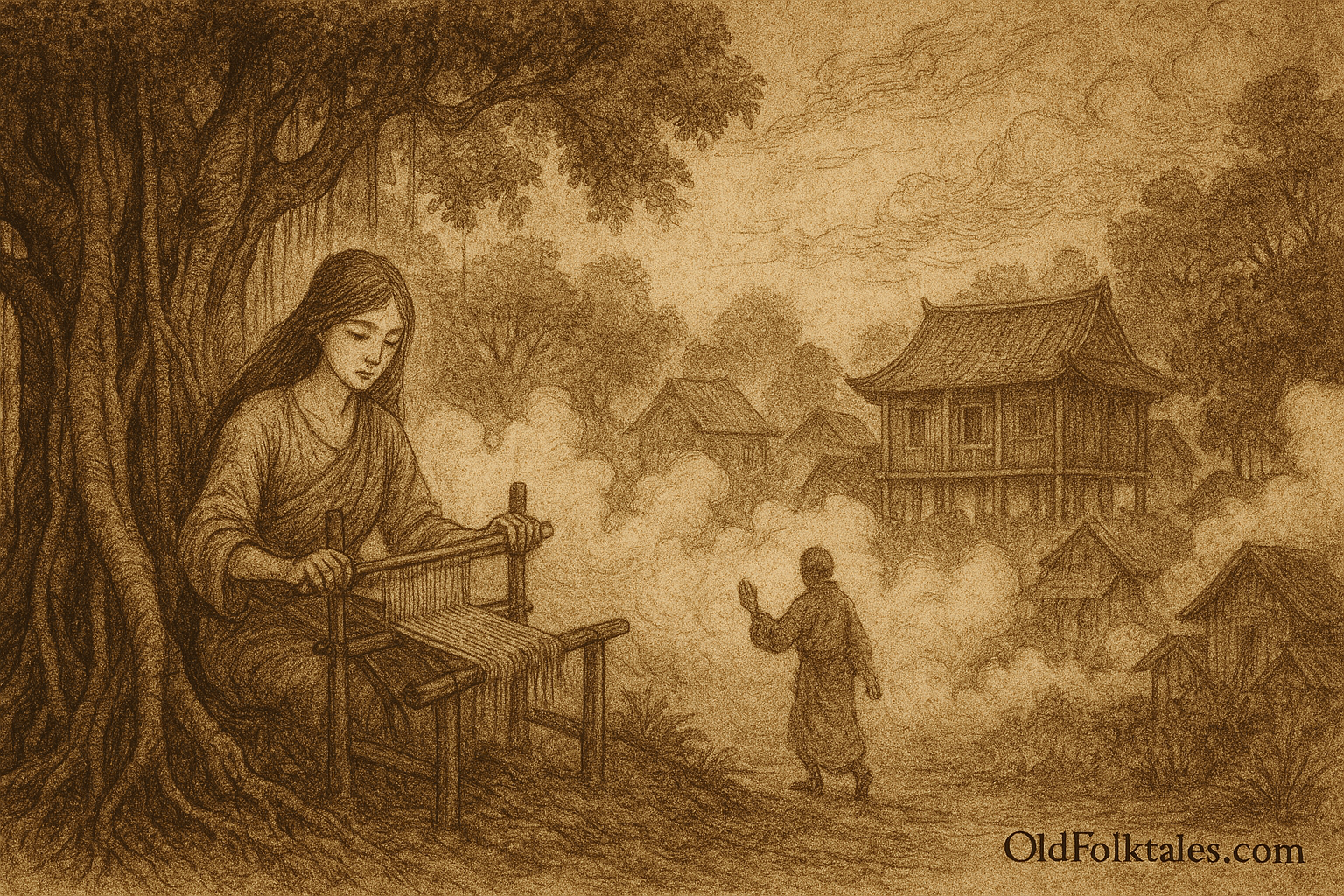
But the banyan tree of Tra Kieu is more than ancient timber and twisting roots. Within its hollow heart, where the wood has grown around emptiness to create a chamber hidden from casual eyes, dwells a spirit. She appears as a young woman, though her eyes hold the weight of ages. Her form is delicate, almost translucent in certain lights, and she is always seen engaged in the same timeless activity: weaving cloth on a loom that exists between the mortal world and the spirit realm.
Click to read all East Asian Folktales — including beloved stories from China, Japan, Korea, and Mongolia.
The villagers of Tra Kieu have known about the weaving woman for as long as stories have been told. Farmers passing the tree at dawn or dusk sometimes catch glimpses of her through gaps in the aerial roots, her hands moving rhythmically as the shuttle passes back and forth, creating patterns that seem to shift and change like water reflecting clouds. The sound of her loom, a soft clicking and whisper of thread, carries on the wind when the tree wishes to be heard. Most often, she remains hidden, content to weave her mysterious cloth in peace, a guardian spirit watching over the land and its people.
The cloth she weaves is said to be the fabric of fate itself, each thread representing a life, each pattern showing the connections between souls, each color marking joy or sorrow, peace or conflict. Those who have seen her work closely, in dreams or visions, report that she weaves with intense concentration, her face serene but her eyes constantly scanning the patterns, searching for disruptions, for threads that warn of danger to come.
It is this gift of foresight that makes the banyan spirit so precious to Tra Kieu. She does not merely weave and observe; she warns. When storms gather beyond the horizon, before any cloud appears in the sky, the sound of her loom grows urgent and loud. When disease threatens to sweep through the villages, she appears to healers in dreams, showing them the herbs they need to gather. When misfortune approaches in any form, the spirit finds ways to communicate, using the language of signs that the people have learned to read over generations.
But the greatest test of the banyan spirit’s protection came centuries ago, during a time of war and invasion. Foreign troops had been marching through the countryside, conquering villages, conscripting men, and claiming land for distant powers. The people of Tra Kieu heard reports of the approaching army, stories of brutality and destruction that preceded these soldiers like a dark wind. Fear gripped the villages. They were farmers and craftspeople, not warriors. They had no fortifications, no weapons to match those of trained soldiers, no way to resist the coming tide.
The villagers gathered near the ancient banyan tree, as their ancestors had always done in times of crisis. They brought offerings of rice, fruit, and flowers, laying them respectfully around the massive roots. They burned incense and prayed, asking the spirit for guidance, for protection, for any help she could provide. The air filled with fragrant smoke, and the evening sun cast long shadows through the banyan’s canopy.
Then she appeared, not hidden this time but standing clearly visible within the natural chamber formed by the tree’s roots. The weaving woman looked at the gathered villagers with eyes full of compassion and determination. She spoke no words, but her message was clear in the gesture she made: they should trust her and be ready to move quickly when the time came.
The foreign troops arrived the next morning, their armor glinting in the sun, their boots trampling the earth, their voices harsh with commands in a language the villagers did not understand. The soldiers expected an easy conquest, another village to add to their growing list of subjugated territories. They marched confidently toward Tra Kieu, their weapons ready, their formation precise.
But as they approached the outskirts of the village, something inexplicable occurred. The banyan spirit began to cry out, and her cries were unlike anything ever heard before. They were not loud in the way of human screaming, but they carried across dimensions, resonating in the space between earth and sky, between the seen and unseen worlds. The sound was haunting, mournful, and charged with ancient power.
In response to those spirit cries, the air itself began to change. A fog rose up from nowhere, thick and white as fresh milk, rolling across the landscape with supernatural speed. This was no ordinary mist that formed gradually from river water and cool air. This fog appeared instantly and completely, a wall of white that swallowed everything in its path. Within moments, the entire region around Tra Kieu disappeared into impenetrable whiteness.
The foreign soldiers found themselves blind, unable to see their own hands in front of their faces. Their formations broke apart as men lost sight of their commanders. Orders shouted into the fog were muffled and distorted, coming back as strange echoes that seemed to originate from multiple directions at once. Soldiers stumbled into each other, into trees, into ditches hidden by the white blanket. Some panicked, convinced they had marched into a spirit trap. Others tried to press forward but found themselves walking in circles, always returning to the same spot no matter which direction they chose.
While the foreign troops struggled in confusion and growing fear, the villagers of Tra Kieu moved with purpose and certainty. The spirit’s warning had prepared them, and now her protection gave them the precious gift of time. They could see through the fog, or perhaps they simply knew their land so well that sight was unnecessary. They gathered their children, their elderly, their essential belongings, and fled along paths that their feet knew by heart. They moved like water through the landscape, silent and swift, heading toward the hills and forests where they could hide until the danger passed.
By the time the fog finally lifted, hours later, the villagers had vanished. The foreign troops found only empty homes, cold cooking fires, and the massive banyan tree standing silent and ancient at the heart of the abandoned village. The soldiers, unnerved by the supernatural fog and finding no one to conquer or conscript, decided that this place was cursed and moved on, leaving Tra Kieu intact.
The villagers eventually returned to find their homes untouched, their fields unburned, their sacred tree still standing watch. They knew that the banyan spirit had saved them, that her cries had called forth the protective fog and given them the escape they needed. From that day forward, the tree was honored even more reverently, and the story of its protection was told and retold, each generation ensuring that the next would know to trust the weaving woman’s warnings.
Even now, in modern times, the ancient banyan of Tra Kieu stands near the old ruins, its roots deep in soil enriched by history. People still leave offerings at its base, still pay respect to the spirit who dwells within. Farmers still listen for the sound of her loom, knowing that when it grows urgent, they should prepare for storms. Villagers still teach their children that some trees are more than wood and leaves, that some spirits exist to protect, and that the boundary between the physical and spiritual worlds is thinner than most people believe, especially in places where ancient beings have chosen to make their home.
Click to read all Southeast Asian Folktales — featuring legends from Thailand, Indonesia, Vietnam, and the Philippines.
The Moral Lesson
The legend of the Banyan Spirit of Tra Kieu teaches that protection often comes from unexpected sources and that respecting the spiritual guardians of the land creates bonds that endure through generations. The villagers’ survival depended not on military might but on their relationship with the tree spirit, cultivated through centuries of reverence and offerings. This Vietnamese tale reminds us that paying attention to warnings from sources beyond ordinary perception can mean the difference between destruction and survival, and that communities thrive when they honor the sacred connections between the human and spirit worlds. True security comes not from walls and weapons alone but from maintaining right relationships with the forces, seen and unseen, that share our world.
Knowledge Check
Q1: What is the Banyan Tree of Tra Kieu and what makes it significant in Vietnamese folklore?
A1: The Banyan Tree of Tra Kieu is an ancient tree near the ruins of Tra Kieu in Vietnam, so old that no one remembers its beginning. Its significance lies in the spirit dwelling within its hollow heart, a young woman who appears to be weaving cloth on a loom. This tree spirit serves as a guardian and protector of the local villagers, warning them of approaching dangers such as storms, invasions, and disasters. The tree represents the Vietnamese belief in the spiritual significance of ancient natural landmarks and their role as mediators between the human and spirit worlds.
Q2: Who is the weaving woman spirit and what is she constantly doing inside the banyan tree?
A2: The weaving woman is the guardian spirit who dwells within the hollow heart of the ancient banyan tree. She appears as a young woman with eyes that hold the weight of ages, and she is perpetually engaged in weaving cloth on a loom that exists between worlds. The cloth she weaves is said to represent the fabric of fate itself, with each thread representing a life and each pattern showing connections between souls. Through her weaving, she monitors the future and can detect approaching dangers, allowing her to warn the villagers when threats approach.
Q3: How did the banyan spirit warn villagers of dangers in this Vietnamese legend?
A3: The banyan spirit warned villagers through various signs and manifestations. The sound of her loom would grow urgent and loud when storms approached before any clouds appeared. She would appear to healers in dreams showing them needed herbs when disease threatened. The villagers learned to read these signs over generations, developing a language of communication with the spirit. Her warnings gave people time to prepare for or avoid disasters, demonstrating the practical value of maintaining spiritual awareness and respecting the relationship between human and spirit communities.
Q4: What happened when foreign troops approached Tra Kieu centuries ago according to this tale?
A4: When foreign troops approached Tra Kieu intending to conquer the village, the banyan spirit intervened dramatically. After the villagers gathered at the tree with offerings and prayers, the spirit appeared and signaled them to trust her. As the soldiers arrived, she began crying out with cries that resonated across dimensions. In response, a supernatural fog arose instantly, thick and impenetrable, that completely blinded the foreign soldiers and threw them into confusion. While the troops stumbled helplessly in the white fog, the villagers, guided by their knowledge of the land and the spirit’s protection, escaped safely to the hills.
Q5: What was special about the fog that the spirit summoned to protect the villagers?
A5: The fog was supernatural in origin and behavior, appearing instantly rather than forming gradually like natural mist. It was thick as milk and completely impenetrating for the foreign soldiers, who became disoriented, unable to see their hands or maintain formation. However, the villagers could navigate through it, either seeing through it or knowing their land well enough to move without sight. The fog lasted for hours, giving the villagers enough time to flee safely, and only lifted after they had reached safety. This selective nature of the fog, protecting villagers while confounding invaders, marked it as a spiritual phenomenon rather than a natural weather event.
Q6: What does this legend reveal about Vietnamese cultural attitudes toward nature spirits and sacred trees?
A6: This legend reveals that Vietnamese folk religion views ancient natural landmarks, particularly old trees, as potential homes for protective spirits deserving of reverence and offerings. The relationship between humans and these spirits is reciprocal: the villagers maintain the relationship through respect, prayers, and offerings, while the spirit provides warnings and protection in return.
Source: Adapted from Spirits, Ghosts, and Fortunes in Vietnamese Folk Religion by Nguyễn Duy Hinh
Cultural Origin: Tra Kieu region, Vietnam