
On the island of Langkawi, where limestone cliffs rise dramatically from turquoise waters and the jungle grows thick with secrets, there exists a story within a story. Most people know the tragic tale of Mahsuri, the beautiful woman falsely accused of adultery and executed despite her innocence, her white blood proving her purity even as her dying curse condemned the island to seven generations of misfortune. But fewer know what happened to her mother in the aftermath of that terrible injustice, and fewer still understand the meaning of the white flowers that appeared in the wake of her grief.
Mahsuri’s mother had no name recorded in the stories, as if her identity had been consumed entirely by her role as mother to the martyred innocent. She had been a simple woman, neither wealthy nor influential, living quietly on Langkawi with her daughter, tending their small plot of land, weaving cloth, and offering prayers at the local shrine. Her life had been unremarkable but content, filled with the ordinary joys of watching her daughter grow into a woman of exceptional beauty and virtue.
Click to read all East Asian Folktales — including beloved stories from China, Japan, Korea, and Mongolia.
When the accusation came against Mahsuri, the mother had defended her daughter with desperate fury. She had pleaded with the village elders, sworn on every sacred thing she knew that her daughter was pure and innocent, that the rumors spreading like poison through the community were lies born of jealousy. But her words carried no weight against the tide of gossip and the political machinations that demanded a scapegoat. She was just a mother, powerless before the machinery of judgment that had fixed itself upon her child.
She had been forced to watch as they tied her daughter to the execution post. She had screamed when the blade pierced Mahsuri’s flesh, and she had collapsed when the white blood flowed, proving beyond any doubt what she had known all along: her daughter was innocent. The white blood was a sign recognized by all as the mark of absolute purity, and its appearance should have stopped everything, should have brought the executioners to their knees in horror at what they had done. But it was too late. Mahsuri was dying, her curse upon the island already spoken, and nothing could undo the murder of innocence.
When they cut her daughter down, the mother held the body and wept. She wept until her voice gave out, until no more sound would come, only the silent shaking of shoulders and the endless flow of tears. The villagers, realizing the magnitude of their error and frightened by the curse, did not know what to say to her. Some tried to offer condolences, but their words were hollow and fell into the chasm of her grief like stones into an endless well. Others avoided her entirely, unable to face the living evidence of their collective guilt.
After the burial, something in Mahsuri’s mother broke. The part of her that could exist among other people, that could speak and function and participate in the daily life of the community, simply stopped working. She could not bear to remain in the village where her daughter had been killed, where every face reminded her of those who had believed the lies, those who had allowed the execution, those who had looked away when they should have stood up.
She wandered away from the village and into the hills, carrying nothing but her grief. The hills of Langkawi are rugged and beautiful, covered in dense jungle vegetation, limestone caves, and sudden clearings where sunlight breaks through the canopy in golden shafts. She walked without direction or purpose, not eating, barely drinking from the streams she crossed, existing in that liminal state between life and death where the body continues to move even though the spirit has already begun to depart.
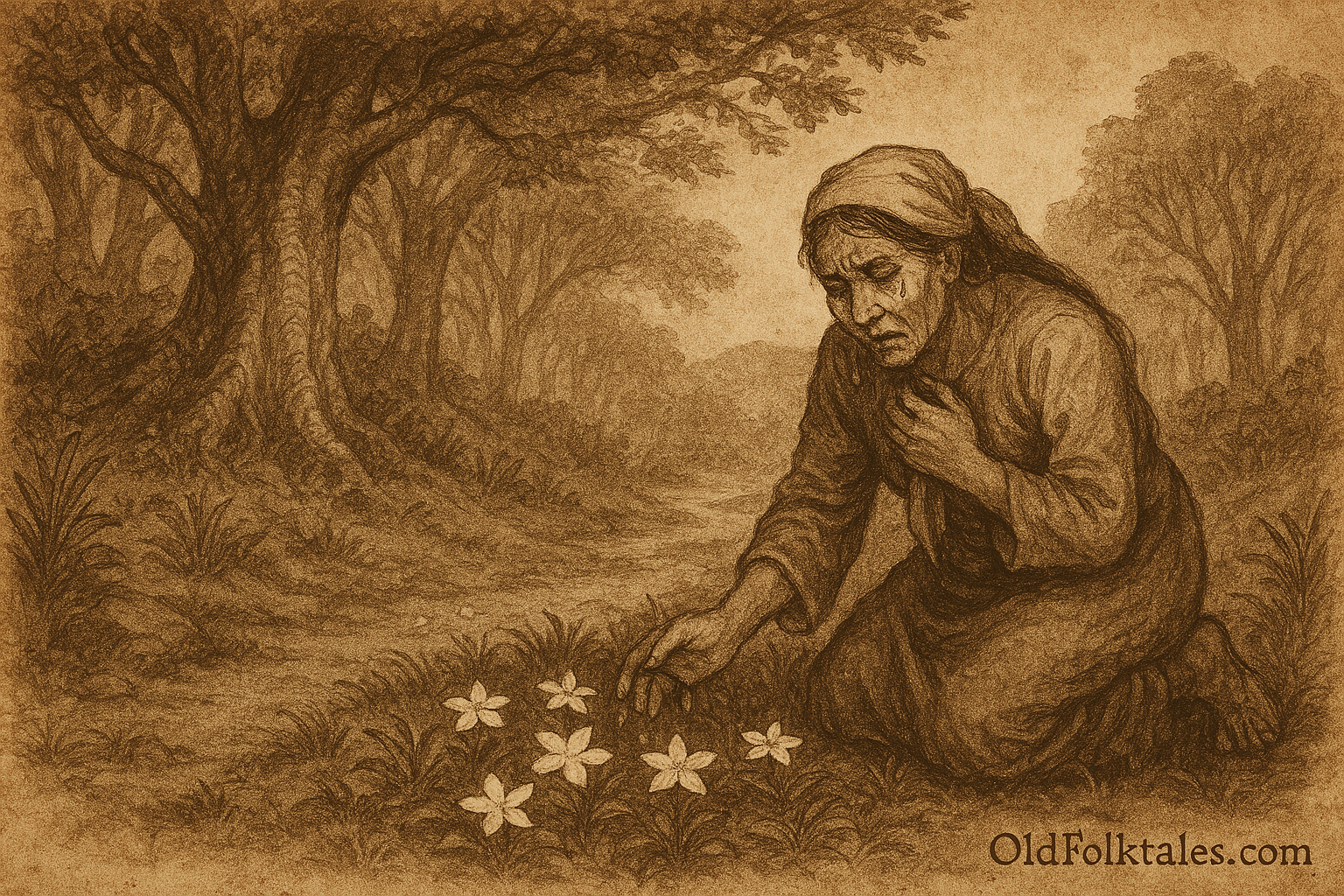
As she wandered, she continued to weep. The tears came endlessly, as if her body contained an ocean of sorrow that would never run dry. She did not wipe them away but let them fall freely, drops of distilled grief striking the earth and soaking into the soil. She climbed higher into the hills, away from any human habitation, seeking perhaps to lose herself entirely in the wilderness, to disappear into the green embrace of the jungle and never return to the world that had taken her daughter.
Behind her, something miraculous began to happen. Wherever her tears had fallen upon the ground, white flowers began to bloom. They appeared overnight, impossibly fast, as if the earth itself was responding to her pain. These were not ordinary flowers. They were pure white, without any hint of color, their petals soft as silk and shaped like stars. They gave off a subtle fragrance, sweet but with an underlying note of sorrow, a scent that seemed to carry memory within it.
The first villagers to discover these flowers were hunters who had ventured into the hills. They followed the trail of white blooms, which led them through the jungle like a pathway of light. The flowers grew in clusters where the mother’s tears had been most abundant, and in solitary blooms where single drops had fallen. The hunters realized they were following the path of Mahsuri’s mother, and fear mixed with wonder in their hearts.
They never found her body. The trail of white flowers led deep into the hills and then simply stopped, as if she had finally been taken by the spirits or had transformed into something else entirely. Some believed she died in a cave or fell from a cliff, her body claimed by the jungle. Others whispered that she had been so consumed by grief that she had dissolved into pure sorrow, becoming nothing more than tears and then nothing at all. Still others believed the spirits had taken pity on her and carried her away to the afterlife, reuniting her with her daughter in whatever realm waited beyond death.
But the flowers remained. They continued to bloom in those places where her tears had fallen, reappearing year after year without need for planting or tending. The local people soon began to notice patterns in the flowers’ appearance. They bloomed most abundantly when injustice was about to be revealed, when hidden truths were forcing their way to the surface, when innocence long suppressed was finally being recognized.
The people of Langkawi learned to read these white flowers as omens. When they appeared unexpectedly in a new location, the villagers knew that some wrong was about to be exposed, that purity was asserting itself against lies, that suffering kept in shadow was about to be brought into light. The flowers became associated with vindication, with the inevitable revelation of truth no matter how deeply it had been buried.
Mothers began to teach their daughters about the white flowers, telling them Mahsuri’s story and her mother’s grief. They explained that purity and innocence, even when violated and destroyed, leave marks upon the world that cannot be erased. They taught that unjust suffering does not simply disappear but transforms into something that testifies forever to the truth. The flowers became a symbol of hope for the wrongly accused, a promise that innocence, even when condemned, will eventually be recognized.
To this day, when someone on Langkawi suffers false accusation or experiences injustice, others will say, “Wait for the white flowers.” They mean that truth has a way of asserting itself, that what is pure cannot be permanently stained, and that the tears of those who suffer unjustly water seeds of revelation that will bloom when the time is right.
The white flowers of Mahsuri’s mother continue to appear in the hills of Langkawi, marking the path of a grief so profound it changed the landscape itself. They stand as living testimony that innocence destroyed leaves an indelible mark, that a mother’s love transcends death, and that no injustice, no matter how complete it seems in the moment, can remain hidden forever. The earth itself remembers and speaks through flowers that bloom white as the blood that proved what should never have needed proving: that some souls are too pure for this world’s cruelty, and their passing transforms grief into permanent witness.
Click to read all Southeast Asian Folktales — featuring legends from Thailand, Indonesia, Vietnam, and the Philippines.
The Moral Lesson
The legend of Mahsuri’s mother and the white flowers teaches that unjust suffering, though it cannot be undone, transforms into eternal testimony that truth cannot be permanently suppressed. The mother’s grief was so pure and profound that it literally changed the landscape, creating lasting signs that remind each generation of the cost of false accusations and rushed judgment. This Langkawi tale reminds us that innocence destroyed leaves permanent marks upon the world, that the pain of injustice transforms into evidence that outlasts those who committed the wrong, and that even when individual voices are silenced, truth finds other ways to speak.
Knowledge Check
Q1: Who was Mahsuri and why is her story significant to this Langkawi legend?
A1: Mahsuri was a beautiful woman from Langkawi who was falsely accused of adultery and executed despite her innocence. When she was killed, her blood ran white, proving her absolute purity and marking one of Malaysia’s most famous tales of injustice. Her story is the foundation for this lesser-known legend about her mother, whose grief following Mahsuri’s execution led to the miraculous appearance of white flowers. Mahsuri’s tale represents the tragedy of innocence destroyed by false accusations, while her mother’s story shows the lasting impact of such injustice.
Q2: What happened to Mahsuri’s mother after her daughter’s execution in this Malaysian tale?
A2: After witnessing her daughter’s execution and seeing the white blood that proved Mahsuri’s innocence, the mother was consumed by profound grief that destroyed her ability to function in society. Unable to remain in the village where her daughter had been killed, she wandered into the hills of Langkawi, weeping continuously and carrying nothing but her sorrow. She walked without purpose through the jungle, barely surviving, leaving a trail of tears behind her. She eventually disappeared completely, her body never found, as if her grief had consumed her entirely or the spirits had taken her to reunite with her daughter.
Q3: What was miraculous about the flowers that appeared after the mother’s tears fell?
A3: The white flowers bloomed overnight wherever the grieving mother’s tears touched the ground, appearing impossibly fast as if the earth itself was responding to her pain. These were not ordinary flowers but pure white blooms shaped like stars, with petals soft as silk and a sweet fragrance carrying an undertone of sorrow. They appeared without being planted, continued to bloom year after year in those same locations, and most miraculously, seemed to appear at other times and places when injustice was about to be revealed or when innocence needed to be vindicated.
Q4: What do the white flowers symbolize in Langkawi folklore?
A4: The white flowers symbolize purity, innocence, and the inevitable revelation of truth despite attempts to suppress it. They serve as omens that unjust suffering never remains hidden and that innocence, even when destroyed, leaves permanent marks testifying to the truth. In Langkawi tradition, the flowers represent hope for the falsely accused, a promise that what is pure cannot be permanently stained, and evidence that grief transformed by injustice becomes eternal witness. They embody the principle that truth will eventually assert itself no matter how deeply it has been buried.
Q5: How do the people of Langkawi interpret the appearance of these white flowers?
A5: The people of Langkawi have learned to read the white flowers as spiritual omens indicating that hidden truths are about to surface or that injustice is about to be revealed. When the flowers appear unexpectedly in new locations, villagers understand that some wrong is about to be exposed, that purity is asserting itself against lies, or that suffering kept in shadow will soon be brought into light. The saying “Wait for the white flowers” has become a local expression meaning that truth will eventually reveal itself and that patience in the face of injustice will be rewarded with vindication.
Q6: What does this Langkawi side-legend reveal about Malaysian cultural attitudes toward justice and innocence?
A6: This legend reveals that Malaysian culture, particularly in Langkawi, holds deep beliefs about the permanence of innocence and the inevitable revelation of truth. It shows cultural understanding that unjust suffering transforms into lasting testimony that transcends individual lives, that the natural world responds to profound human emotion and injustice, and that patience and faith in eventual vindication are culturally valued virtues. The story demonstrates that in Malaysian folk tradition, truth is not merely a human construct but something fundamental to reality itself, supported by spiritual and natural forces that ensure wronged innocence will ultimately be recognized and remembered.
Source: Adapted from The Malay Magician & Other Malay Stories by R.O. Winstedt
Cultural Origin: Langkawi island, Malaysia








