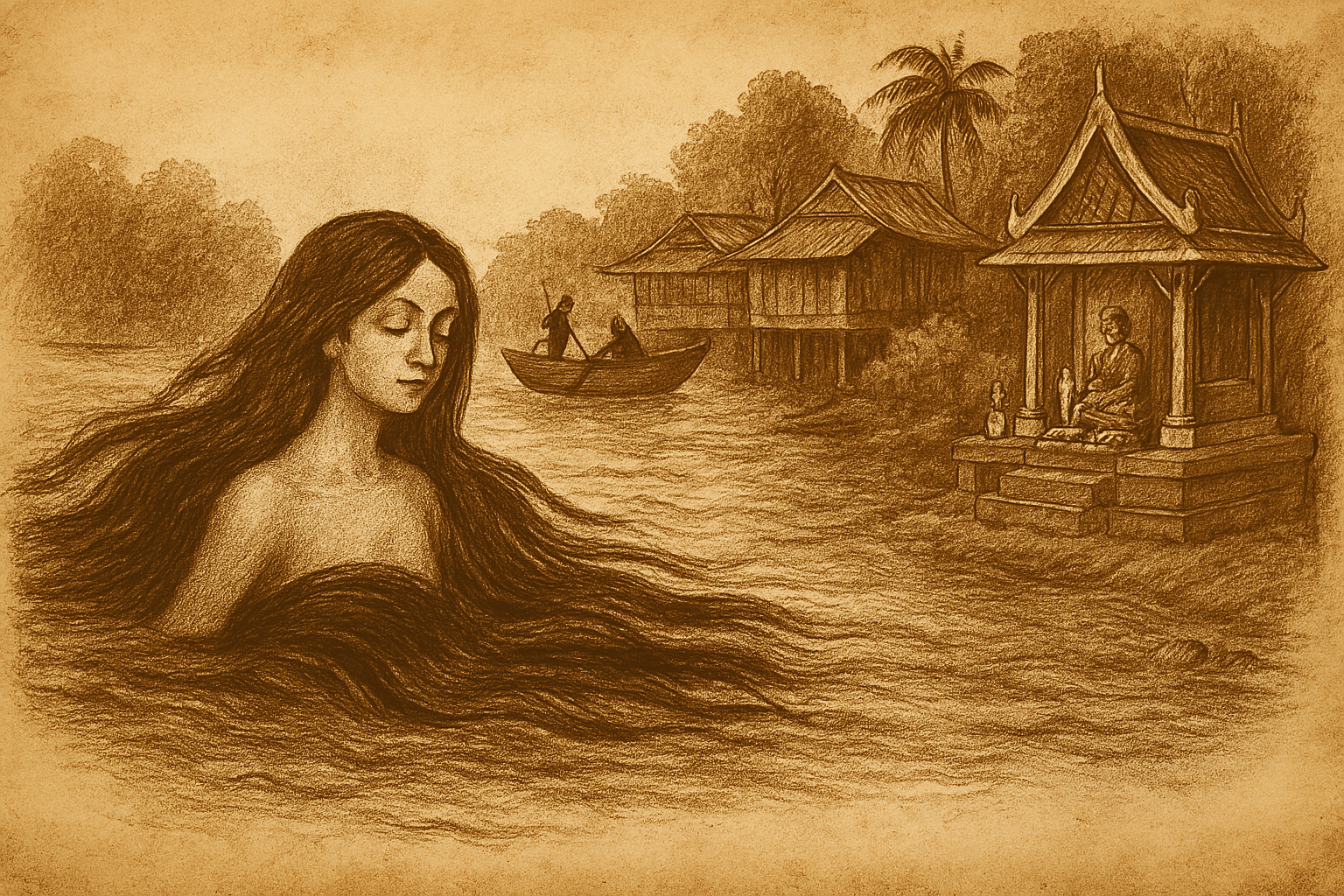
The Mae Klong River winds through the heart of Thailand like a great serpent of silver and jade, its waters carrying the lifeblood of the land. Along its banks, where wooden houses stand on stilts and fishing boats rock gently in the current, the people know better than to speak carelessly of the river. For beneath those dark waters dwells Nang Choom Num, a spirit both beautiful and terrible, whose story has been whispered from generation to generation.
Long ago, before the old temples crumbled and before the modern world cast its shadow upon the river villages, there lived a young woman of extraordinary beauty. Her name was Choom Num, and she was known throughout the district for her kindness and grace. Her laughter was like wind chimes in the evening breeze, and her smile could brighten even the cloudiest monsoon day. She would often walk along the riverbank at dawn, gathering jasmine flowers that grew wild near the water’s edge, weaving them into garlands for the local shrine.
Click to read all East Asian Folktales — including beloved stories from China, Japan, Korea, and Mongolia.
But fate, as it often does, had cruel plans for the gentle Choom Num. One evening, as the sun painted the sky in shades of orange and crimson, she ventured too close to the water’s edge. The riverbank, softened by seasonal rains, gave way beneath her feet. With a cry that echoed across the water, she plunged into the depths of the Mae Klong River. The current was strong that day, swollen with rainwater from the mountains, and despite the desperate efforts of nearby fishermen, Choom Num was pulled beneath the surface, her hands reaching toward the fading light above.
They say her body was never recovered. Instead, something stranger occurred. In the days following her drowning, fishermen began to report strange sightings. Beneath their boats, they glimpsed long strands of black hair flowing like riverweed in the current, moving with a life of its own. The hair seemed to stretch for impossible lengths, drifting and dancing in the underwater realm where Choom Num had met her end.
At first, the fishermen were terrified. Some refused to cast their nets in certain parts of the river. But then a pattern emerged. Those who spoke respectfully of the river, who honored its power and mystery, found their nets full and their passage safe. Their boats glided smoothly even when the current ran fierce. But those who mocked the river, who boasted of conquering its waters or who cursed Choom Num’s name these men met with misfortune.
There was the story of Somchai, a arrogant young man who laughed at the old tales. “Spirits in the water?” he scoffed, spitting into the river. “Nothing but superstition for frightened children.” That very afternoon, his boat capsized in calm waters. Witnesses on the shore swore they saw something wrap around his legs, pulling him down. When he finally surfaced, gasping and pale with terror, his legs bore strange marks, as if wound by thick strands of hair. He never spoke ill of the river again.
Word spread quickly, and the elders of the village gathered to discuss what must be done. They built a small shrine near the spot where Choom Num had disappeared, painting it in red and gold, decorating it with traditional Thai patterns. They instructed the fishermen to bring offerings before venturing onto the water jasmine flowers, for these had been Choom Num’s favorite, and candles to light her way in the dark depths below.
The practice took hold and became tradition. Every morning before dawn, the fishermen would stop at Nang Choom Num’s shrine. They would light candles that flickered in the pre-dawn darkness, their flames reflected in the river’s surface like fallen stars. They would place fresh jasmine flowers at the base of the shrine, their sweet fragrance mixing with the earthy smell of the river. And they would speak words of respect, acknowledging the spirit who dwelled beneath the waves.
Those who honored Nang Choom Num found themselves protected. Even in the worst storms, their boats would find safe harbor. Even when fish were scarce elsewhere, their nets would yield enough to feed their families. The river, it seemed, remembered kindness and rewarded those who showed reverence.
To this day, the shrine still stands along the Mae Klong River. The paint may be faded, and the offerings are left by fewer hands than in generations past, but the old fishermen still remember. They still bring their jasmine and their candles. They still teach their children to speak respectfully of the water and the spirit who guards it.
And on certain evenings, when the light slants just right across the river’s surface, those with keen eyes might glimpse something moving beneath the water long, dark strands that flow like silk in the current, like hair trailing from an unseen head, eternally drifting through the depths of the Mae Klong.
Click to read all Southeast Asian Folktales — featuring legends from Thailand, Indonesia, Vietnam, and the Philippines.
The Moral Lesson
The legend of Nang Choom Num teaches us the importance of respect for nature, for tradition, and for forces beyond our understanding. Her story reminds us that arrogance and mockery invite misfortune, while humility and reverence bring protection and blessing. The river demands acknowledgment of its power, just as life itself requires us to approach the unknown with respect rather than dismissal. Those who honor the sacred, whether in nature or in human experience, find themselves guided and guarded through life’s dangerous currents.
Knowledge Check
Q1: Who was Nang Choom Num before she became a river spirit?
A: Nang Choom Num was a beautiful and kind young woman known for her grace and her habit of gathering jasmine flowers near the Mae Klong River to make garlands for the local shrine.
Q2: How did Choom Num die and become a water spirit?
A: She drowned in the Mae Klong River when the rain-softened riverbank gave way beneath her feet, and the strong current pulled her under. Her body was never recovered, and she became a guardian spirit of the river.
Q3: What do fishermen see beneath the water that represents Nang Choom Num?
A: Fishermen report seeing long strands of black hair flowing like riverweed beneath the surface, stretching for impossible lengths and moving with supernatural life in the river current.
Q4: What offerings do fishermen bring to Nang Choom Num’s shrine and why?
A: Fishermen bring jasmine flowers (her favorite) and candles to light her way in the dark depths. These offerings show respect and ensure safe passage and good catches on the river.
Q5: What happens to those who disrespect Nang Choom Num or mock the river?
A: Those who show disrespect are dragged down by unseen forces in the water, experience capsized boats even in calm conditions, and bear strange marks as if wound by thick strands of hair.
Q6: What does the Nang Choom Num legend symbolize in Thai river culture?
A: The legend symbolizes the importance of respecting natural forces, honoring traditional beliefs, and maintaining humility before the power of nature. It reinforces the cultural practice of making offerings to spirits and treating sacred places with reverence.
Source: Adapted from Bangkok Folklore Project, Field Notes on River Spirits (Mae Klong district)
Cultural Origin: Thai folklore tradition, Mae Klong River region, central Thailand