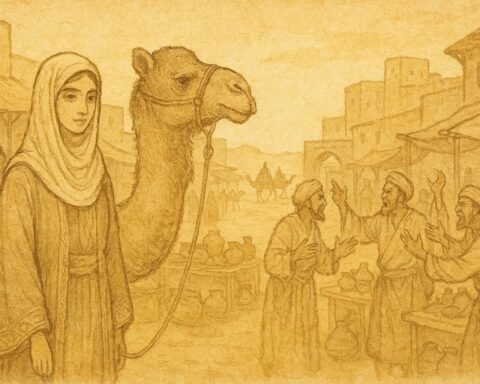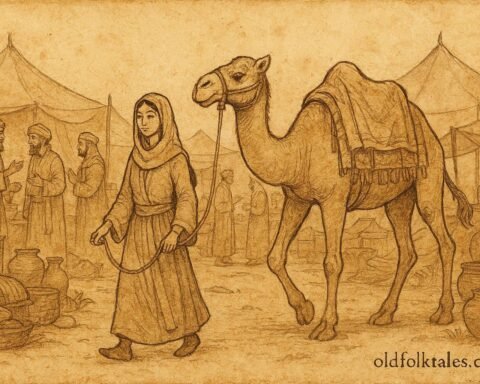
The old desert road stretching between Al Zubarah and Doha had witnessed centuries of merchants traveling across the dunes with their goods, pearls from the northern coast, dates from inland farms, cloth imported from distant ports, and spices carried by caravans from the east. It was a path carved not only by trade but by stories, for traders were known to exchange tales as readily as they exchanged goods.
Among these merchants was Saif, a man respected for his honesty and admired for his sharp mind. He traveled lightly, carrying a wooden chest of pearls he intended to sell in Doha’s bustling souq. The journey was familiar, and the early morning air was cool as he set out, his camel’s hooves pressing gentle prints into the sand.
As the sun climbed higher, Saif noticed a lone traveler approaching from the horizon. The man waved cheerfully, guiding his camel closer until they rode side by side. He introduced himself with a broad smile and warm voice that carried no hint of danger. “Peace upon you, brother traveler. The road is long, shall we ride together for company?”
Saif agreed. In the Gulf’s open deserts, shared company was as valuable as water.
They chatted throughout the day. The stranger spoke easily, asking about Saif’s trade, his family, his route, and the value of the goods he carried. Saif answered politely, though he sensed the man’s curiosity was sharper than his courtesy.
When evening approached, the two stopped beside a low ridge, where they tethered their camels and prepared to rest. The desert night fell quickly, bringing cool winds and a wide canopy of stars. Saif slept lightly.
He awoke before dawn to an eerie stillness. The stranger was gone, along with Saif’s camel, his chest of pearls, and every item of value he owned.
A thief.
Saif stood quietly in the dim light, letting the cold air fill his lungs. Anger rose in him, but so did understanding. Desert roads were notorious for such trickery. Yet violence would solve nothing. As his elders taught, “With sabr and aql, even the strongest hand can be defeated.” With patience and intellect.
He began to walk toward Doha on foot. The sun rose behind him, casting long shadows across the sand. By midday he saw the outlines of the city, its towers of coral-stone, its dhow-filled harbor, and its crowded souq where merchants called out prices beneath colorful awnings.
When Saif entered the marketplace, he observed every stall carefully. He did not hurry. The thief, he knew, would not be able to resist showing off his stolen goods or attempting to sell the pearls too soon.
Sure enough, he spotted the man, dressed in the same travel-worn clothes, haggling loudly with a jeweler. Saif watched from a distance, noting the thief’s nervous gestures and shifty glances.
Saif approached the jeweler casually. “Peace be upon you. I have heard,” he said loudly enough for the thief to hear, “that a great treasure has fallen from the sky just outside Doha. A chest so heavy with jewels that no one can lift it. I am offering a reward to any man who helps me retrieve it.”
The thief turned sharply. “A treasure, you say? What kind of chest?”
“A chest decorated with golden patterns,” Saif replied. “Larger than any I have seen.”
The thief’s greed sparked instantly. He excused himself hastily from the jeweler and followed Saif out of the souq.
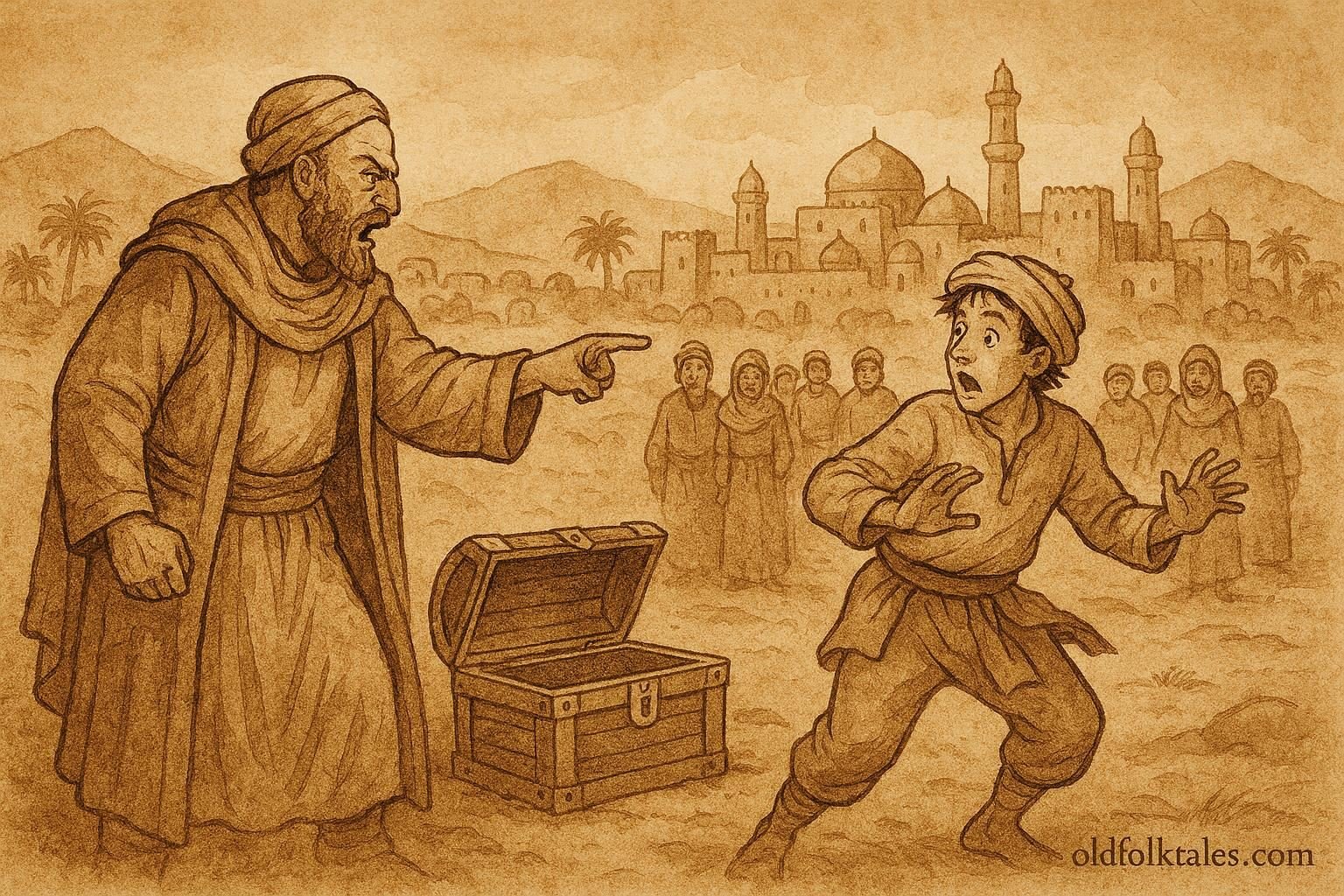
When they reached a quiet stretch of the city outskirts, Saif gestured toward a mound of rocks. Atop it sat a small wooden box, one Saif had filled earlier with worthless pebbles. “There,” he said. “But it is guarded by a riddle. Whoever solves it may claim the treasure.”
The thief, enchanted by the idea of even greater riches, stepped eagerly toward the box. Saif then spoke loudly so that others nearby could hear:
“What kind of man steals another’s goods but still believes he deserves more?”
The thief froze. Several passersby paused, hearing the merchant’s words. Their eyes shifted from Saif to the traveler, who was now sweating and visibly panicked.
Saif continued, his voice calm but clear: “This man robbed me on the desert road. He stole pearls that were entrusted to me. And now, blinded by greed, he hoped to steal again.”
The thief protested weakly, but the crowd had already judged him. Dishonesty in the marketplace was a serious offense; a merchant’s reputation was his livelihood. Before long, community elders were summoned, and the thief, frightened by the growing crowd, surrendered Saif’s camel and the entire chest of pearls.
Saif thanked the elders and quietly returned to the souq. He sold his pearls at a fair price, as he had originally intended. Yet word of his cleverness spread quickly, and soon traders throughout Doha spoke of the merchant who reclaimed his stolen goods not through force, but through wit.
That evening, as Saif prepared to journey home, an old pearl merchant placed a hand on his shoulder. “You have shown us,” the man said, “that justice does not always require a sword. Sometimes, the sharpest weapon is the mind.”
Saif simply smiled and began his journey back toward Al Zubarah, the desert wind brushing warmly across his path.
Moral Lesson
The tale teaches that true strength lies not in force, but in wisdom, patience, and clear thinking. Greed blinds the heart, while integrity and calm strategy lead to rightful justice.
Knowledge Check
1. What is the main theme of “The Merchant and the Thief”?
The story highlights intelligence and patience as the true tools for justice in Qatari folktale tradition.
2. Why is the desert road between Al Zubarah and Doha important in the story?
It reflects Qatar’s historic trade routes and sets the cultural backdrop of traveling merchants.
3. How does the thief deceive the merchant initially?
He pretends to be a friendly fellow traveler, gaining trust before stealing the merchant’s goods.
4. What strategy does the merchant use to expose the thief?
He plants a fake treasure and uses a public riddle to reveal the man’s greed and guilt.
5. What cultural value is emphasized through the merchant’s actions?
Sabr (patience) and aql (intellect) are shown to be more powerful than violence.
6. What lesson does the community learn from the merchant?
That justice and reputation in trade depend on honesty and clever problem-solving.
Source
Adapted from the Qatari folktale “The Merchant and the Thief,” referenced in the QNL Oral History Archive and Arab News cultural features.