The Belait River flowed through the heart of Brunei’s coastal lands like a silver thread woven by the gods themselves. Its waters carried life to the villages nestled along its banks: fish to fill nets, water to nourish crops, and stories that passed from grandmother to grandchild beneath the shade of ancient rain trees. But of all the tales whispered along Sungai Belait, none was more beautiful or more cautionary than that of the widow who sang to the spirits.
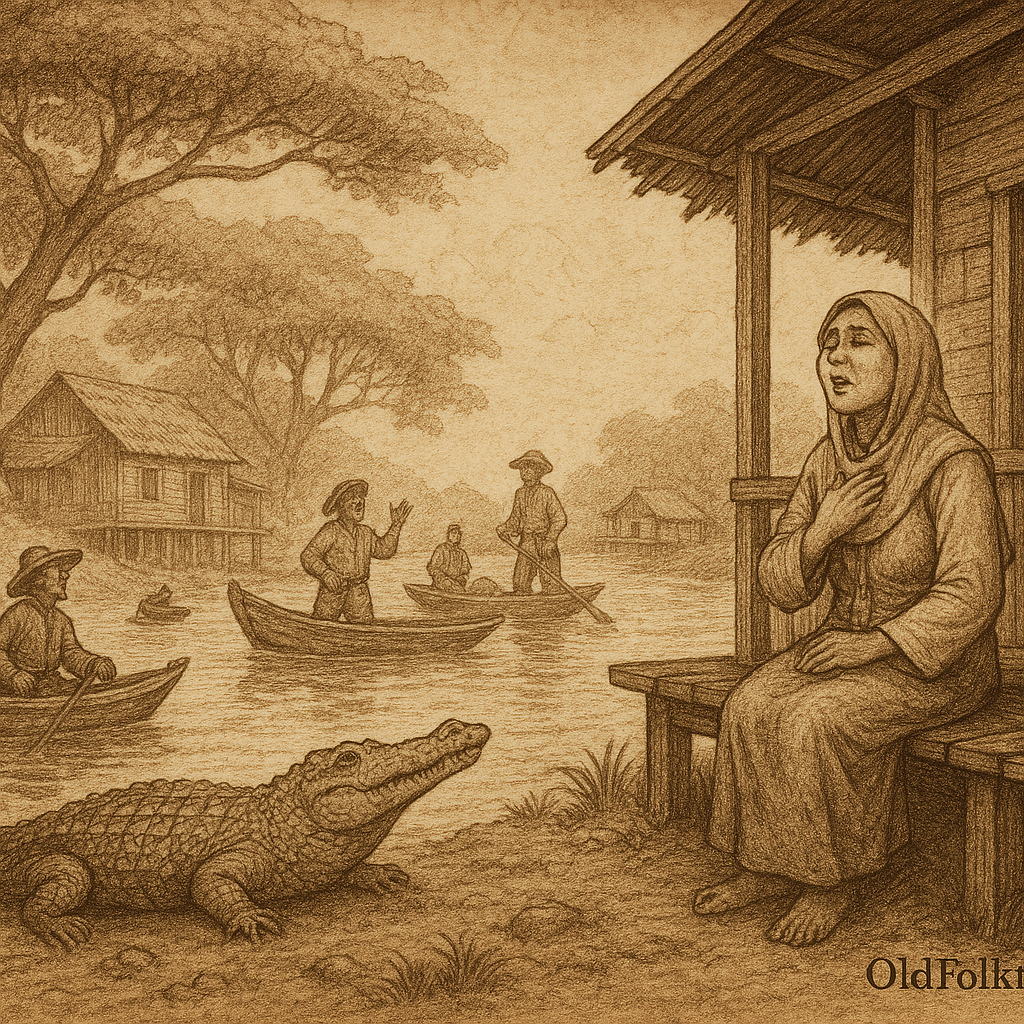
Her name has been lost to time, worn away like river stones smoothed by endless currents. What remained was her story, and the memory of her voice rising with the dawn mist. She lived in a simple wooden house raised on stilts, its weathered planks overlooking the muddy banks where crocodiles once sunned themselves on half submerged logs. The house had grown quiet after her husband’s death, a fisherman taken by fever during the monsoon season, and the widow found herself alone with only the river for company.
Click to read all East Asian Folktales — including beloved stories from China, Japan, Korea, and Mongolia.
In her grief, she began to sing.
At first, the songs were soft, barely more than whispers carried on the morning breeze. She would sit on her veranda as the sky transformed from deepest indigo to bands of coral and gold,and let her voice float across the water. The melodies were old ones, taught to her by her mother, songs about the spirits that dwelled in rivers and forests, about respect for the natural world, about the unseen forces that walked beside the living.
The villagers noticed that something had changed.
Fishermen who cast their nets near the widow’s home found their catches growing more abundant. Fish practically leaped into their boats, silver bodies flashing in the early light. More remarkably, the crocodiles, those ancient, armored predators that had claimed more than one careless swimmer, seemed to vanish from the stretch of river near the village. Mothers no longer clutched their children’s hands in white knuckled fear when they went to fetch water. Young men dove from the banks without glancing over their shoulders for saw toothed shadows beneath the surface.
The elders understood what the younger villagers did not. They recognized the widow’s songs for what they were: offerings of respect, bridges between the human world and the realm of spirits. The river spirits, the penunggu sungai, had heard her voice and found it pleasing. They had been moved by her sorrow, touched by her devotion, and in return, they extended their protection over those who lived beside their waters. The crocodiles still lurked in the river, but the spirits guided them away from the village, steering them toward deeper channels and uninhabited bends.
The widow asked for nothing in return. She sang because it eased the ache in her heart, because it connected her to something larger than her loneliness. The villagers, grateful and respectful, sometimes left small offerings at her door: a portion of their catch, fresh fruit from their gardens, woven baskets to replace her worn ones. She accepted these gifts with quiet grace and continued her dawn ritual.
But in every village, there lives someone who cannot bear to see others prosper without claiming credit or casting doubt. In this village, that man was called Hamid, a fisherman whose nets never seemed to fill as abundantly as his neighbors’, whose luck always ran thin. While others attributed their good fortune to the widow’s songs and the spirits’ favor, Hamid grew bitter. How could an old woman’s voice accomplish what his years of experience could not?
One morning, as the widow’s song drifted across the water like incense smoke, Hamid stood on his boat and raised his voice in mockery. He mimicked her melody with exaggerated warbles, laughing cruelly as he did so. He called out that her singing was nothing but the wailing of a lonely woman, that the spirits cared nothing for her voice, that the villagers were fools to believe such superstitious nonsense.
The widow’s song faltered and stopped.
Silence fell over the river like a held breath. The birds ceased their chatter in the mangrove roots. Even the water seemed to still, its surface becoming glass-smooth and waiting.
Within days, the crocodiles returned.
They appeared first as dark shapes sliding beneath the surface near the fishing boats. Then they grew bolder, hauling themselves onto the banks where children played, their eyes like polished stones fixed on the village. One fisherman barely escaped when a massive crocodile surged from the shallows, its jaws snapping shut on the spot where he’d been standing moments before. Fear crept back into daily life like floodwater rising beneath the houses.
The widow had stopped singing. Her veranda remained empty at dawn, her windows shuttered. Without her offerings of respect, without the bridge her voice had built between worlds, the river spirits had withdrawn their protection. They had been insulted through her, and they would not return until that insult was answered.
The village elders convened beneath the headman’s house. They knew what had to be done, what had always been done when the balance between humans and spirits was broken. Hamid was brought before them, his bravado withered in the face of the danger he’d unleashed. Under their stern instruction, he walked to the widow’s house with his head bowed, carrying offerings of fine cloth, dried fish, and a carved wooden box containing his wife’s precious silver betel nut set.
On the widow’s doorstep, Hamid prostrated himself and begged forgiveness. His voice cracked as he spoke, admitting his jealousy, his foolishness, his disrespect for both the widow and the spirits she honored. The widow watched him from her doorway, her face unreadable. For a long moment, she said nothing.
Then, as the sun began to rise, she stepped onto her veranda and began to sing once more.
Her voice rose like prayer, like memory, like morning itself given sound. And the river seemed to sigh in response, its waters stirring with something beyond wind or current. Within days, the crocodiles withdrew again to their distant haunts. The fishing boats returned to safe waters. The village breathed easily once more, having learned anew what their grandparents had always known: that some gifts should never be mocked, and that respect, once broken, must be rebuilt with humility.
Click to read all Southeast Asian Folktales — featuring legends from Thailand, Indonesia, Vietnam, and the Philippines.
Moral Lesson
This Bruneian folktale teaches us that respect for others and for the spiritual forces that protect our communities should never be taken lightly or mocked out of jealousy or pride. The story reminds us that what we cannot see or fully understand may still hold great power, and that humility and genuine apology can restore what arrogance destroys. When we honor the gifts others bring to our community, whether through song, skill, or devotion, we preserve the delicate balance that keeps everyone safe.
Knowledge Check
Q1: Who was the Widow of Sungai Belait and what made her special? A: The Widow of Sungai Belait was a grieving woman who lived alone beside the Belait River in Brunei after her fisherman husband died. She became special because her dawn songs honored the river spirits (penunggu sungai), who in turn protected the village’s fishermen and kept dangerous crocodiles away from the community.
Q2: What were the river spirits called and how did they respond to the widow’s songs? A: The river spirits were called penunggu sungai in the Bruneian tradition. They were moved by the widow’s respectful songs and her genuine devotion, responding by protecting the villagers from crocodile attacks and blessing the fishermen with abundant catches as long as respect was maintained.
Q3: Why did the fisherman Hamid mock the widow’s singing? A: Hamid mocked the widow’s singing because of jealousy and bitterness. While other fishermen prospered with abundant catches, his own nets remained less full. Rather than recognizing the spiritual significance of her songs, he attributed his neighbors’ success to superstition and couldn’t accept that an old woman’s voice could accomplish what his experience could not.
Q4: What happened when the widow stopped singing after being mocked? A: When the widow stopped singing after Hamid’s mockery, the river spirits withdrew their protection from the village. Dangerous crocodiles returned to the waters near the settlement, threatening fishermen and children. The balance between the human and spirit worlds was broken, and fear returned to daily life along Sungai Belait.
Q5: How was the balance restored between the village and the river spirits? A: The village elders required Hamid to formally apologize to the widow, bringing valuable offerings including fine cloth, dried fish, and a silver betel nut set. He prostrated himself on her doorstep and admitted his jealousy and disrespect. Only after this genuine act of humility did the widow resume her singing, allowing the river spirits to restore their protection.
Q6: What is the cultural significance of singing to spirits in Bruneian tradition? A: In Bruneian tradition, singing to spirits represents a form of respectful communication between the human and spiritual realms. Such songs serve as offerings that acknowledge the power of nature spirits and maintain harmonious relationships. This practice reflects the broader Southeast Asian belief in maintaining balance with unseen forces that influence daily life and community wellbeing.
Source: Adapted from oral traditions documented in Brunei Museum Ethnology Papers, Belait River Oral Traditions collection.
Cultural Origin: Brunei Darussalam, Belait District, Southeast Asia