
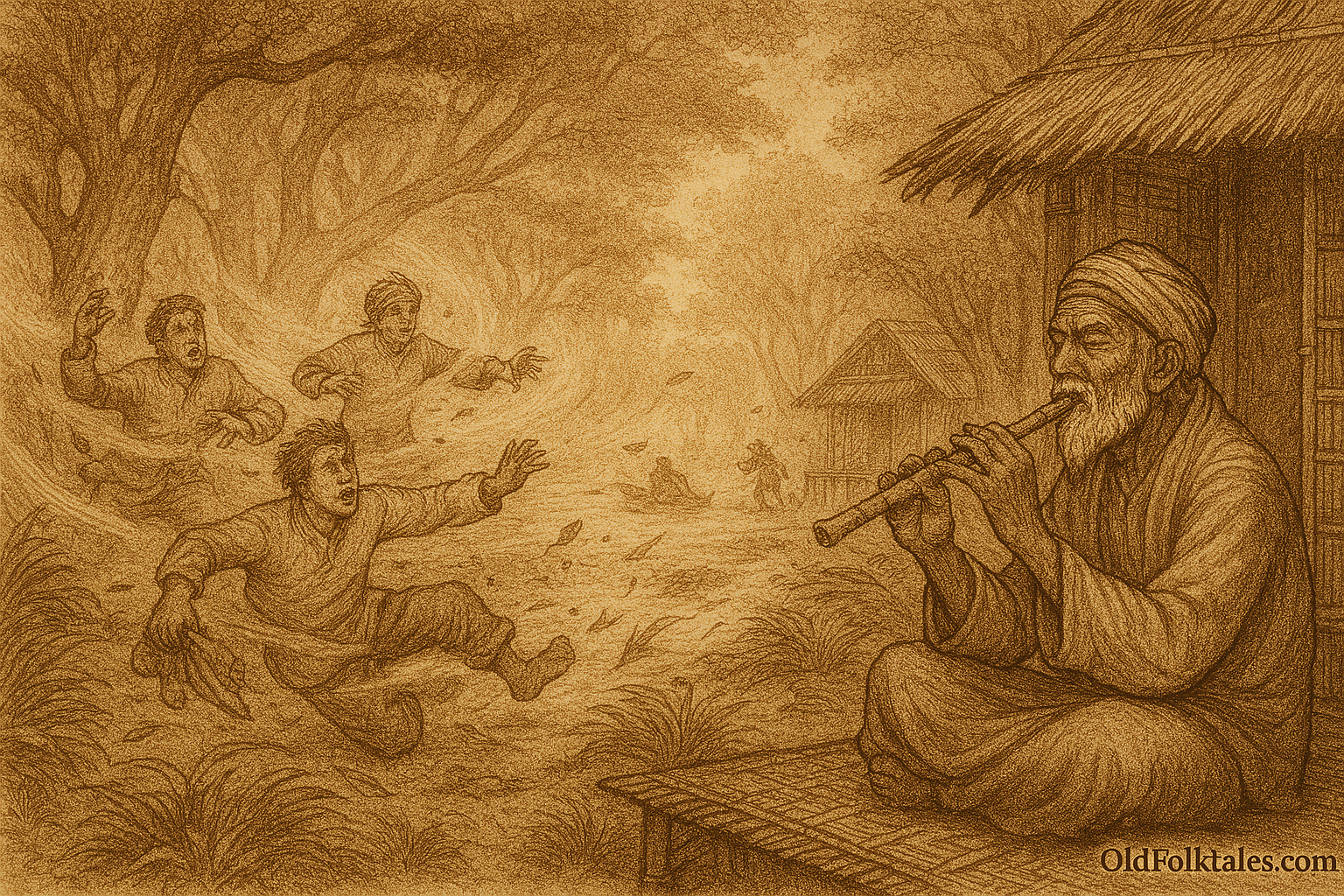
Deep within the shadowed groves of Ulu Muar, where the ancient trees grew so thick that sunlight barely kissed the forest floor, there lived a hermit whose name had been forgotten by time itself. The villagers of Negeri Sembilan spoke of him only in hushed whispers, calling him simply “the old one” or “he who dwells beyond the river.” His hut, woven from bamboo and palm fronds, stood in a clearing so remote that even the most experienced hunters sometimes lost their way trying to find it.
The hermit was a figure of mystery and quiet power. His face was weathered like old bark, creased with lines that told stories of decades spent in solitude. His eyes, dark and knowing, seemed to hold the secrets of the forest itself. But what made him truly remarkable was the bamboo flute he carried a simple instrument carved from a single piece of golden bamboo, worn smooth by years of handling. The local Minangkabau people believed this was no ordinary flute, for when the hermit played, the very winds themselves would listen and obey.
Click to read all East Asian Folktales — including beloved stories from China, Japan, Korea, and Mongolia.
On calm days, when the air hung still and heavy, villagers would sometimes hear the distant, haunting melody of the hermit’s flute drifting through the trees. And always, within moments, a gentle breeze would rise, rustling through the leaves like a whispered conversation between earth and sky. The elders nodded knowingly at such moments, reminding the young ones to show respect for the forest and all who dwelt within it.
One sweltering afternoon, when the heat pressed down upon the land like a heavy blanket, three young hunters ventured deep into the forest of Ulu Muar. They were strong men, proud of their skills with spear and trap, and their pouches were already heavy with the day’s catch. Their names were Rashid, Hamzah, and Ahmad men who had begun to believe that their prowess made them masters of the forest.
As they pushed through a thick tangle of ferns and vines, they stumbled unexpectedly into the hermit’s clearing. There, sitting cross-legged on a woven mat before his humble dwelling, sat the old man. His bamboo flute rested across his lap, and he regarded the intruders with calm, unblinking eyes.
“Old man!” Rashid called out, his voice bold and mocking. “We’ve heard tales of your wind-calling magic. Do you truly believe you can command the air itself with that stick of bamboo?”
The hermit said nothing, but his gaze remained steady.
Hamzah laughed, emboldened by his companion’s rudeness. “Perhaps he’s too old to remember how to play it! Or maybe the stories are nothing but foolish superstition told to frighten children.”
Ahmad joined in, his pride swelling. “We are hunters of Negeri Sembilan we fear nothing in this forest, not tigers, not spirits, and certainly not an old man with a flute!”
The hermit’s expression remained unchanged, but something shifted in the air around them. Slowly, deliberately, he raised the bamboo flute to his lips. The first note that emerged was low and mournful, like the sound of distant thunder rolling across hills. The second note was sharper, more insistent.
Suddenly, the forest exploded with movement.
A wind arose from nowhere, fierce and howling, tearing through the clearing with a fury the hunters had never experienced. Trees bent and swayed wildly, their branches whipping like angry serpents. Leaves, twigs, and debris swirled in violent spirals around the three men. The force of the gale knocked them off their feet, sending them tumbling across the ground like dried leaves in a monsoon storm.
Rashid clutched desperately at a tree root, his earlier bravado vanished. Hamzah cried out in fear as his prize catches were torn from his pouch and scattered into the forest. Ahmad tried to shield his face from the stinging debris, all thoughts of pride forgotten in the face of nature’s raw power.
The hermit continued to play, and the winds grew stronger still. The hunters found themselves separated, each blown in a different direction, lost in the chaos of the storm. For hours they stumbled through the raging forest, unable to find their way, their bodies battered and their spirits broken.
As darkness began to fall, the three men finally managed to regroup, exhausted and humbled. Together, they made their way back to the hermit’s clearing, where the old man still sat, serene and unmoved, his flute now silent in his hands. The forest around him was perfectly calm, as if the storm had never happened.
The hunters fell to their knees before him, their heads bowed low.
“Forgive us, wise one,” Rashid said, his voice trembling with genuine remorse. “We were foolish and disrespectful. We let our pride blind us to the truth of your power and the mysteries of this forest.”
“We should not have mocked what we do not understand,” Hamzah added, shame coloring his words.
Ahmad spoke last: “Please, grant us your forgiveness and calm the winds so that we may return safely to our village. We have learned our lesson.”
The hermit studied them for a long moment, his ancient eyes measuring the sincerity of their apology. Then, slowly, he nodded. Once more, he raised the flute to his lips, but this time the notes that emerged were soft and soothing, like a lullaby for the forest itself. The last remaining gusts settled into gentle breezes, and peace returned to Ulu Muar.
“Go,” the hermit said at last, his voice raspy from disuse. “Remember this day. The forest demands respect, and those who dwell within it deserve your honor, not your scorn.”
The three hunters bowed deeply and departed, their steps careful and reverent. They returned to their village changed men, and the story of their encounter spread throughout Negeri Sembilan.
To this day, when sudden gusts of wind rise unexpectedly in the forests of the region, the elders still call them “the hermit’s breath” a reminder that nature holds powers beyond human understanding, and that respect and humility will always serve us better than pride and mockery.
Click to read all Southeast Asian Folktales — featuring legends from Thailand, Indonesia, Vietnam, and the Philippines.
The Moral Lesson
This folktale teaches us that pride and arrogance often lead to our downfall, while humility and respect open paths to wisdom and peace. The hunters learned that true strength lies not in mocking what we don’t understand, but in honoring the knowledge and power of others especially the mysteries of nature and those who live in harmony with it. Respect, whether shown to people or to the natural world, is never wasted and often protects us from our own foolishness.
Knowledge Check
Q1: Who was the hermit of Ulu Muar in Malaysian folklore? A: The hermit of Ulu Muar was a mysterious forest-dwelling elder who lived in the remote forests of Negeri Sembilan and was believed to control the winds through his magical bamboo flute. He was known for his quiet power and deep connection to nature.
Q2: What role did the bamboo flute play in the Hermit of Ulu Muar story? A: The bamboo flute was the hermit’s instrument of power, through which he commanded and controlled the winds. When he played it, he could summon fierce storms or gentle breezes, demonstrating his mastery over natural forces.
Q3: What mistake did the three hunters make in the Malaysian folktale? A: The hunters Rashid, Hamzah, and Ahmad arrogantly mocked the hermit and dismissed his powers as superstition. Their pride and disrespect led to their punishment when the hermit summoned a violent storm that scattered and humbled them.
Q4: What cultural lesson does the Hermit of Ulu Muar teach about respect? A: The story teaches that respect for elders, nature, and powers beyond our understanding is essential. Pride and mockery lead to consequences, while humility and genuine apology can restore balance and peace.
Q5: What do the Minangkabau people of Negeri Sembilan call sudden forest winds? A: They call sudden forest gusts “the hermit’s breath,” a phrase that keeps alive the memory of the wind-controlling hermit and serves as a reminder to show respect for the forest and its mysteries.
Q6: What is the origin and cultural significance of the Hermit of Ulu Muar tale? A: This folktale originates from the Minangkabau community in Negeri Sembilan, Malaysia. It reflects traditional beliefs about forest spirits, the power of hermits and holy men, and the importance of respecting nature and those who possess special knowledge or spiritual power.
Source: Adapted from Malay Folk Beliefs and Traditions, Negeri Sembilan field notes, compiled by Mohd. Taib Osman.
Cultural Origin: Malaysia








