In the 1800s, when Singapore’s harbor bustled with trading ships from across the maritime world, the waters off Telok Blangah held a mystery that sent shivers down the spines of even the most hardened seafarers. It was a time when Bugis traders from the Celebes, Chinese junks, and Malay perahu filled the straits, their sails catching the monsoon winds as they carried spices, textiles, and precious goods between distant ports. But amid the commerce and bustle, there existed a phenomenon that no amount of modern reasoning could explain the ghostly apparition known as the Lantern Woman.
The story begins with a young Bugis woman whose beauty was renowned throughout the trading communities of the Malay Archipelago. Her name was Siti, and she had married a skilled Bugis trader named Hasan, a man whose reputation for honest dealing and masterful navigation had earned him respect in every port from Makassar to Singapore. Their love was the kind sung about in traditional pantun poetry deep, devoted, and unshakeable.
Click to read all East Asian Folktales — including beloved stories from China, Japan, Korea, and Mongolia.
Hasan’s prahu was a magnificent vessel, its hull painted in the traditional colors of his people, with eyes carved into the bow to watch for danger on the endless sea. Siti would often stand on the shore of their small kampong near Telok Blangah, watching as her husband’s boat disappeared into the blue horizon, carrying goods to trade in distant lands. Each time he departed, Hasan would promise to return before the new moon, and each time, he kept his word.
“Wait for my lantern,” he would tell her, embracing her before boarding his vessel. “When you see my golden lantern swinging from the mast as I return at night, light your own lamp and guide me home to shore.”
And so it became their ritual. Siti would stand on the rocky beach at Telok Blangah, her own brass lantern glowing in her hands, watching for the answering light that would signal her husband’s safe return.
But one fateful monsoon season, when the winds turned fierce and unpredictable, Hasan set sail despite the warnings of the village elders. His cargo was valuable, and he had given his word to merchants in Malacca that he would deliver their goods before the festival season. Siti begged him to wait for calmer seas, but Hasan, confident in his skills and knowledge of the waters, kissed her forehead and promised he would return within ten days.
“I will light my golden lantern,” he assured her, “and you will guide me home as always.”
The days passed slowly for Siti. She went about her duties weaving mats, preparing food, helping the other women of the kampong but her eyes constantly drifted to the horizon. On the eighth day, the sky darkened ominously. Thick, bruised clouds rolled in from the south, and the sea began to churn with an anger that frightened even the oldest fishermen. The storm that followed was legendary a tempest so fierce that it tore roofs from houses and sent fishing boats crashing into the shore like broken toys.
For three days and nights, the storm raged. When it finally passed, leaving the air heavy with salt and sorrow, Hasan’s prahu had not returned. Siti stood on the beach, her lantern clutched in trembling hands, scanning the empty waters for any sign of her husband’s vessel. Days turned into weeks, and weeks into months, but Hasan never came home.
The other traders brought news eventually wreckage had been spotted near the rocky shoals south of Sentosa. Hasan’s distinctive prahu had been identified by its painted hull, shattered and scattered across the reef. There were no survivors. The sea, in its fury, had claimed the skilled trader and his entire crew.
Siti’s grief was inconsolable. She refused to believe her husband was truly gone. Every evening at dusk, she would walk to the shore at Telok Blangah, lighting her brass lantern and holding it high, waiting for the answering light that would never come. The women of the kampong tried to comfort her, but she would not be consoled.
“He promised to return,” she would whisper, her eyes distant and glassy. “He promised to light his golden lantern. I must be here to guide him home.”
As the months wore on, Siti grew thin and pale, her beautiful face hollow with sorrow. She ate little and spoke less, existing only for those evening vigils by the water’s edge. Then one night, during a particularly violent storm, Siti did not return from the beach. The villagers found her brass lantern washed up on the shore the next morning, but Siti herself had vanished, swallowed by the same sea that had taken her beloved husband.
The kampong mourned her loss, and the elders said prayers for her troubled soul. But soon, sailors began reporting something extraordinary and terrifying.
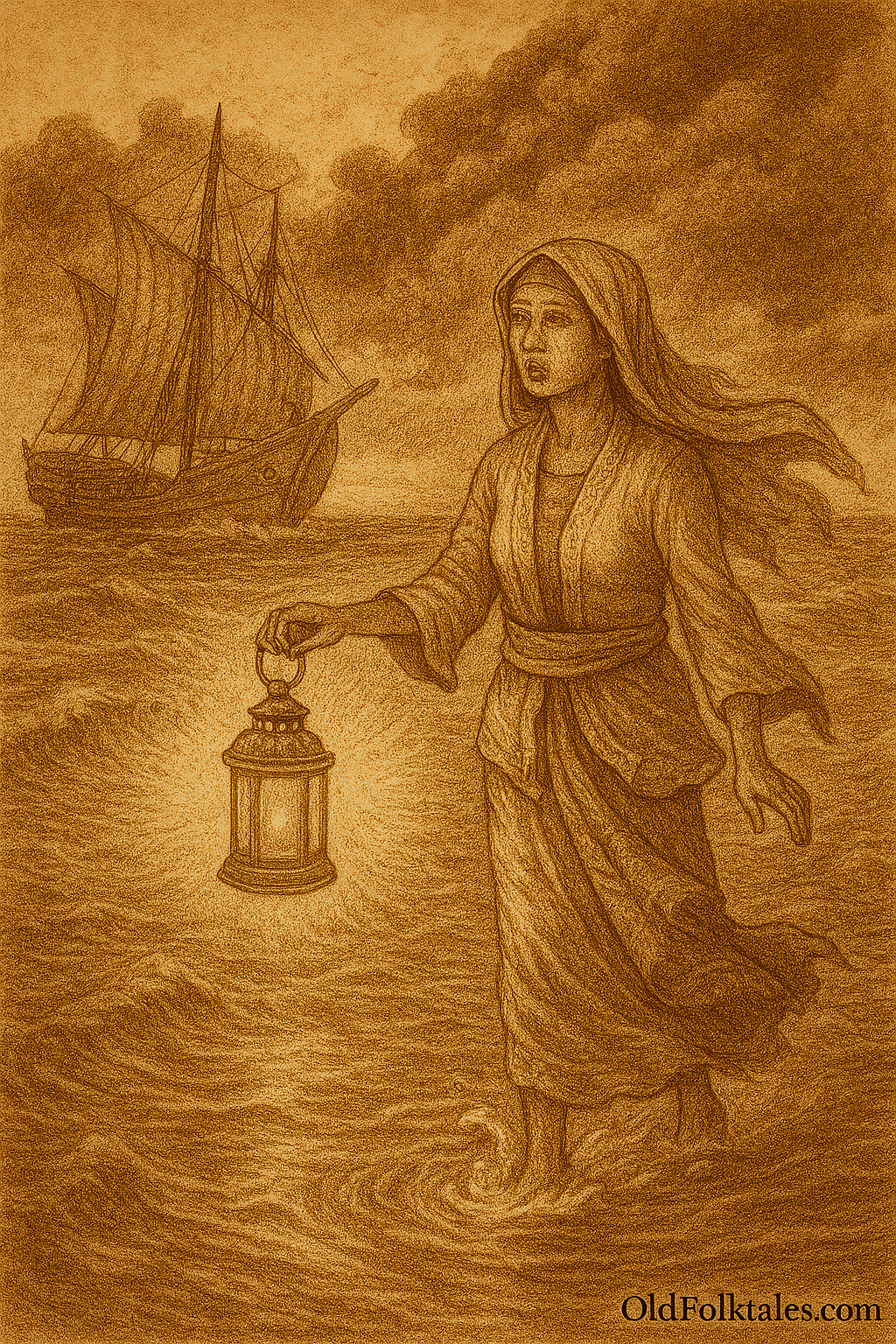
On dark nights, particularly before storms or shipwrecks, a glowing figure could be seen walking upon the surface of the water near Telok Blangah. It was a woman in traditional Bugis dress, her sarong flowing as if moved by an unfelt breeze, and in her hands she carried a golden lantern that cast an eerie, phosphorescent light across the waves. She would glide across the water with purpose, swaying slightly as if walking on solid ground, her face turned always toward the horizon, searching, searching, endlessly searching.
Fishermen learned to recognize her appearance as an omen. When the Lantern Woman walked the waters, they would quickly return to shore, securing their boats and warning other vessels. Invariably, within hours of her appearance, fierce storms would arise, or ships would founder on hidden rocks. Some said she was trying to warn sailors of the danger that had claimed her husband. Others believed she was still searching for Hasan’s lost vessel, unable to rest until she found him.
Captain James Morrison, a British merchant sailor, recorded an encounter in his ship’s log in 1847: “This night, at approximately nine bells, the watch reported a most peculiar sight a native woman walking upon the water itself, carrying a lamp of golden hue. The men were greatly distressed. Within two hours, we were struck by a sudden squall that nearly capsized our vessel. The Malay crew insisted the woman was a warning spirit of these waters.”
Another account from a Chinese trader named Lim Ah Teck described seeing her during a clear night in 1852: “The woman’s face was beautiful but filled with unbearable sadness. She looked directly at our junk as she passed, and I felt my heart grow cold. Her lantern swung gently in her hand, and her lips moved as if calling a name, though no sound reached us. The next day, we learned a Bugis trader’s boat had struck a reef and sank near where we saw her.”
Throughout the latter half of the nineteenth century, the Lantern Woman of Telok Blangah became one of Singapore’s most famous maritime ghosts. Sailors of every nationality Malay, Chinese, Bugis, Indian, and European reported sightings. Each description remained remarkably consistent: a woman in traditional dress, walking on water, carrying a golden lantern, appearing before maritime disasters.
The old Bugis community at Telok Blangah never forgot Siti’s story. They would leave offerings on the beach flowers, food, and small oil lamps hoping to give her restless spirit some peace. The elders would tell their children about the devoted wife whose love transcended death itself, who continued her faithful vigil even from beyond the grave.
As Singapore modernized and the old kampongs gave way to port developments and urban expansion, sightings of the Lantern Woman became less frequent. Yet even today, some fishermen and sailors claim to have seen her on dark, stormy nights a luminous figure walking the waters off Telok Blangah, her golden lantern swinging gently as she searches eternally for the husband who promised to come home but never could.
Click to read all Southeast Asian Folktales — featuring legends from Thailand, Indonesia, Vietnam, and the Philippines.
The Moral Lesson
This haunting tale reminds us of the profound power of love and devotion, showing how the bonds between souls can transcend even death itself. Siti’s eternal search speaks to the depth of commitment and the tragedy of promises broken by forces beyond our control. The story also teaches respect for the sea’s power and the importance of heeding warnings both natural and supernatural. In honoring the memories of those lost to the waters, we acknowledge that some griefs are so deep they leave permanent marks on the world, and that love, in its purest form, knows no boundaries between life and death.
Knowledge Check
Q1: Who was the Lantern Woman of Telok Blangah in Singapore folklore? A: The Lantern Woman was the ghost of Siti, a devoted Bugis trader’s wife who drowned while waiting for her husband Hasan to return from sea. After her death, her spirit was said to walk on the waters near Telok Blangah, carrying a golden lantern as she eternally searched for her lost husband’s vessel.
Q2: What was the significance of the golden lantern in the Singapore ghost story? A: The golden lantern represented the signal that Hasan promised to light upon his return, which Siti would answer with her own lamp to guide him safely to shore. After both perished at sea, the ghostly golden lantern became a symbol of her undying devotion and eternal search for her beloved husband.
Q3: Why did sailors fear seeing the Lantern Woman of Telok Blangah? A: Sailors learned that the Lantern Woman’s appearance was an omen of impending danger she typically appeared before storms, shipwrecks, or other maritime disasters. Her sighting warned seafarers to return to port quickly, as dangerous conditions would soon follow.
Q4: What cultural groups were involved in the Telok Blangah Lantern Woman legend? A: The legend originated with the Bugis trading community from the Celebes (modern-day Sulawesi, Indonesia) who settled in Singapore. However, sailors from many cultures Malay, Chinese, Indian, British, and other European seafarers all reported encountering the Lantern Woman throughout the 1800s.
Q5: How did the Singapore maritime community honor the Lantern Woman’s spirit? A: The Bugis community at Telok Blangah left offerings on the beach, including flowers, food, and small oil lamps, hoping to bring peace to Siti’s restless spirit. These rituals acknowledged her tragic story and showed respect for her devoted love and eternal vigil.
Q6: What does the Lantern Woman legend reveal about 19th-century Singapore’s maritime culture? A: The legend reflects Singapore’s role as a major trading port where diverse maritime cultures intersected, sharing stories and supernatural beliefs. It shows the dangers faced by sailors, the importance of maritime warnings, and how communities honored those lost at sea while maintaining deep respect for the ocean’s power.
Source: Adapted from Malay–Bugis Oral Lore Collection.
Cultural Origin: Telok Blangah, Singapore