Long ago, in a quiet valley surrounded by low green hills in Laos, there stood a village known for its peaceful ways. The people lived simply. They shared water from the same stream, worked together in the rice fields, and greeted one another with gentle words. At the edge of the village grew an unusual bamboo grove. Its stalks shimmered faintly in the sunlight, carrying a warm golden hue unlike any other bamboo in the region.
The villagers called it the golden bamboo. Elders said it had grown there longer than memory itself. Children were warned never to cut it without cause, and hunters bowed when passing nearby. The bamboo did not belong to any family but to the spirit of harmony that watched over the valley.
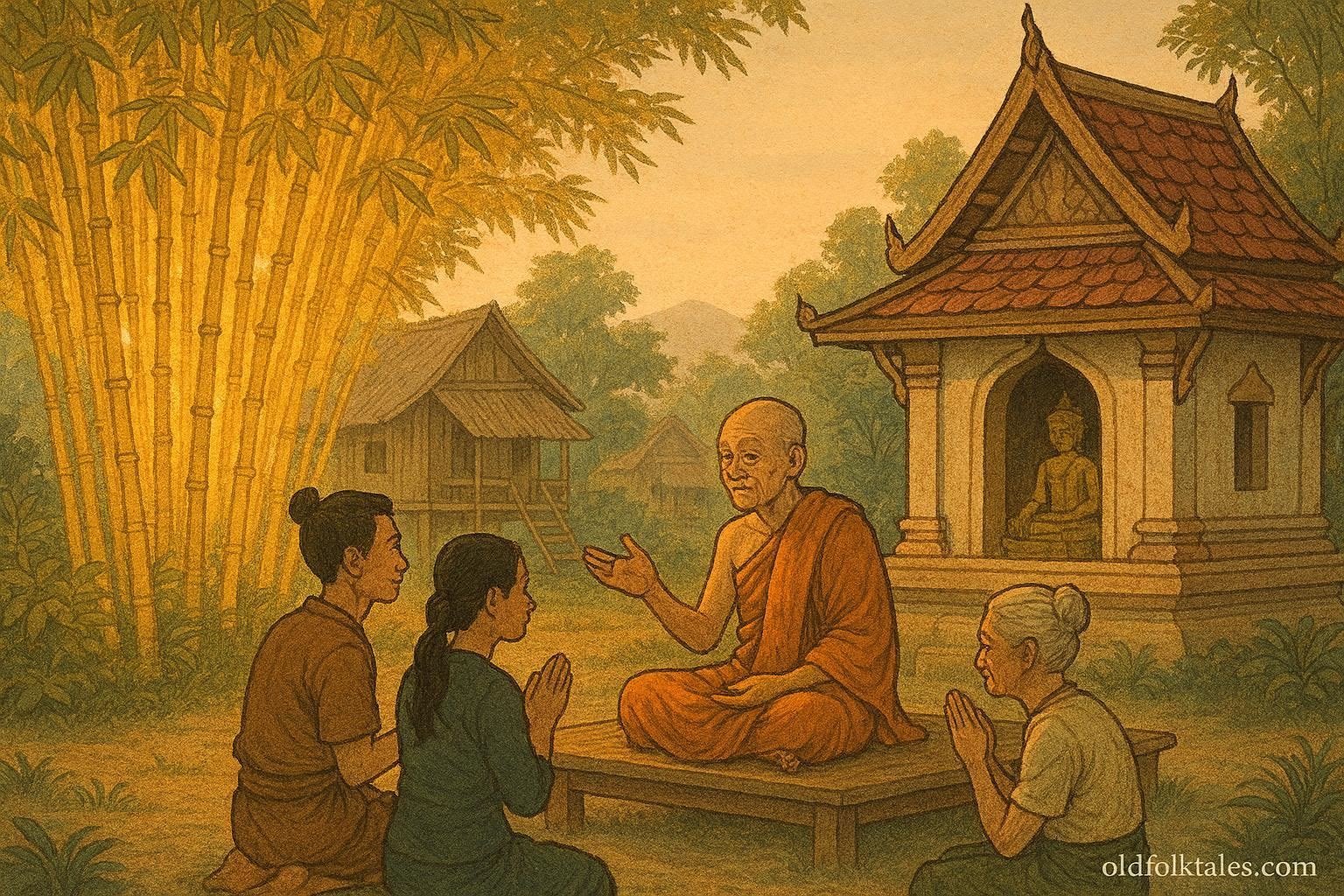
One morning, a wandering monk arrived at the village. He was old, with bare feet hardened by years of walking and a robe patched many times over. He carried only his alms bowl and a staff polished smooth by use. His name was Phra Ananda, though few knew it at first.
The villagers welcomed him warmly. They offered him rice, water, and a place to rest beneath a fig tree near the temple. That evening, as the sun dipped low, Phra Ananda walked slowly toward the golden bamboo grove. He stood silently among the stalks, eyes closed, listening to the wind move gently through them.
Explore timeless legends from China, Japan, and Korea in our East Asian Folktales collection.
The next day, the monk spoke to the villagers. He told them that the bamboo was no ordinary plant. It reflected the hearts of those who lived nearby. When kindness guided the people, the bamboo flourished. When greed and cruelty took root, it weakened.
At first, the villagers smiled. They believed themselves kind and saw no reason to worry. The bamboo stood tall and radiant, proof enough of their goodness.
Phra Ananda stayed in the village for many days. Each morning, he accepted alms and offered simple teachings. He spoke of generosity without expectation, of words spoken gently, and of actions guided by compassion. Many listened closely, but some grew impatient. They whispered that the monk spoke too much of kindness and too little of effort.
Among them was a man named Kham, a prosperous trader who had recently returned from distant markets. Kham believed the village was too generous. He argued that sharing weakened those who worked hard. Slowly, his words spread. People began to argue over water rights and field boundaries. Small acts of selfishness became common. A neighbor refused help. A merchant charged unfair prices. Apologies grew rare.
Phra Ananda noticed the change. One morning, he returned to the bamboo grove and found several stalks duller than before. Their golden sheen had faded to pale yellow.
That evening, he gathered the villagers and spoke again. He warned them gently that the bamboo was responding to their actions. He urged them to reflect on their behavior and return to compassion.
Some villagers listened with shame. Others dismissed him. Kham laughed openly, saying plants did not judge people. He suggested cutting the bamboo and selling it, believing its golden color would fetch a high price.
The next week, without consulting the elders, Kham and a few followers cut several stalks. The bamboo made a sound like a sigh as it fell. That night, a heavy silence settled over the valley.
By morning, the grove had changed. The remaining stalks bent low. Their leaves curled and fell. The golden glow vanished entirely. Even the air around the grove felt cold.
Fear spread through the village. Crops grew weak. The stream slowed. Disagreements turned bitter. Families stopped sharing meals. Children quarreled, and laughter disappeared from the streets.
Phra Ananda called the villagers together one final time. He did not scold them. Instead, he sat quietly and asked them to look within themselves. He reminded them that the bamboo was only a mirror. The true sickness lay in the hearts of the people.
Moved by his calm presence, the villagers began to speak openly. They confessed selfish acts, harsh words, and broken promises. Kham stood apart at first, arms crossed. But when he saw the sorrow in the eyes of those he had influenced, his pride weakened.
That night, Kham approached the monk alone. He knelt and admitted his greed. He asked how to restore what was lost.
Phra Ananda told him that restoration began with action. Apologies must be followed by kindness. Greed must be replaced with generosity.
The next morning, Kham returned land he had claimed unfairly. He shared his stored rice with struggling families. Others followed his example. Neighbors repaired one another’s homes. Elders were honored again. Children were taught patience and respect.
For seven days, the village practiced deliberate compassion. On the eighth day, as the sun rose, a soft glow returned to the bamboo grove. New shoots emerged from the earth, bright and strong. The golden hue deepened, warmer than before.
The villagers gathered in awe. Phra Ananda smiled quietly. That evening, without ceremony, he prepared to leave. When the villagers begged him to stay, he reminded them that the lesson now lived within them.
By dawn, the monk was gone. Only his footprints remained, leading toward the hills. The golden bamboo stood tall once more, a living reminder that kindness was not merely taught but practiced.
From that day on, whenever conflict arose in the village, elders would walk with the young to the bamboo grove and ask them to listen to the wind.
Moral Lesson
True harmony cannot be maintained through words alone but through consistent compassionate action. Greed weakens not only communities but the natural balance around them. Kindness, generosity, and humility restore both human relationships and the world they inhabit.
Knowledge Check
- Who was the wandering monk
Answer: Phra Ananda. - What made the bamboo grove special
Answer: It reflected the kindness or greed of the villagers. - Who encouraged selfish behavior in the village
Answer: Kham the trader. - What happened when villagers acted greedily
Answer: The golden bamboo withered and village harmony collapsed. - How was the bamboo restored
Answer: Through acts of compassion, generosity, and reconciliation. - What lasting lesson did the village learn
Answer: That kindness sustains both people and nature.
Source
Adapted from Lao Buddhist Literary Archives, 2015.
Cultural Origin
Theravada Buddhist folk heritage of Laos