In the heart of Laos, where the Red River Plains stretch endlessly beneath vast tropical skies, there once lived a creature of extraordinary power and grace. This was no ordinary frog that dwelled among the lotus blossoms and muddy banks. This was a golden frog, its skin gleaming like polished sunshine, its eyes shimmering with ancient wisdom. The rice farmers who worked the fertile paddies knew this magnificent creature well, for it was their guardian, their protector against the forces that threatened their livelihood.
The golden frog made its home among the rice fields, nestled beneath broad leaves and hidden in the cool shadows of irrigation channels. During the day, it would sit motionless as a temple statue, watching over the emerald, green shoots that pushed through the water. Its presence was both mysterious and reassuring, a living connection between the earthly realm and the spirit world that the Lao people had honored since time immemorial.
Click to read all East Asian Folktales — including beloved stories from China, Japan, Korea, and Mongolia.
When the planting season arrived and farmers bent low to press seedlings into the flooded earth, the golden frog would emerge from its hiding place. It moved with dignity through the paddies, its golden skin catching the light and casting small reflections that danced across the water like scattered coins. The farmers would pause in their work to watch it pass, pressing their palms together in respectful greeting, for they understood that this was no mere animal but a spirit in physical form.
But the true power of the golden frog revealed itself when danger threatened the crops. Every season, dark clouds of insects would descend upon the plains locusts with insatiable appetites, beetles that devoured tender shoots, and swarms of rice bugs that could strip an entire field in hours. These invasions struck terror into the hearts of farming families, for their survival depended entirely on the harvest. A failed crop meant hunger, debt, and hardship through the long months ahead.
Yet whenever these destructive swarms approached the fields where the golden frog dwelled, something miraculous would occur. The frog would position itself at the edge of the paddy, its throat swelling with power. Then it would croak not the simple sound of an ordinary frog, but a deep, resonant call that seemed to vibrate through the very earth itself. The sound rolled across the plains like thunder, carrying with it an authority that no creature could ignore.
And the insects would flee. As if struck by an invisible hand, the swarms would change direction mid-flight, scattering in panic and confusion. Locusts that had been moments away from devouring the rice would suddenly veer away, their wings beating frantically as they sought escape. Beetles would tumble from the leaves they’d been attacking. Within moments, the threat would vanish entirely, and the crops would stand untouched, glistening peacefully in the sunlight.
The farmers whose fields the golden frog protected prospered greatly. Their rice grew tall and heavy with grain. Their harvests overflowed the granaries. Children grew strong and healthy, and there was always enough to share with neighbors and offer at the temple. Word of the golden frog’s protection spread throughout the region, and people spoke of it with reverence and gratitude.
But not everyone who heard these tales felt gratitude in their hearts. In a grand house overlooking the plains lived a powerful lord whose wealth could not satisfy his endless greed. He possessed vast estates, storehouses filled with rice, and servants who answered his every whim. Yet when he heard about the golden frog and its miraculous powers, a dark desire took root in his mind.
“If I could capture that frog,” he thought, his eyes narrowing with cunning, “I could control which fields prosper and which fail. I could demand tribute from every farmer in the region. My wealth would multiply beyond measure, and my power would be absolute.”
The greedy lord assembled his most skilled hunters and trappers. He promised them rewards of silver and gold if they could bring him the golden frog alive. These men, hardened by years of catching wild game in the forests and mountains, set out confidently toward the Red River Plains, carrying nets and cages of bamboo.
They arrived at the rice fields at dawn, when mist still clung to the water and the world was hushed and gray. Moving with practiced stealth, they spread out across the paddies, their nets ready. It did not take long to spot the golden frog, for its radiant skin glowed even in the dim morning light, a beacon impossible to miss.
The hunters closed in, their movements calculated and coordinated. They had trapped leopards and pythons, bears and wild boar. Surely one frog, however magical, could not elude them. But as their nets descended, the golden frog’s eyes flashed with knowing light. In that instant, the creature understood the greed and darkness that motivated its pursuers.
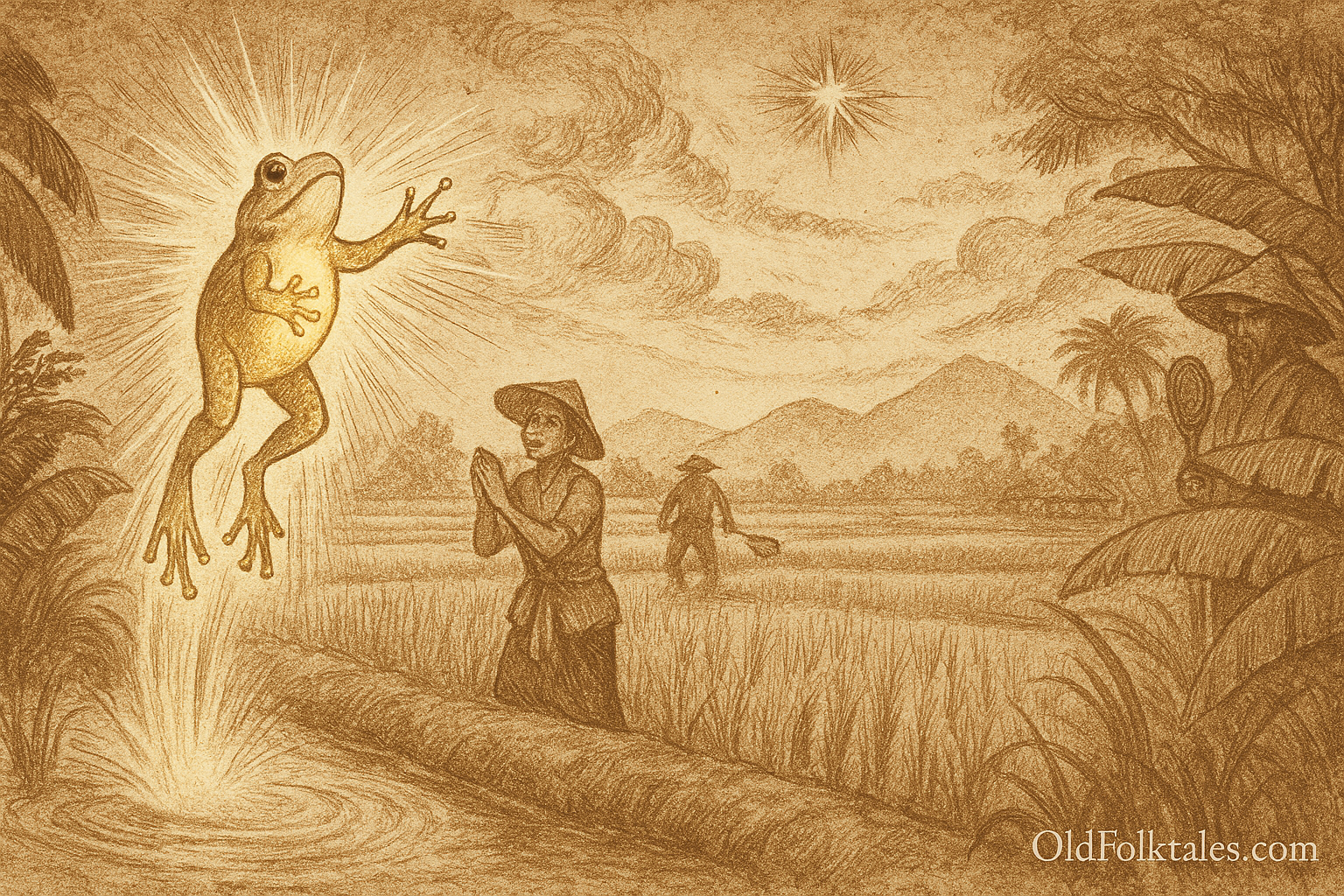
With a powerful thrust of its golden legs, the frog leapt. But this was no ordinary jump. The frog soared upward with impossible speed, sailing past the nets, past the treetops, past the clouds themselves. The hunters watched in stunned disbelief as the golden creature rose higher and higher, its body growing smaller and more brilliant until it looked like a point of pure light against the blue vault of heaven.
And there, in the celestial realm far beyond the reach of mortal greed, the golden frog came to rest. It transformed into a star, a steadfast point of golden light that would shine forever over the rice fields it had once protected. The farmers below fell to their knees, weeping at the loss of their guardian but also marveling at the beauty of what they witnessed.
From that day forward, the rural farmers of Laos have called that particular star “the frog’s lantern.” On clear nights, they look up and find comfort in its gentle glow, remembering the golden guardian that loved them so much it chose to watch over them for eternity rather than fall into the hands of greed. And they teach their children that some gifts are meant to be cherished, not captured, and that true protection comes not from possession but from respect and reverence.
The greedy lord returned home empty-handed, his hunters defeated by a creature’s nobility. His fields, no longer blessed by the frog’s presence, suffered plague after plague of insects. His wealth slowly diminished, and he learned too late that some treasures cannot be owned.
Click to read all Southeast Asian Folktales — featuring legends from Thailand, Indonesia, Vietnam, and the Philippines.
The Moral Lesson
This Laotian folktale teaches us that greed destroys the very blessings we seek to possess. The golden frog freely protected the farmers who respected it, but when someone tried to capture and control it for selfish gain, the blessing was lost to all. True gifts come to those who approach them with reverence and gratitude, not with grasping hands and selfish hearts. Some sacred things must remain free to fulfill their purpose, and attempting to cage the divine only drives it away forever.
Knowledge Check
Q1: What was the golden frog’s role in the Red River Plains of Laos?
A: The golden frog was a spirit guardian that protected rice fields from destructive insect swarms by croaking with a powerful, thunderous sound that caused the insects to flee in fear.
Q2: How did the golden frog protect crops from insects?
A: When insect swarms threatened the rice paddies, the golden frog would position itself at the field’s edge and emit a deep, resonant croak that vibrated through the earth, causing all insects to scatter and flee immediately.
Q3: Why did the greedy lord want to capture the golden frog?
A: The greedy lord wanted to capture the golden frog to control agricultural prosperity in the region, believing he could demand tribute from farmers and increase his wealth and power by possessing the creature.
Q4: What happened when hunters tried to trap the golden frog?
A: When hunters attempted to capture it with nets, the golden frog leapt into the sky with supernatural power, rising beyond the clouds and transforming into a star in the heavens.
Q5: What do Lao farmers call the star that the golden frog became?
A: Rural Lao farmers call the star “the frog’s lantern,” and they look to it on clear nights as a reminder of their lost guardian and the importance of respecting sacred spirits.
Q6: What is the cultural significance of this Laotian legend?
A: This tale reflects Lao agricultural spirituality, teaching reverence for nature spirits and the consequences of greed. It embodies traditional beliefs about guardian spirits protecting rice cultivation, which is central to Lao culture and survival.
Source: Adapted from Rural Animal-Spirit Narratives collected by the Lao National Folklore Centre
Cultural Origin: Lao people, Red River Plains region, Laos