In the time before memory, when the mountains of Timor Leste were young and the valleys below them knew only shadow, the world existed in perpetual darkness. The people lived without ever seeing the sky, without knowing the warmth of sunlight on their skin, without witnessing the brilliant colors that dawn could paint across the heavens. They moved through their days guided only by firelight and the faint glow of stars that seemed impossibly distant in the black vault above.
The elders spoke in hushed voices of a time when light had existed, when something called the sun had traveled across the sky, bringing warmth and brightness to the land. But that was long ago, before the great lizard came. This creature was enormous beyond imagination, with scales that gleamed like polished stone and eyes that burned with an ancient, selfish hunger. It had discovered the sun and, coveting its radiance for itself alone, had dragged it deep into a vast cave in the mountainside, trapping the light within the stone walls of its lair.
Click to read all East Asian Folktales — including beloved stories from China, Japan, Korea, and Mongolia.
The people suffered terribly in the endless night. Crops would not grow without sunlight. Children were born, grew, and aged without ever seeing their own faces clearly. The cold crept into their bones, and hope became as scarce as warmth. Many had given up, accepting the darkness as the unchangeable nature of the world. But not everyone had surrendered to despair.
In a small village nestled in the highlands lived a young girl named Bui. She was perhaps ten years old, though in the darkness it was difficult to mark the passage of time with certainty. What set Bui apart from others was not her age or appearance, but her voice. When she sang, even in that lightless world, people stopped whatever they were doing to listen. Her songs carried something indefinable within them, a quality that made even the coldest heart remember warmth, made even the most hopeless soul recall joy.
Bui’s grandmother had been one of the last people to see the sun before the lizard stole it away. The old woman would sit by the fire, her weathered hands wrapped around Bui’s small ones, and describe what had been lost. She spoke of golden mornings when light would spill across the valleys like honey. She described how the sky would transform through shades of pink and orange and purple as day arrived. She told of how plants would turn their faces toward the sun, how water would sparkle in its light, how shadows would dance at noon.
These stories filled Bui’s heart with longing. While others had accepted their fate, she dreamed of the light her grandmother described. And as she grew, a determination took root within her, hard and bright as a seed of fire. She would find the lizard’s cave. She would bring back the sun.
Her family tried to dissuade her. The journey to the mountain cave was treacherous even in daylight, they said, and in darkness it was surely suicide. The lizard was enormous and fierce, they warned, and had devoured anyone who ventured too close to its lair. But Bui’s resolve could not be shaken. She prepared herself with the few provisions she could gather and set out alone into the darkness, guided by the faint instructions her grandmother had given her from ancient memory.
For days, Bui climbed. Her hands bled from gripping sharp rocks she could not see. Her feet stumbled over roots and stones. The air grew thin and cold as she ascended the mountain, and more than once she nearly fell to her death on the invisible slopes. But she pressed on, driven by the vision of light that her grandmother’s stories had planted in her imagination.
Finally, high on the mountainside, she felt a change in the darkness around her. There was a presence here, something vast and watchful. And then she saw it, a faint glimmer leaking from between massive stones, the entrance to the lizard’s cave. The light was so dim after the absolute darkness of her journey that it seemed brilliant to her eyes, even though it was merely the barest trace of the imprisoned sun.
Bui stood at the mouth of the cave and felt her courage waver. From deep within came sounds of movement, the scraping of enormous claws on stone, the heavy breathing of something immense. Every instinct screamed at her to flee, to run back down the mountain and accept the darkness as so many others had done. But she thought of her grandmother’s descriptions, of children who had never seen their mothers’ faces in daylight, of a world that had forgotten color and warmth.
And so she began to sing.
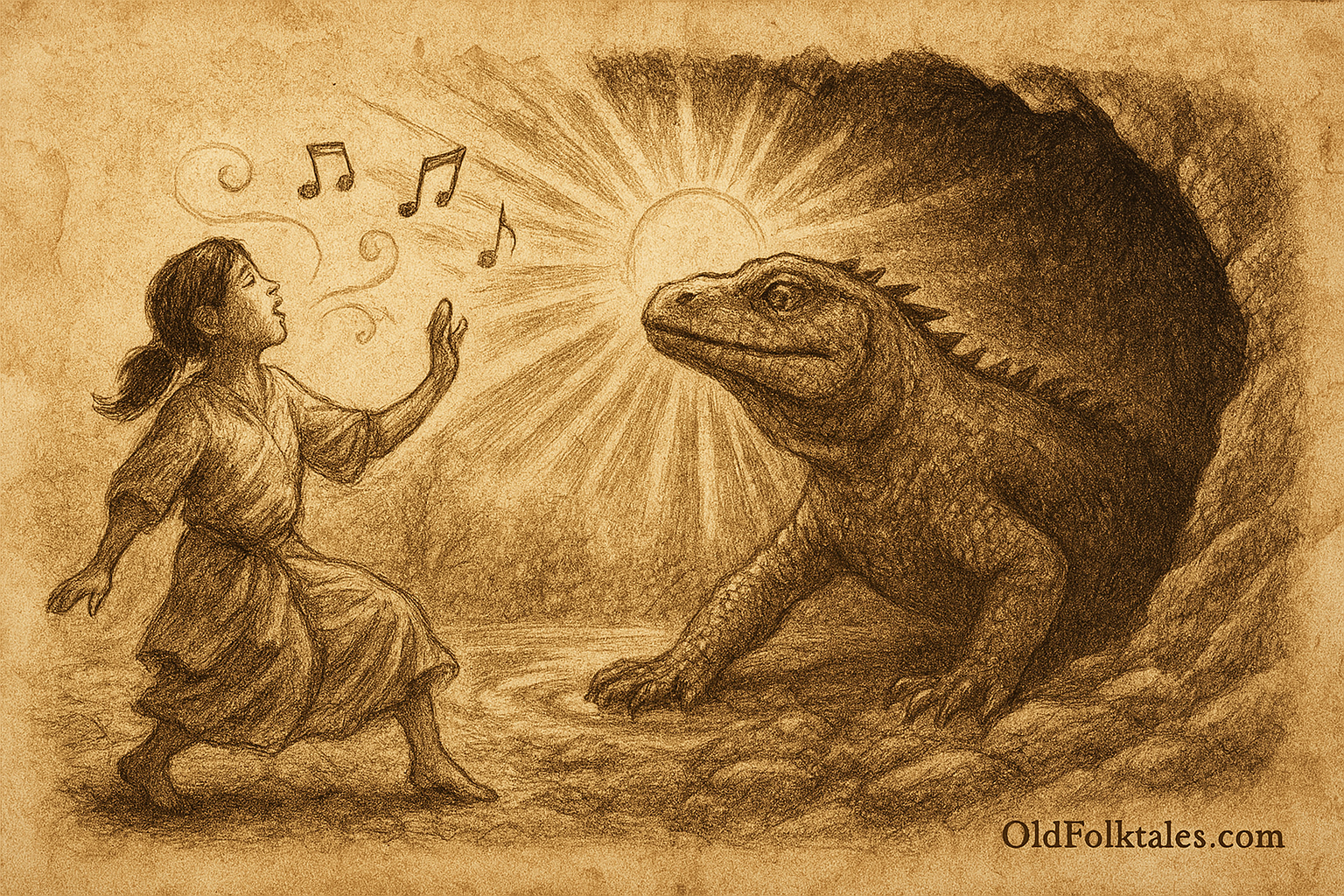
Her voice rose clear and pure in the darkness, carrying the melodies her grandmother had taught her, songs from the time before the lizard, songs that spoke of morning and hope and life renewed. The sound echoed off the stone walls of the cave entrance, traveling deep into the mountain’s heart.
Inside the cave, the giant lizard stirred. It had not heard music in ages beyond counting. The sound was strange to it, compelling in a way it could not resist. Slowly, its massive head emerged from the darkness, drawn by the irresistible beauty of Bui’s song.
Bui did not stop singing, though terror froze her blood at the sight of the creature. The lizard was larger than ten houses, its scales catching what little light escaped from the cave and reflecting it in mesmerizing patterns. Its eyes fixed on her, and she saw in them something unexpected, not hunger or rage, but a kind of lonely fascination.
She changed her song, making it livelier, more rhythmic. Her feet began to move in the dance patterns her grandmother had taught her, the dances people once performed in celebration of sunrise. The lizard’s great head swayed in time with her movements, and then, incredibly, its enormous body began to shift. It moved forward, drawn irresistibly from its cave by the music and dance.
With each step the lizard took out of the cave, more light spilled past its massive form. The imprisoned sun, no longer completely blocked by the creature’s body, began to send rays of brilliance streaming across the mountainside. Bui kept singing, kept dancing, leading the lizard further and further from the cave entrance, even as tears of joy streamed down her face at the sight of light, true light, for the first time in her life.
The lizard danced clumsily, enchanted by the girl’s performance, moving in circles around her as she sang. And as it danced, the sun rose fully from the cave mouth, climbing into the sky where it belonged, flooding the world below with radiant warmth and golden brilliance.
The people in the valleys below cried out in amazement and joy as light returned to the world. They saw their homes, their families, the mountains and forests and rivers all revealed in stunning clarity. The darkness that had imprisoned them for so long dissolved like smoke in the wind.
But as the sun climbed higher, the giant lizard seemed to realize what had happened. It looked up at the escaped sun, then back at the girl who had tricked it. For a moment, Bui thought it would devour her in its rage. Instead, something changed in the creature’s eyes. Perhaps it was shame at being so easily deceived, or perhaps it was a strange kind of relief at being freed from its obsessive guarding of the light.
The lizard turned and retreated back into its cave. But as it entered the darkness once more, a transformation began. With each step deeper into the shadow, the creature shrank. Its massive form diminished, bones and scales compressing until it was no longer a monster but a small, ordinary lizard that could fit in the palm of a hand.
And so it remains to this day. The descendants of that great lizard are the small house lizards that Timorese people find in their homes, creatures no bigger than a finger, that cling to walls and ceilings and emerge when darkness falls. They are harmless now, content to hunt insects in the corners of rooms, their appetite for hoarding sunlight vanished with their size. Some say they remain as a reminder of the time before light, of the young girl whose courage and song freed the sun from captivity.
Click to read all Southeast Asian Folktales — featuring legends from Thailand, Indonesia, Vietnam, and the Philippines.
The Moral Lesson
This Timor Leste legend teaches us that courage and creativity can overcome even the most overwhelming obstacles. Bui succeeded not through force or violence, but through the power of art and the wisdom to understand what moved her adversary. Her story reminds us that sometimes the greatest battles are won not by strength but by beauty, not by confrontation but by invitation. The tale also illustrates how even those who hoard and hide away blessings may be transformed, reduced from threatening monsters to harmless remnants when light and goodness are restored to the world.
Knowledge Check
Q1: Who is Bui in this Timor Leste folktale?
A: Bui is a brave young girl from the Timorese highlands whose beautiful singing voice and courage enabled her to lure the giant lizard from its cave and free the imprisoned sun, bringing light back to the world.
Q2: Why did the world exist in darkness at the beginning of the story?
A: A giant lizard had discovered the sun and dragged it deep into a mountain cave, hoarding its light for itself and leaving the entire world trapped in perpetual darkness and cold.
Q3: How did Bui free the sun from the lizard’s cave?
A: Bui stood at the cave entrance and sang beautiful songs that enchanted the giant lizard. As she sang and danced, the creature was drawn irresistibly out of the cave, allowing sunlight to escape and return to the sky.
Q4: What happened to the giant lizard after the sun escaped?
A: When the lizard returned to its cave after the sun escaped, it began to shrink with each step into darkness, transforming from an enormous monster into a tiny house lizard no bigger than a finger.
Q5: Why are small lizards found in Timorese homes today?
A: According to the legend, the small house lizards found throughout Timor Leste are descendants of the great lizard that once stole the sun, now harmless creatures that serve as living reminders of the time before light.
Q6: What is the cultural significance of this creation story in Timor Leste?
A: This highland tale explains the origin of day and night while teaching Timorese values of courage, creativity, and the power of art to transform darkness into light. It reflects traditional beliefs about the connection between the natural world and ancestral stories passed down through generations.
Source: Adapted from Highland Children’s Tales documented in the Timor Leste Oral History Project
Cultural Origin: Highland communities, Timor Leste (East Timor)