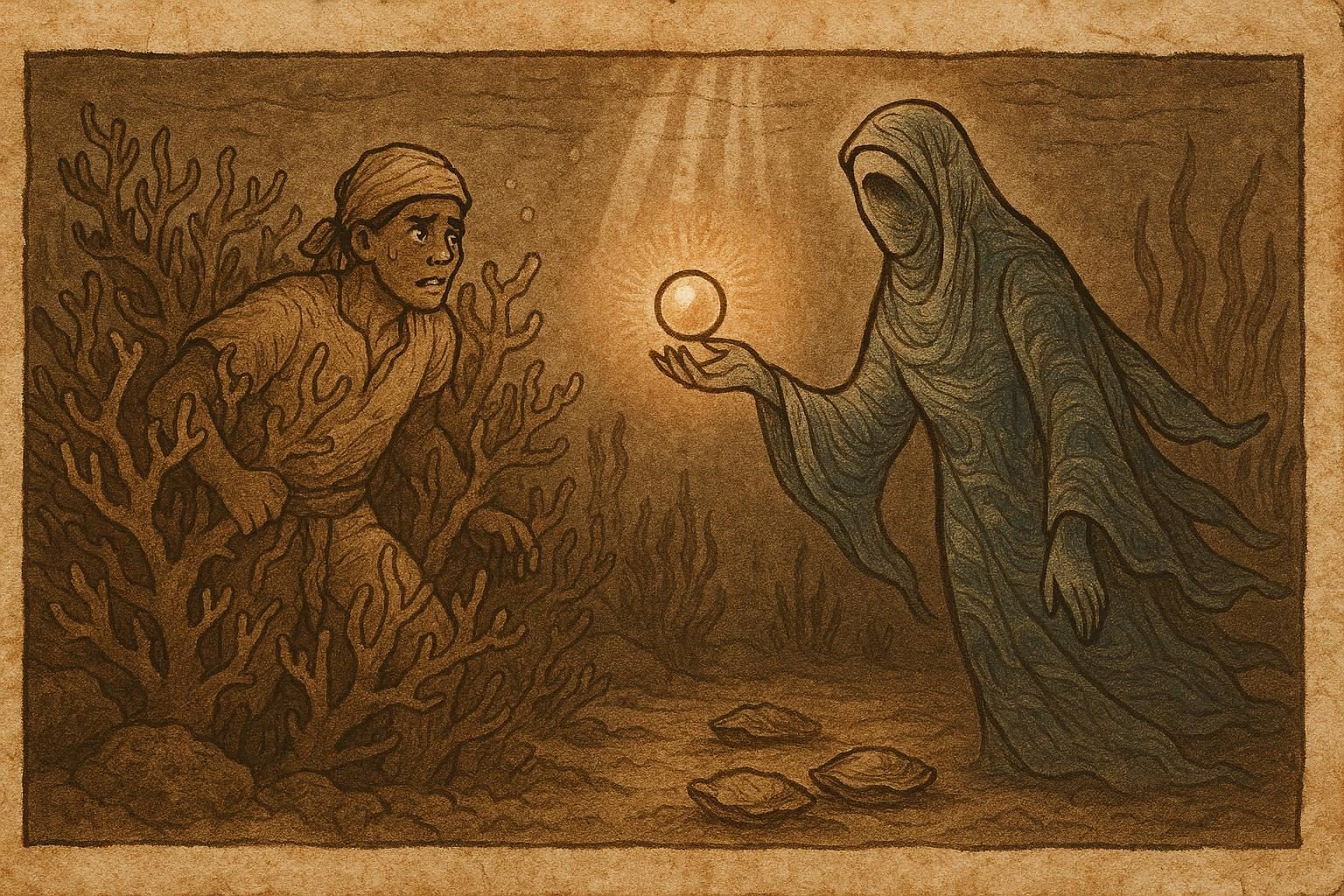
In the days before oil reshaped the islands of Bahrain, when the sea was both livelihood and judge, pearl divers lived by the rhythm of the tides. Among them was Khalifa, a skilled diver from the communities that worked the rich oyster beds near Sitra. Like many men of his time, he carried both courage and need in his chest. Each descent into the green-blue depths promised sustenance for his family, and the risk of never seeing the sun again.
One still morning, Khalifa joined his crew at sea. The air was heavy with salt, and the water lay deceptively calm. He tied the diving rope around his waist, whispered a prayer learned from his elders, and slipped beneath the surface. Light thinned as he descended, the world narrowing to breath, pressure, and shadow. Oysters clung to the seabed, and coral rose like ancient stone.
As Khalifa reached for a promising cluster, his rope snagged. It twisted tightly around jagged coral, biting into his waist as he struggled. Panic surged. He tugged once, twice—each movement stealing precious air. The surface felt impossibly far away. The sea, which had fed generations, now closed around him like a clenched fist.
Then the darkness shifted.
From between the coral columns emerged a figure unlike any Khalifa had known. She moved without effort, her form glowing softly in the depths. Her skin shimmered as though lit from within, and her hair drifted around her like strands of seaweed stirred by a gentle current. In her hands she held a luminous pearl, bright enough to cast light across the seabed.
The mermaid did not speak with words, yet Khalifa understood her. With calm strength, she freed his rope from the coral, easing it loose as though the stone itself obeyed her will. He felt the pressure ease, the panic retreat. She gestured for him to follow, and though fear remained, gratitude guided his movements.
She led him through a hidden passage between reefs to an oyster bed unlike any he had ever seen. Pearls glimmered faintly in the shells, numerous and large, resting in silence beneath the sea. Before Khalifa could reach for them, the mermaid’s presence sharpened, her warning clear and heavy.
He could take what he needed. He could rise and prosper.
But he must never speak of her, and he must never return with greed in his heart.
The sea seemed to hold its breath as Khalifa nodded. In moments, he was guided back toward the path of ascent, his lungs burning, his heart pounding with awe and relief. He broke the surface gasping, hauled into the boat by his companions who praised his survival and marveled at the pearls he carried.
In the months that followed, Khalifa’s fortune changed. The pearls he sold were fine and rare, and wealth came steadily. His name spread through the markets of Muharraq, and his household knew comfort instead of worry. Yet with prosperity came restlessness. The memory of the hidden oyster bed lingered, shining in his thoughts brighter than any pearl he sold.
At first, he resisted. He remembered the warning, the calm authority of the mermaid’s gaze. But slowly, contentment thinned. Others grew curious about his success. Questions pressed in like the tide. Khalifa began to imagine not survival, but abundance beyond measure.
At last, he gave in.
He gathered other divers and returned to the waters near Sitra, his heart set not on sustenance but on possession. As their boat drifted over the familiar depths, the sea felt different, darker, less forgiving. Khalifa descended again, leading the way to the hidden bed.
But the light that once welcomed him did not appear.
Instead, the water churned. From the shadows rose a shape vast and terrible. The mermaid emerged transformed, her beauty twisted into something ancient and monstrous, her luminous calm replaced by the force of the deep itself. The sea surged at her command. Waves struck the boat above, splintering wood and casting men into chaos.
The vessel capsized.
The divers struggled toward the surface, coughing and crying out, but Khalifa was pulled downward. The last they saw of him was a glimpse of his form vanishing into the dark, claimed by the depths he had betrayed.
Khalifa never returned.
Fishermen later spoke in hushed tones of a presence beneath the waves on moonless nights near the oyster beds. Some claimed to see a shadow moving where no diver swam, guarding the pearls in silence. They said it was Khalifa’s ghost, bound to the sea, a reminder etched into the water itself.
From that time on, elders told the story to young divers before their first descent: the sea gives, but it also remembers.
Moral Lesson
This tale teaches that contentment preserves life, while greed invites ruin. The sea’s bounty must be respected, for wealth gained without restraint carries a cost deeper than the ocean itself.
Knowledge Check
1. Who is Khalifa in Bahraini folklore?
Khalifa is a pearl diver whose story warns against greed during Bahrain’s pearling era.
2. Where does the story take place?
Near the oyster beds of Sitra and the pearling communities of Muharraq, Bahrain.
3. What supernatural being appears in the tale?
A mermaid who guides and later punishes the diver for breaking her warning.
4. What condition does the mermaid place on Khalifa?
He must not speak of her or return to the pearl bed with greed.
5. What happens when Khalifa breaks his promise?
The mermaid transforms into a monstrous sea creature and takes him to the depths.
6. What cultural lesson does the story convey?
Respect for the sea, contentment, and the dangers of avarice.
Source
Adapted from Tales from Ancient Bahrain (1987) by A. R. Khalla, recorded from elderly pearl divers in Muharraq.