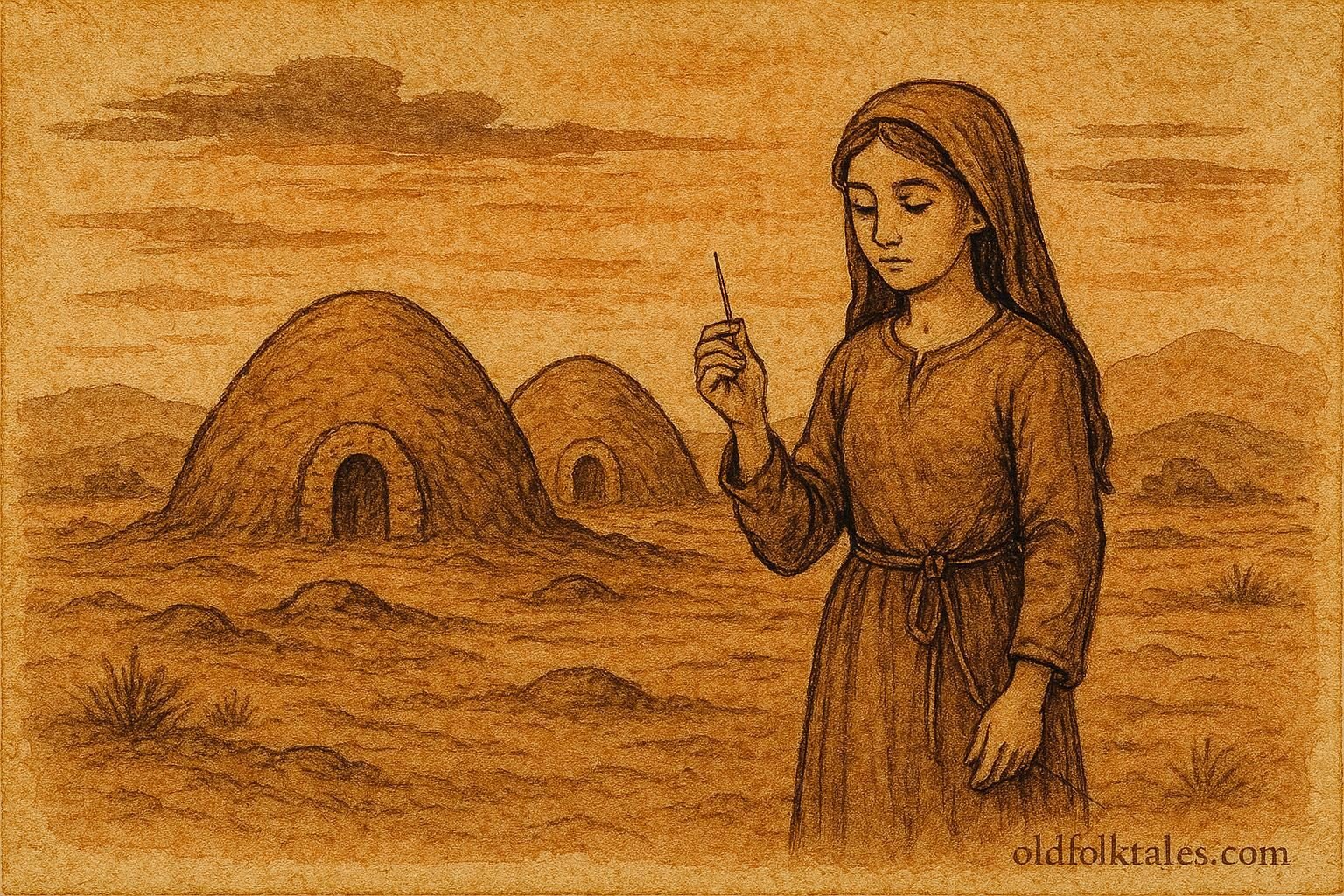
At the heart of Bahrain, where the land rises and falls in silent earthen waves, lie the ancient burial mounds of A’ali. Hundreds of them stretch across the plain like the backs of sleeping giants, built by hands long turned to dust. At dusk, when the sun sinks low and the sky glows copper and ash, the mounds cast long shadows that twist and merge. It was said among the villagers that this was the hour when one must not wander, for the burial grounds were guarded by a fearsome being known as Dhul-Makhab, the ghoul of A’ali.
Dhul-Makhab was no ordinary creature. Elders whispered that he was a shape-shifter, born of the desert and the dead. He could appear as a handsome Bedouin traveler, his robe clean and his voice gentle. At times, he took the form of a lost child, weeping softly among the mounds. Sometimes, he was nothing more than a shimmering mirage, wavering in the heat of twilight. Whatever shape he chose, his purpose was always the same, to lead travelers astray.
Those who followed him found themselves drawn deeper into the maze of burial mounds, where paths curved back upon themselves and landmarks vanished. Water skins emptied. Throats burned. By the time they realized the deception, escape was no longer possible. The ghoul never struck them down with claws or teeth; instead, he let the desert and thirst claim them, adding their silence to the long memory of the land.
For generations, the people of A’ali village warned their children never to approach the mounds at dusk. Yet curiosity, as always, proved stronger than fear.
Among the villagers lived a clever young girl named Fatima. She was known for her sharp mind and steady hands, and she listened closely to the stories told by elders rather than dismissing them as idle tales. Fatima believed that every story held a lesson, and that knowledge, when used wisely, could be stronger than fear.
One evening, as the call of birds faded and the sky dimmed, Fatima prepared herself. She tied a strong thread around her waist, leaving the other end secured at the entrance to the burial grounds. Into her pocket, she placed a silver needle, an object said to repel ghouls. The elders spoke of silver as a metal that unsettled beings born of illusion and shadow, a belief shaped by Islamic influence layered upon far older traditions.
With calm steps, Fatima entered the burial mounds.
The air grew still. Soon, she heard a voice calling softly. Ahead stood a lost child, eyes wide and frightened, asking for help to find the way home. Fatima felt her heart tighten, but she remembered the warnings. Without answering, she pricked her finger lightly with the silver needle and held it where the figure could see.
The child vanished like smoke.
Moments later, a handsome Bedouin appeared, offering water and guidance through the mounds. His smile was warm, his words kind. Again, Fatima revealed the needle. This time, the figure’s face twisted, his form flickering before settling into its true shape.
Before her stood Dhul-Makhab, his eyes burning with ancient cunning.
Instead of fleeing, Fatima spoke calmly. She told the ghoul that she knew the burial mounds were ancient and sacred, and that greed had brought many to their deaths. She claimed she sought not plunder, but understanding. Intrigued by her courage and bound by the strange rules that governed such beings, Dhul-Makhab followed her deeper into the mounds, boasting of his power.
As they walked, Fatima subtly kept hold of the guiding thread, ensuring she never lost her path. She questioned the ghoul carefully, praising his knowledge and pretending awe. In his pride, Dhul-Makhab revealed the locations of ancient treasures buried beneath certain mounds, offerings placed with the dead long ago.
When the moment came, Fatima thrust the silver needle toward him. The ghoul recoiled, howling as his form dissolved into dust and mirage, vanishing into the dusk.
Fatima followed the thread back to the entrance and returned safely to A’ali.
True to her character, she did not keep the treasures for herself. Instead, she distributed them among the poor, easing hunger and hardship throughout the village. From that day on, Dhul-Makhab was no longer seen, and the burial mounds stood silent once more, respected, feared, and undisturbed.
Moral Lesson
This folktale teaches that wisdom and restraint are stronger than fear or greed. Knowledge protects those who respect the past, while arrogance and deception ultimately undo themselves.
Knowledge Check
1. Who was Dhul-Makhab in the folktale?
He was a shape-shifting ghoul guarding the A’ali burial mounds.
2. What forms could Dhul-Makhab take?
He appeared as a Bedouin traveler, a lost child, or a mirage.
3. How did the ghoul trap his victims?
He led them deeper into the burial mounds until they died of thirst.
4. What tools helped Fatima survive the burial mounds?
A guiding thread and a silver needle that repelled ghouls.
5. What did Fatima do with the ancient treasures?
She distributed them among the poor of A’ali village.
6. What cultural purpose did this folktale serve?
It explained the burial mounds and discouraged grave robbing.
Source & Cultural Origin
Source: Field recordings from the Memory of the Nation project (BACA), featuring interviews with A’ali elders (2010).
Origin: Bahrain, a pre-Islamic tale later shaped by Islamic beliefs, explaining burial mounds and warning against greed.