Along the banks of the Perfume River in the ancient imperial city of Hue, where mist rises at dawn from water the color of jade and the towers of forgotten temples pierce through canopies of longan trees, there grows a vine known throughout central Vietnam for its extraordinary properties. The locals call it dây sao vàng, the golden star vine, for its flowers bloom in perfect five-pointed stars that gleam like hammered gold in the sunlight. But what makes this vine truly remarkable is not its beauty alone: according to folk tradition stretching back through countless generations, the golden star vine blooms out of season only when a newborn will bring great fortune to the village.
In a time when the Nguyễn emperors still ruled from the Imperial City and Hue was the heart of Vietnamese culture and learning, there lived on the outskirts of the city a poor couple named Minh and Lan. They made their living as they could: Minh worked as a day laborer in the rice paddies and helped repair fishing nets for more prosperous families, while Lan took in washing and sewing, her fingers moving swiftly even in the dim light of their small oil lamp.
Click to read all East Asian Folktales — including beloved stories from China, Japan, Korea, and Mongolia.
Their home was barely worthy of the name: a humble hut constructed from bamboo and thatch, with walls that let in the wind during storms and a floor of packed earth that turned to mud when the rains came. They owned almost nothing: a few clay pots for cooking, two sets of clothes each, a sleeping mat woven from dried reeds, and little else. Yet despite their poverty, Minh and Lan possessed something that many wealthier families lacked: they were rich in kindness, generosity, and hope.
When Lan discovered she was with child, both joy and worry filled their hearts. How would they feed another mouth when they could barely sustain themselves? Where would they find money for the herbs and medicines that new mothers need? But Lan placed her hand on her growing belly and smiled.
“We will manage,” she said to Minh. “Love will sustain us where money cannot. This child will be a blessing, not a burden.”
The pregnancy progressed through the hot, humid months of summer. Lan grew large and uncomfortable, but she continued her work, washing clothes in the river until the day before her labor began. Neighbors, though hardly better off themselves, brought what they could spare: a handful of rice, a few eggs, a small fish wrapped in banana leaves. The community might have been poor in material wealth, but they understood the importance of supporting one another.
It was on a night in early autumn, when the air had finally begun to cool and the moon hung full and bright above the Perfume River, that the miracle occurred.
Minh had been away seeking work in a neighboring village and was returning home late. As he approached their humble dwelling, he noticed something strange: the entire area around their hut was bathed in a soft golden light, as if illuminated by hundreds of tiny lanterns. Drawing closer, he saw the source of this radiance and stopped in his tracks, his mouth falling open in astonishment.
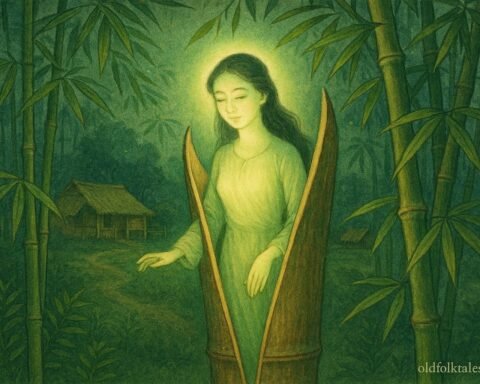
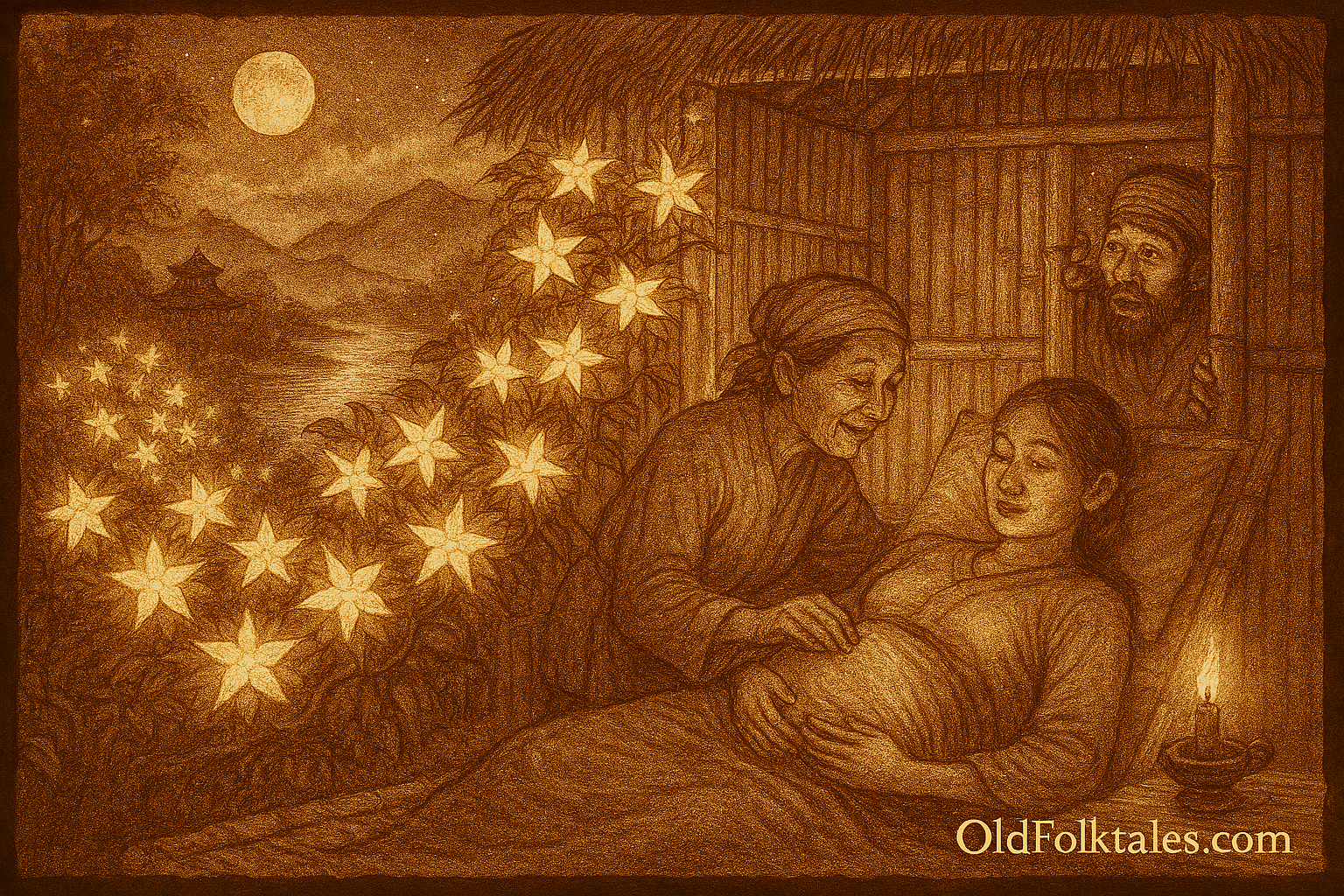
The golden star vines that grew wild along the riverbank and in the scrubby vegetation near their home were in full bloom. Not just a few flowers, but thousands upon thousands of perfect five-pointed stars, each one glowing with a luminescence that seemed to come from within the petals themselves. The vines had climbed up the bamboo walls of their hut, covering it in a tapestry of golden blossoms that swayed gently in the night breeze.
Minh stood frozen, his heart pounding. Everyone in Hue knew the legend of the golden star vines. They bloomed reliably in spring, their golden flowers a common sight throughout the region. But when they bloomed out of season, especially at night with this supernatural radiance, it meant only one thing: a child of great destiny was about to be born.
His wonder was interrupted by a cry from inside the hut. Lan’s labor had begun.
Minh rushed inside to find his wife gripping the bamboo frame of their sleeping platform, her face contorted with pain but her eyes filled with determination. The midwife, an elderly woman named Bà Tư who had helped deliver half the children in their district, was already there, having been summoned by a neighbor who had seen the miraculous blooms.
“The vines have spoken,” Bà Tư said quietly to Minh, her wrinkled face solemn. “Whatever child is born tonight will be touched by destiny. Make sure your wife has everything she needs. This is no ordinary birth.”
Through the long hours of that night, as Lan labored to bring new life into the world, the golden star vines continued to glow, casting their gentle light through the gaps in the bamboo walls. Neighbors gathered at a respectful distance, watching in awe, whispering among themselves about what this omen might mean.
Just before dawn, as the first pale light appeared on the eastern horizon, a baby’s cry pierced the air. The child was a girl, small but perfectly formed, with eyes that seemed unusually alert and aware for a newborn. As Bà Tư cleaned and wrapped the infant, the golden star vines began to fade, their glow diminishing with the coming of daylight until they appeared as ordinary flowers once more.
Minh and Lan named their daughter Hoa, which means “flower,” in honor of the miraculous blooms that had heralded her arrival.
Hoa grew, and as she did, it became apparent that she was indeed no ordinary child. While other infants cried and fussed, Hoa was remarkably calm and observant. She learned to walk early, to speak early, to understand complex ideas that should have been beyond her years. But what truly set her apart was her affinity for healing.
Even as a small child, Hoa would wander to where the golden star vines grew and sit among them, her tiny fingers touching the leaves and flowers as if listening to secrets they whispered. She began gathering herbs from the forest and the riverbank, somehow knowing instinctively which plants could soothe fever, which could ease pain, which could knit broken bones and heal infected wounds.
By the time Hoa was twelve years old, people throughout the district knew of her gifts. They would come to the humble hut seeking help for their ailments, and Hoa would prepare remedies using the plants she had gathered, mixing them according to knowledge that seemed to come from somewhere deep within her, knowledge she could not explain but simply knew.
Then came the year of the great epidemic.
A terrible disease swept through Hue and the surrounding villages, striking without warning and spreading with frightening speed. Those afflicted developed high fevers, violent coughing, and a weakness so profound they could not rise from their beds. Many died within days of showing the first symptoms. The physicians of the Imperial City tried every remedy they knew, but nothing seemed to work. Entire families were wiped out. Villages were decimated. Fear gripped the region like a cold hand.
Hoa was sixteen years old when the epidemic reached her village. She watched as neighbors fell ill, as children she had played with as a young girl grew fevered and died, as strong men who had worked in the fields were reduced to skeletal figures too weak to lift their heads. The conventional medicines were useless against this plague.
For three days and three nights, Hoa retreated to the grove where the golden star vines grew thickest, the same place where they had bloomed to announce her birth. She sat among the vines in meditation, her mind reaching out to the knowledge that lived within her, searching for an answer to the terrible sickness that was destroying her community.
On the third night, under a sky brilliant with stars, Hoa received her revelation. She understood suddenly what needed to be done: a complex remedy combining the roots of the golden star vine itself with seven other plants found near the Perfume River, prepared in a specific way and administered at precise intervals.
Working with desperate speed, Hoa began gathering the ingredients and preparing the medicine. Her parents helped her, though they didn’t fully understand what she was doing. They simply trusted in their daughter’s extraordinary gifts, gifts that had been prophesied by the miraculous bloom of the golden star vines on the night of her birth.
Hoa administered her remedy first to the sickest patients in her own village, those who were already at death’s door. Within hours, their fevers began to break. Within a day, they could sit up and take food. Within three days, they were recovered, weak but alive, saved from a disease that had seemed certain to kill them.
Word spread rapidly. Hoa’s remedy was prepared in massive quantities, with volunteers helping to gather the necessary plants and mix the medicine according to her instructions. It was distributed throughout the affected region, and wherever it went, the epidemic’s grip was broken. Lives were saved by the hundreds, then by the thousands.
The grateful people of Hue wanted to reward Hoa with wealth and honors. The imperial court sent representatives offering her a position as a court physician, along with money and lands. But Hoa declined all material rewards.
“The golden star vines bloomed to announce that I would bring fortune to my village,” she said. “They did not say I would gain fortune for myself. The ability to heal is a gift, not a commodity to be sold. I will continue to help those who need healing, as I have always done, asking only that people remember to show kindness to one another and to honor the natural world that provides such powerful medicines.”
Hoa lived a long life, continuing her work as a healer until she was old and gray. Her reputation spread far beyond Hue, and people traveled from distant provinces to seek her help. She trained others in her methods, ensuring that her knowledge would not be lost. She taught them not just about medicines and herbs, but about compassion, about seeing patients as whole people rather than collections of symptoms, about listening to what the natural world could teach.
When Hoa finally passed away at a great age, surrounded by children and grandchildren who had inherited both her healing gifts and her generous spirit, something remarkable happened. The golden star vines throughout the region bloomed out of season once more, just as they had on the night of her birth, covering the land in a carpet of golden stars that glowed softly in the twilight.
From that day forward, the people of Hue understood that the golden star vines were not just beautiful flowers but sacred guardians, forever linked with protection and healing. They tended the vines carefully, never allowing them to be cut down or destroyed. When the flowers bloomed in their regular season each spring, mothers would bring their children to see them, telling the story of Hoa and the miraculous night when the vines announced the birth of the girl who would save her people.
The tradition continues to this day. In villages around Hue, golden star vines are planted near homes and temples, their presence a reminder of the connection between humans and nature, between prophecy and fulfillment, between individual destiny and communal benefit. And when, on rare occasions, the vines bloom out of season, people still gather to witness the miracle, still whisper that somewhere nearby, a child of special destiny has been born.
Click to read all Southeast Asian Folktales — featuring legends from Thailand, Indonesia, Vietnam, and the Philippines.
The Moral Lesson
This legend teaches that true fortune lies not in accumulating wealth but in using one’s gifts to serve others. Hoa’s destiny, announced by the miraculous vines, was fulfilled through compassion and healing rather than personal gain. The story shows that extraordinary abilities carry responsibilities to the community, and that the greatest rewards come from alleviating suffering and spreading knowledge rather than hoarding it for profit.
Knowledge Check
Q1: What was the traditional belief about golden star vines in Hue folklore? A: According to folk tradition in Hue, golden star vines (dây sao vàng) bloomed out of season with supernatural radiance only when a newborn destined to bring great fortune to the village was about to be born. While they bloomed normally in spring, their miraculous appearance at other times was considered a prophecy of an extraordinary child’s arrival.
Q2: Who were Minh and Lan in the Vietnamese legend? A: Minh and Lan were a poor couple living on the outskirts of Hue. Minh worked as a day laborer in rice paddies and repaired fishing nets, while Lan took in washing and sewing. Despite their extreme poverty, living in a humble bamboo hut, they were rich in kindness, generosity, and hope, qualities that shaped their daughter’s character.
Q3: What miracle occurred on the night of Hoa’s birth? A: On the night Hoa was born, thousands of golden star vines around her parents’ humble hut bloomed out of season, glowing with supernatural luminescence that bathed the entire area in golden light. The vines covered their home in radiant blossoms until dawn, when the glow faded as the baby girl was born, fulfilling the prophecy.
Q4: What special abilities did Hoa possess as she grew up? A: Hoa had an innate gift for healing that manifested from early childhood. She instinctively knew which plants could cure various ailments, gathering herbs and preparing remedies using knowledge she couldn’t explain but simply possessed. She had an affinity for the golden star vines and learned by sitting among them, as if they whispered healing secrets to her.
Q5: How did Hoa save her village from the epidemic? A: When a terrible epidemic struck Hue that killed many people and resisted all conventional treatments, sixteen-year-old Hoa meditated for three days among the golden star vines. She received a revelation about a complex remedy combining golden star vine roots with seven other riverside plants, prepared and administered in a specific way. This medicine broke the epidemic’s grip, saving thousands of lives.
Q6: What does the golden star vine symbolize in Vietnamese culture according to this legend? A: The golden star vine symbolizes the connection between nature and human destiny, prophecy and healing, and the responsibility of gifted individuals to serve their communities. It represents protection, the wisdom found in the natural world, and the belief that extraordinary children are chosen by higher powers to bring benefit to others. The vines became sacred guardians forever linked with healing traditions in Hue.
Source: Adapted from Vietnamese Folk Tales and Legends compiled by Nguyễn Đổng Chi.
Cultural Origin: Hue (Imperial City), Central Vietnam