In the heart of Vientiane, the capital of Laos, rises the golden spire of Pha That Luang, the Great Stupa, the most sacred Buddhist monument in the entire nation. Its golden surface catches the sun and blazes like captured fire, visible for miles across the Mekong River valley. For centuries, this magnificent structure has been the spiritual center of the Lao people, a place where monks pray, pilgrims gather, and the faithful come to make merit and seek blessings.
Each year during the full moon of the twelfth lunar month, the That Luang Festival transforms the grounds around the great stupa into a sea of celebration. Thousands of people journey from across Laos and beyond to participate in the sacred rituals: the procession of monks carrying candles around the stupa, the offerings of flowers and incense, the chanting of sutras that echo through the night air, and the joyful festivities that blend ancient tradition with community celebration.
Click to read all East Asian Folktales — including beloved stories from China, Japan, Korea, and Mongolia.
It was during one such festival, many generations ago, that the miracle of the Weeping Lotus occurred, an event that would become one of the most cherished legends in Lao Buddhist tradition.
The festival that year had been particularly grand. The golden stupa had been freshly gilded, its surface gleaming with renewed splendor. Monks from every province had traveled to Vientiane to participate in the ceremonies. The air was thick with the scent of incense and jasmine, and the sound of prayer bells mingled with the laughter of children and the voices of vendors selling their wares.
Among the many monks present was an elderly abbot named Luang Pho Kham, a revered teacher who had spent his entire life in service to the Buddha’s teachings. Luang Pho Kham was known throughout Laos for his wisdom, his gentle manner, and most of all, for his dedication to his students. He had trained hundreds of young monks over his long lifetime, guiding them with patience and compassion through the complexities of Buddhist philosophy and meditation practice.
But as Luang Pho Kham walked slowly around That Luang during the festival procession, his heart was heavy with an unspoken sorrow. Many of his former students had abandoned the monastic life, seduced by the material world, forgetting the teachings they had once embraced so earnestly. Others had been scattered by wars and political upheavals that had troubled the region, their fates unknown to their old teacher. Some had passed away, their lives cut short before they could fully realize the wisdom they had sought.
The old abbot looked at the young monks walking beside him, their saffron robes bright in the candlelight, and he wondered how many of these would remain on the path, how many would remember their training when faced with life’s temptations and trials. The thought filled him with profound sadness, a grief made sharper by his advanced age and the knowledge that his time to guide and teach was drawing to a close.
That night, after the formal ceremonies had ended and most of the pilgrims had retired to their camps or homes, Luang Pho Kham could not sleep. His sorrow weighed too heavily upon him. He rose from his sleeping mat and walked alone to the base of That Luang, seeking solace in meditation before the sacred monument.
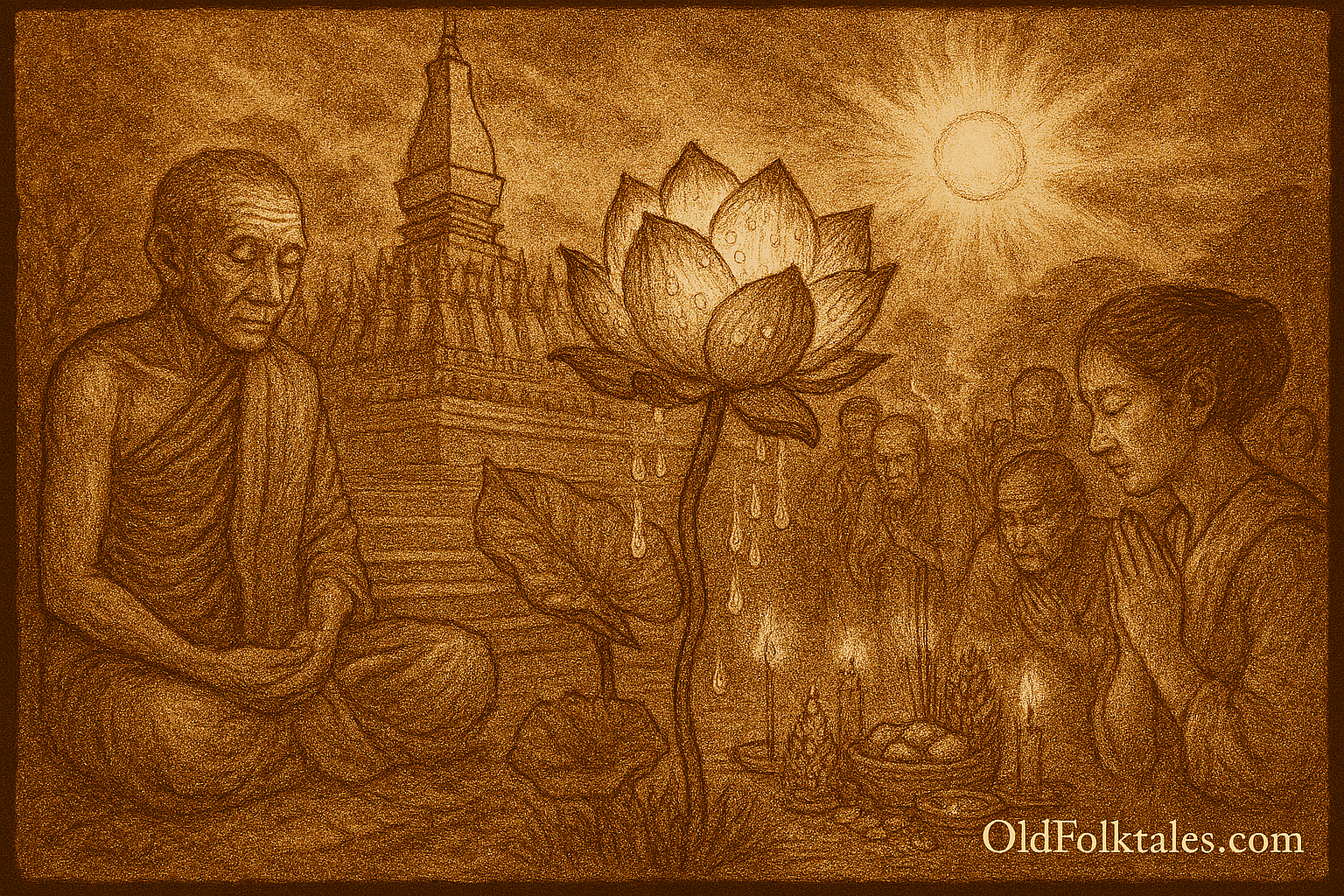
The stupa rose above him, its golden surface glowing faintly in the light of the full moon. The old monk sat in the traditional meditation posture, his weathered hands folded in his lap,and began to pray. He prayed for his lost students, for those who had strayed from the path, for those whose lives had been cut short before enlightenment could be achieved. He prayed that wherever they were, in this life or the next, they would find peace and eventually return to the dharma.
As he prayed, tears began to flow down his lined cheeks. These were not tears of despair but tears of compassion, of a teacher’s infinite love for his students, of hope that transcended the disappointments of the mortal world. The tears fell onto the ground at the base of the stupa, soaking into the earth where countless pilgrims had walked and prayed over the centuries.
Luang Pho Kham meditated through the night, his prayers becoming deeper, more profound, until he entered a state of consciousness where the boundaries between self and universe seemed to dissolve. In this state, he felt his sorrow transform into something else: a blessing, a wish for peace that encompassed not just his lost students but all beings who struggled and suffered.
As dawn approached and the old monk finally emerged from his deep meditation, he opened his eyes and gasped in wonder. There, growing from the exact spot where his tears had fallen, was a lotus bud that had not been there before. But this was no ordinary lotus. Its petals were pure white with edges that seemed to shimmer with an iridescent quality, like mother of pearl catching the light. And strangest of all, despite the approaching dawn, the bud was just beginning to open, as if it had bloomed during the night rather than with the morning sun as lotus flowers typically do.
Luang Pho Kham stared at the miraculous flower, understanding immediately that something sacred had occurred. The lotus, the most revered symbol in Buddhism, representing spiritual enlightenment emerging from the mud of material existence, had appeared in response to his prayers and tears. It was a sign, but of what, he was not yet certain.
As the first rays of sun touched the golden spire of That Luang, other early risers began to appear for morning prayers. They quickly noticed the unusual lotus and the old monk sitting beside it. Word spread rapidly through the festival grounds: a miraculous lotus had bloomed at night near the great stupa, and Luang Pho Kham had witnessed its appearance.
Villagers and monks gathered around the flower, maintaining a respectful distance, speaking in hushed, awed tones. The lotus continued to open slowly, revealing layer after layer of pristine white petals, each one perfect in form. But what truly captured everyone’s attention was the appearance of the petals themselves. In the early morning light, they seemed to glisten as if covered with dew, but the liquid on them was not water. It looked and moved like tears, clear droplets that caught the light and sparkled with an almost supernatural brilliance.
“The lotus is weeping,” whispered an old woman, her hands pressed together in prayer. “It carries the tears of Luang Pho Kham, the sorrow of a teacher for his lost disciples.”
An elderly monk who had known Luang Pho Kham for many years approached the abbot. “What does this mean, Venerable One? Why has this lotus appeared in such an unusual way?”
Luang Pho Kham, still moved by the depth of his meditation and the appearance of the miraculous flower, spoke softly. “Last night, I wept for my students who have lost their way, who have forgotten the dharma, who have been scattered by the winds of karma. My tears fell onto this sacred ground, and the compassion of the Buddha has answered. This lotus is a reminder that no sorrow is wasted when it arises from genuine love and compassion. Every tear shed for others is a seed that can bloom into blessing.”
As the sun rose higher, more people gathered. The festival, which had been winding down, took on renewed energy focused on the miraculous lotus. People began bringing offerings: flowers, incense, fruits, candles, and coins, placing them respectfully around the weeping lotus. They made wishes and prayers, each person bringing their own sorrows and hopes to this sacred spot.
Then, as the morning progressed and the offerings accumulated around it, something even more extraordinary occurred. The lotus, which had been facing slightly downward as if in mourning, slowly began to move. Its stem straightened, and the entire flower turned, its face rotating toward the east where the sun was now climbing into the sky.
A collective gasp rose from the assembled crowd. In Buddhist tradition, the east is the direction of enlightenment, the direction from which spiritual wisdom comes. The lotus turning toward the east was seen as a powerful symbol, a message from the spirit world.
“It is a blessing,” declared one of the senior monks present. “The weeping lotus has accepted our offerings and transformed its sorrow into hope. By turning toward the east, it signals that peace will come, that those who are lost will find their way, that suffering will eventually transform into enlightenment.”
Luang Pho Kham watched the turning lotus with tears once again streaming down his face, but this time they were tears of joy and relief. He understood now what the miracle meant: his sorrow for his lost students was heard and honored. The lotus appeared not to compound his grief but to transform it, to show that compassionate concern for others is never wasted, that prayers for the welfare of others are always answered in ways we might not expect.
The festival, which should have ended that day, continued for three more days as people came from across the region to witness the Weeping Lotus and to make offerings. The flower remained fresh and vibrant throughout this time, never wilting despite being cut from any root or water source, another sign of its miraculous nature.
On the fourth day, as the last of the special offerings were being made, the lotus suddenly released a cascade of the tear-like droplets, sending them in a gentle shower over those gathered nearby. People reported feeling a profound sense of peace wash over them as the droplets touched their skin, as if the accumulated blessings and prayers of all the offerings were being distributed to those present.
Then, as the sun set on that fourth evening, the lotus began to glow with a soft, golden light, the same color as the great stupa behind it. The light grew brighter and brighter until people had to shield their eyes, and when they looked again, the lotus had vanished, leaving behind only a faint fragrance of sandalwood and jasmine and a sense of profound peace that lingered in the air.
From that day forward, the story of the Weeping Lotus became an integral part of That Luang’s spiritual heritage. Luang Pho Kham lived several more years, his heart lightened by the miracle he had witnessed. Many of his former students, hearing the story, returned to visit their old teacher, some even taking up monastic life again, moved by the knowledge that he had wept and prayed for them.
To this day, during the That Luang Festival, monks and laypeople gather at the spot where the Weeping Lotus appeared. They make special offerings there, dedicating them to lost loved ones, to those who have strayed from the path, to all beings seeking peace. Some claim to smell the fragrance of sandalwood and jasmine on quiet mornings at that spot, a lingering reminder of the miraculous flower.
The legend teaches pilgrims that genuine sorrow for others, when combined with compassionate prayer and action, can create miracles. The Weeping Lotus reminds the faithful that no prayer is unheard, no tear of compassion is wasted, and that even the deepest grief can transform into blessing when offered with pure intention to the service of others’ welfare.
Click to read all Southeast Asian Folktales — featuring legends from Thailand, Indonesia, Vietnam, and the Philippines.
The Moral Lesson
This legend teaches that compassionate grief for others is a sacred emotion that can transform into blessing and healing. Luang Pho Kham’s tears for his lost students were not signs of weakness but expressions of profound love that the universe honored with a miracle. The story reminds us that genuine concern for others’ spiritual welfare, expressed through prayer and tears, plants seeds that bloom in unexpected ways, bringing peace not just to those we pray for but to entire communities.
Knowledge Check
Q1: What is Pha That Luang and why is it significant in Lao culture? A: Pha That Luang (the Great Stupa) is the most sacred Buddhist monument in Laos, located in Vientiane. Its golden spire serves as the spiritual center of the Lao people and hosts an annual festival during the twelfth lunar month’s full moon. The site has been a place of pilgrimage and prayer for centuries, representing national and spiritual identity.
Q2: Who was Luang Pho Kham and what caused his deep sorrow? A: Luang Pho Kham was an elderly, revered abbot known throughout Laos for his wisdom and dedication to teaching. His sorrow stemmed from seeing many of his hundreds of former students abandon monastic life, become scattered by wars and upheavals, or die before achieving enlightenment. His grief was a teacher’s compassionate concern for disciples who had lost their way.
Q3: What was miraculous about the lotus that appeared at That Luang? A: The lotus bloomed at night rather than at dawn as lotus flowers typically do, appearing exactly where Luang Pho Kham’s tears had fallen. Its white petals shimmered with iridescent quality and were covered with droplets that looked like tears. Most remarkably, it bloomed without being rooted in water or soil, defying natural laws.
Q4: What did the lotus turning toward the east symbolize in Buddhist tradition? A: In Buddhist tradition, the east represents the direction of enlightenment and spiritual wisdom. When the Weeping Lotus turned its face toward the east after receiving offerings, it was interpreted as a message that peace would come, lost souls would find their way back to the dharma, and suffering would eventually transform into enlightenment.
Q5: What happened during the lotus’s final moments before it vanished? A: On the fourth day, the lotus released a cascade of tear-like droplets over the gathered crowd, who reported feeling profound peace as the droplets touched them. Then it began glowing with golden light matching That Luang’s color, growing brighter until people had to shield their eyes. When they looked again, the lotus had vanished, leaving only sandalwood and jasmine fragrance.
Q6: How did the Weeping Lotus legend affect Luang Pho Kham’s former students? A: Many former students, upon hearing the story of their teacher weeping and praying for them, were deeply moved and returned to visit Luang Pho Kham. Some even resumed monastic life, touched by the knowledge that their teacher had maintained such profound compassion and concern for their spiritual welfare despite their having left the path.
Source: Adapted from the Lao National Museum Oral Folklore Collection.
Cultural Origin: Pha That Luang (Great Stupa), Vientiane, Laos (Lao Buddhist tradition)