
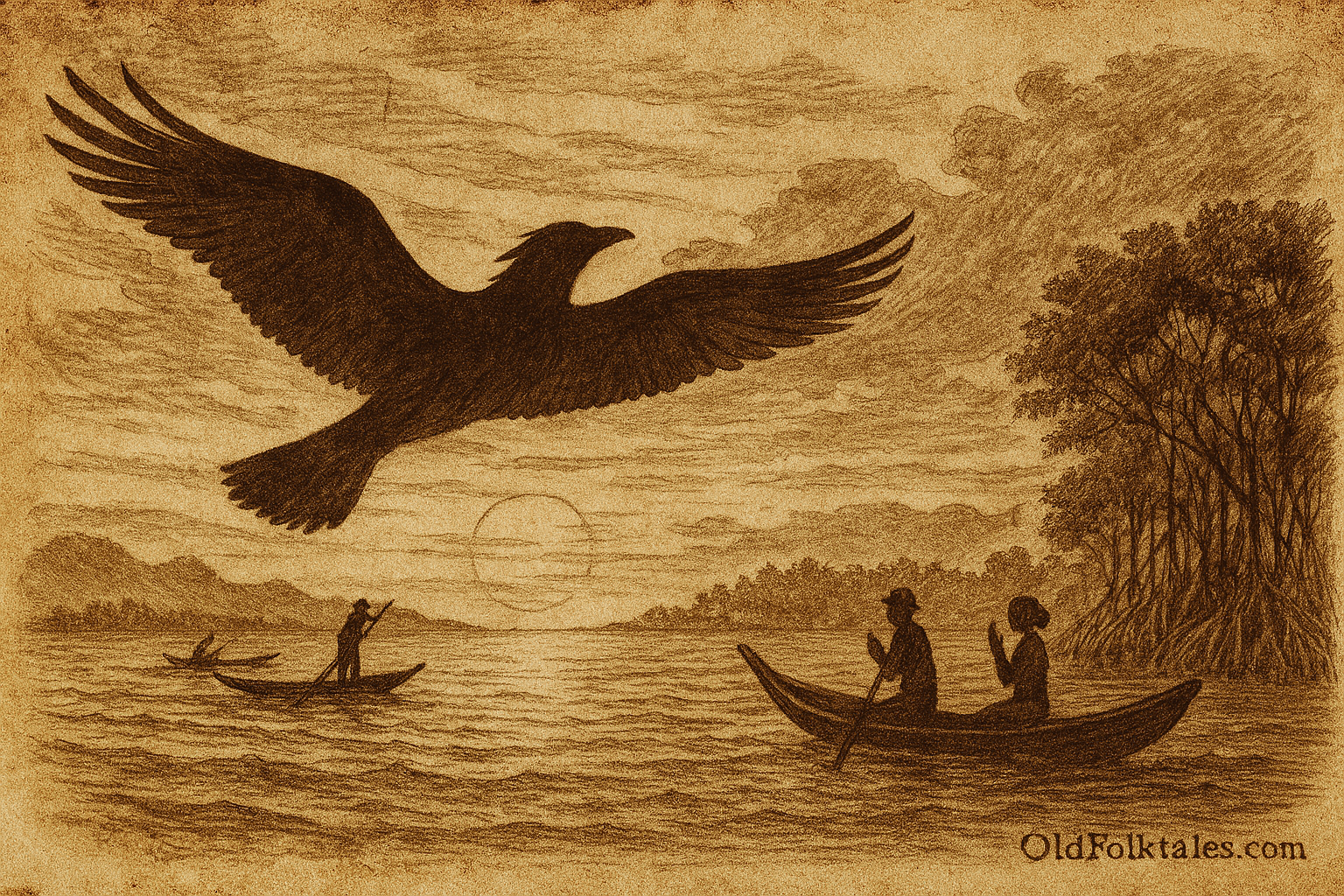
Off the coast of Brunei Darussalam, where the South China Sea meets the mangrove forests and mudflats of the northern shore, there lies a small island known as Pulau Selirong. The island is uninhabited now, its forests dense with nipah palms and kerangas trees, its beaches marked only by the tracks of monitor lizards and the occasional footprints of fishermen who stop to repair nets or seek shelter from sudden squalls. But to the fishing communities of nearby Muara and Serasa, Pulau Selirong is far more than just another dot of land in the coastal waters. It is a place watched over by a guardian, a mysterious presence that has protected generations of seafarers through its timely warnings.
The people who make their living from these waters speak of the Shadow Bird, a creature seen most often at dusk when the setting sun transforms the western sky into a canvas of burning oranges, deep crimsons, and violent purples. Against this dramatic backdrop, the bird appears as a massive silhouette, its wings spread wide as it circles above the island or glides slowly across the darkening sky. No one has ever seen the bird clearly, for it shows itself only as shadow, its form always backlit by the dying sun, its features obscured by the brilliant light behind it.
Click to read all East Asian Folktales — including beloved stories from China, Japan, Korea, and Mongolia.
Yet its size is unmistakable. This is no ordinary sea eagle or heron. The Shadow Bird’s wingspan, witnesses claim, stretches wider than a fishing boat is long. When it banks and turns, the movement is graceful but powerful, suggesting enormous strength held in perfect control. Sometimes it circles the island three times before vanishing into the gathering darkness. Other times it flies a straight path from south to north, its shadow racing across the water below like a dark prophecy written on the waves.
The elders of the fishing communities understand what the younger generation sometimes forgets: the Shadow Bird is not simply a remarkable creature or an optical phenomenon. It is the island’s ancestral messenger, a guardian spirit sent by those who came before to watch over their descendants and to warn them of approaching danger. Most specifically, the Shadow Bird appears before major storms, giving fishermen precious hours to secure their boats, reinforce their moorings, and prepare their homes for the tempest to come.
Old Haji Yusof, a fisherman who has worked the waters around Pulau Selirong for more than fifty years, remembers dozens of encounters with the Shadow Bird. His weathered face grows serious when he speaks of it, and his voice takes on the tone of someone recounting sacred history rather than mere personal experience.
“I first saw the bird when I was twelve years old, fishing with my father,” he recalls, his gnarled hands unconsciously miming the motion of pulling nets. “The evening was beautiful, the sky clear, the sea calm. We were heading home with a good catch when my father suddenly stopped rowing. He was looking at the sky, and I followed his gaze. There it was, huge and black against the red sunset, circling Pulau Selirong slowly, deliberately.”
“My father immediately turned the boat toward shore. ‘Storm coming,’ he said. I protested because the sky was clear, but he would not be argued with. ‘The bird has spoken,’ he said. ‘We must listen.’ We reached the village and my father spent the rest of the evening securing not just our boat but helping neighbors prepare theirs. Some of the younger men laughed at him, saying he was seeing omens where there were none. But my father simply smiled and continued his work.”
“That night, around midnight, the storm hit. It came from nowhere, or so it seemed to those who had not seen the bird. The wind shrieked like demons, the rain fell in sheets so thick you could not see your hand before your face, and the waves rose higher than coconut trees. Boats that had not been properly secured were torn from their moorings and smashed against the rocks. But our boat, and the boats of those who had listened to my father’s warning, survived intact.”
“After that night, I understood. The Shadow Bird is our protector, our early warning system given to us by the ancestors who knew these waters before us and who still watch over us from the spirit world.”
The appearance of the Shadow Bird follows a pattern that the fishing communities have learned to recognize over generations. When the bird circles the island three times, fishermen know they have approximately twelve to eighteen hours before a major storm arrives. This gives them time not only to secure boats and equipment but also to get other members of their families inland, to stock up on necessary supplies, and to help those who might need assistance preparing for the tempest.
When the bird flies straight from south to north, the timeline is shorter, often just six to eight hours. This pattern indicates a faster-moving storm system, one that requires immediate action rather than leisurely preparation. Experienced fishermen drop whatever they are doing when they see this flight pattern and race to complete their storm preparations.
There is a third, rarer pattern that only the eldest fishermen remember seeing: the Shadow Bird hovering in place above the island, its wings beating slowly to maintain position against the evening breeze. This, the elders say with grave voices, warns not just of storms but of natural disasters on a larger scale. Haji Yusof saw this pattern once in his life, three days before the earthquake and tsunami that devastated parts of Southeast Asia in 2004. Though Brunei was spared the worst of that catastrophe, the coastal communities experienced unusual tides and dangerous currents. Those who had heeded the Shadow Bird’s warning and moved their boats to protected anchorages suffered minimal damage.
Not everyone believes in the Shadow Bird, of course. Some modern fishermen, especially younger ones educated in urban schools and exposed to scientific explanations for natural phenomena, dismiss the stories as superstition. They attribute the sightings to unusually large sea eagles or frigatebirds, to tricks of light and shadow at sunset, to the tendency of human minds to see patterns and meaning where none exists.
But even skeptics often find themselves glancing toward Pulau Selirong at dusk, especially during seasons when storms are common. And when they see that massive silhouette against the burning sky, even the most rational among them feel a chill run down their spines and find themselves checking their boats’ moorings just to be safe.
There was one skeptic, a young man named Azman, who learned the hard way that some traditions deserve respect even if they are not fully understood. Azman had studied marine biology at university and returned to his home village full of modern knowledge and scientific certainty. When his uncle mentioned seeing the Shadow Bird and urged the family to prepare for a storm, Azman laughed dismissively.
“It is just a bird, Uncle,” he said. “Perhaps a large eagle or a trick of the light. There is no storm predicted by the meteorological department, and I trust their satellites and computers more than old stories about ancestral messengers.”
Azman’s uncle did not argue but quietly went about his preparations, as did most of the older fishermen in the village. Azman, however, left his expensive new boat inadequately secured, confident that his education and modern understanding trumped what he saw as primitive superstition.
The storm hit eighteen hours later, precisely as the pattern of the Shadow Bird’s flight had predicted to those who understood its language. It was not forecasted by the meteorological department until it was already upon them, having formed and intensified with unexpected speed. Azman’s boat, insufficiently secured, was torn loose and battered against the rocky shore, sustaining damage that cost him months of income to repair. The boats of those who had heeded the Shadow Bird’s warning, properly secured and positioned in protected coves, weathered the storm with minimal damage.
After that incident, Azman became more humble in his approach to traditional knowledge. He did not abandon his scientific training, but he learned to integrate it with the wisdom passed down through generations. Now, when he sees the Shadow Bird at dusk, he checks both the meteorological forecasts and his boat’s moorings, understanding that multiple sources of knowledge can coexist and complement each other.
The legend of the Shadow Bird has been passed down through countless generations of fishing families around Pulau Selirong. Grandmothers tell it to grandchildren as they mend nets in the afternoon shade. Fathers point out the bird to sons during evening fishing trips, teaching them to recognize its patterns and heed its warnings. The story is not written in books or preserved in museums, but it lives in the practical knowledge of people whose lives depend on reading the signs of sea and sky.
Some say the Shadow Bird is the spirit of an ancient headman who died protecting his people from invaders and who continues to guard his descendants from a different kind of danger. Others believe it is a collective manifestation of all the ancestors who died at sea, their love for their families so strong that it takes physical form as a protective guardian. Still others see it as a nature spirit, a being older than human settlement in Brunei, who has chosen to ally itself with the fishing communities and warn them of approaching storms.
Regardless of which interpretation one prefers, the practical result remains the same: those who watch for the Shadow Bird and heed its warnings survive storms that catch unprepared fishermen by surprise. The bird’s perfect track record over generations has earned it a place of respect and reverence in local tradition.
To this day, fishermen working the waters around Pulau Selirong keep one eye on their nets and one eye on the western sky as evening approaches. They know that most sunsets pass without incident, the sky displaying its usual spectacular show of colors before fading to darkness. But they also know that on some evenings, when conditions are right and danger approaches, they will see that massive silhouette circling against the burning sky, and they will drop everything to prepare, grateful for the warning, grateful for the protection, grateful that the ancestors still watch over them from beyond the veil of death.
The Shadow Bird continues its eternal vigil, appearing when needed, delivering its silent warning to those wise enough to watch and humble enough to listen. It is a bridge between past and present, between the living and the dead, between the natural world and the realm of spirit. And as long as fishing boats sail from Brunei’s shores, the legend will endure, passed from generation to generation, a living tradition that saves lives through its timeless wisdom.
Click to read all Southeast Asian Folktales — featuring legends from Thailand, Indonesia, Vietnam, and the Philippines.
The Moral Lesson
This legend teaches that ancestral wisdom and traditional knowledge deserve respect, even in an age of modern technology. The Shadow Bird represents the value of observing natural signs and heeding warnings from those who came before us. It reminds us that multiple forms of knowledge can coexist, that scientific understanding need not exclude traditional wisdom, and that humility in the face of nature’s power is not superstition but survival intelligence passed down through generations of hard-won experience.
Knowledge Check
Q1: What is Pulau Selirong and where is it located? A: Pulau Selirong is a small, uninhabited island off the coast of Brunei Darussalam, surrounded by mangrove forests and mudflats. Located near the fishing communities of Muara and Serasa, the island serves as home to the legendary Shadow Bird, an ancestral guardian spirit that watches over local fishermen and warns them of approaching storms.
Q2: How does the Shadow Bird appear to witnesses? A: The Shadow Bird appears at dusk as a massive silhouette against the colorful sunset sky. Its wingspan is described as wider than a fishing boat is long, but no one has ever seen its features clearly because it always appears backlit by the setting sun. It shows itself only as a dark shadow, its form powerful and graceful as it circles or glides across the sky.
Q3: What are the three flight patterns of the Shadow Bird and what do they mean? A: When the bird circles Pulau Selirong three times, fishermen have 12 to 18 hours before a major storm. A straight flight from south to north indicates 6 to 8 hours until a faster-moving storm. The rarest pattern is hovering in place, which warns of natural disasters on a larger scale, as seen three days before the 2004 tsunami that affected Southeast Asia.
Q4: What lesson did Azman learn about the Shadow Bird? A: Azman, a marine biology graduate, dismissed the Shadow Bird as superstition and refused to secure his boat properly despite his uncle’s warning. When the storm hit exactly as the bird’s pattern predicted but was not forecasted by meteorological departments, his boat was badly damaged. He learned that traditional wisdom and scientific knowledge can complement each other, becoming more humble in respecting ancestral guidance.
Q5: What do elders believe the Shadow Bird represents? A: Elders describe the Shadow Bird as the island’s ancestral messenger, a guardian spirit sent by ancestors to protect their descendants. Some believe it is the spirit of an ancient headman who died protecting his people, others see it as a collective manifestation of all ancestors who died at sea, while some view it as an ancient nature spirit allied with fishing communities.
Q6: How has the Shadow Bird legend been preserved in Brunei culture? A: The legend lives through oral tradition passed down through fishing families. Grandmothers tell it while mending nets, fathers teach sons to recognize the bird’s patterns during fishing trips, and the practical knowledge of reading its warnings is integrated into daily life. Rather than being preserved in books or museums, it survives as living, practical wisdom that continues to save lives.
Source: Adapted from the Brunei Museums Department, Selirong folklore register.
Cultural Origin: Pulau Selirong, Brunei Darussalam








