In the old neighborhoods of Kuwait, before bright streetlights chased away the dark and before children stayed awake past sunset, the evenings belonged to caution and quiet. Narrow alleys wound between mud-brick houses, and palm trees stood like silent guardians along the paths. When the wind rose after nightfall, it carried with it whispers, creaks, and the dry rustle of palm fronds brushing against one another. It was during such nights that parents spoke in hushed, serious tones of Umm Al-Sa‘af (أم السعف).
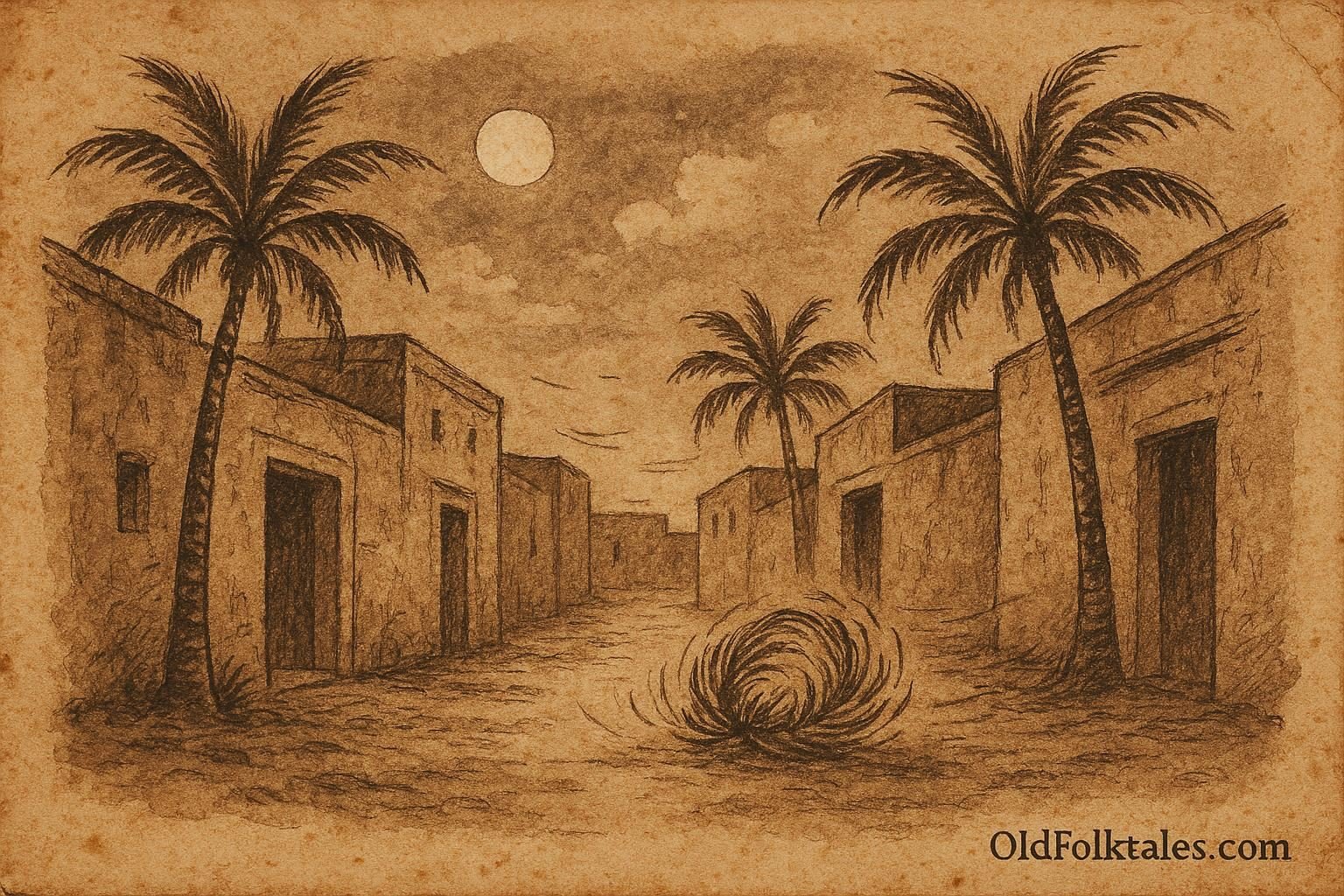
Umm Al-Sa‘af was not a creature one could easily describe with certainty. She was said to be made entirely of palm fronds, bound together into a rough, living form. Some imagined her tall, others round, but all agreed on one thing: when she moved, she rolled like a ball, her body spinning through the alleys with terrifying speed. Wherever she passed, the sound of crackling and rustling fronds announced her presence long before she was seen.
Children were told that Umm Al-Sa‘af appeared only on windy nights, when the palm trees bent and sighed under the force of the air. The darkness, stirred by wind and shadow, gave her life. She haunted the narrow lanes, especially those close to palm groves and old courtyards, searching for children who had ignored their parents’ warnings and stayed out too late.
As dusk fell, mothers would call their children home, their voices sharp with urgency. “Come inside before the wind rises,” they would say. “Umm Al-Sa‘af is listening.” Doors would be barred, lamps lit, and families gathered indoors. Outside, the alleys emptied, leaving only shadows and the restless sound of the wind.
It was said that a child who disobeyed and lingered outside would first hear a strange noise, not footsteps, but a dry, rolling scrape, like palm leaves dragged across stone. The sound would grow louder, faster, echoing between the walls. Then, from the darkness, Umm Al-Sa‘af would appear, spinning toward her target in a blur of fronds and dust.
She did not speak. She did not need to. Her purpose was clear: to chase children back to their homes, to teach them fear of the night and obedience to those who loved them. The children who escaped swore they felt the wind rush past them as they ran, the rustling sound close behind, until they crossed the threshold of their homes. Once a child was safely inside, Umm Al-Sa‘af would stop at the doorway, her form loosening, her fronds scattering back into the shadows.
By morning, there was no sign she had ever been there. Only fallen palm leaves in the alleys and frightened children who promised never to stay out after dark again.
Over time, the tale of Umm Al-Sa‘af became a familiar part of childhood. Parents did not tell it to harm or terrify without reason, but to protect. In a world without electric lights or constant supervision, the night held real dangers, open wells, stray animals, and unfamiliar strangers. Umm Al-Sa‘af embodied all those fears in a single image, one that children could understand and remember.
Though years passed and neighborhoods changed, the story remained. Even as the alleys grew quieter and palm groves fewer, the name Umm Al-Sa‘af still stirred a shiver of recognition. She became one of Kuwait’s classic “neighborhood monsters,” a figure shaped by wind, shadow, and the parental need to keep children safe.
Moral Lesson
The tale of Umm Al-Sa‘af teaches that obedience and caution protect children from unseen dangers. By listening to elders and respecting boundaries, one avoids harm and learns the value of safety within the community.
Knowledge Check
1. What is Umm Al-Sa‘af made of?
She is described as being made entirely of palm fronds.
2. Where does Umm Al-Sa‘af usually appear?
In dark neighborhood alleys, especially on windy nights.
3. What sound signals her presence?
The loud rustling and crackling of palm fronds rolling along the ground.
4. Who is Umm Al-Sa‘af said to chase?
Children who stay outside late and disobey their parents.
5. What cultural purpose does this story serve?
It is a cautionary tale used by parents to keep children safe at night.
6. What type of folklore figure is Umm Al-Sa‘af?
A classic neighborhood monster from Kuwaiti popular folklore.
Source & Cultural Origin
Source: Ubiquitous oral tradition documented in CRSK’s project on Kuwaiti Popular Heritage (التراث الشعبي الكويتي).
Origin: Kuwait — a traditional cautionary folktale rooted in community safety, nighttime dangers, and parental guidance.