
In a small village nestled between rice paddies and dense jungle, there lived a young man named Si Tugal. While his neighbors rose with the sun to tend their fields and his friends worked alongside their fathers learning trades, Si Tugal preferred to spend his days lounging in the shade, dreaming of wealth without effort. His mother despaired over him, his father had long since given up scolding, and the village elders shook their heads whenever his name was mentioned.
“That boy would starve if food didn’t find its way to his mouth,” they would say, clicking their tongues in disapproval.
Si Tugal’s family was not wealthy, but they were not poor either. They had enough rice to fill their bowls and enough shelter to keep them dry during the monsoons. But Si Tugal wanted more without the burden of earning it. He watched traders pass through the village with their goods and coins, and he envied them. He saw successful farmers harvest abundant crops, and he resented the sweat on their brows. He wanted the rewards without the labor, the feast without the planting.
Click to read all East Asian Folktales — including beloved stories from China, Japan, Korea, and Mongolia.
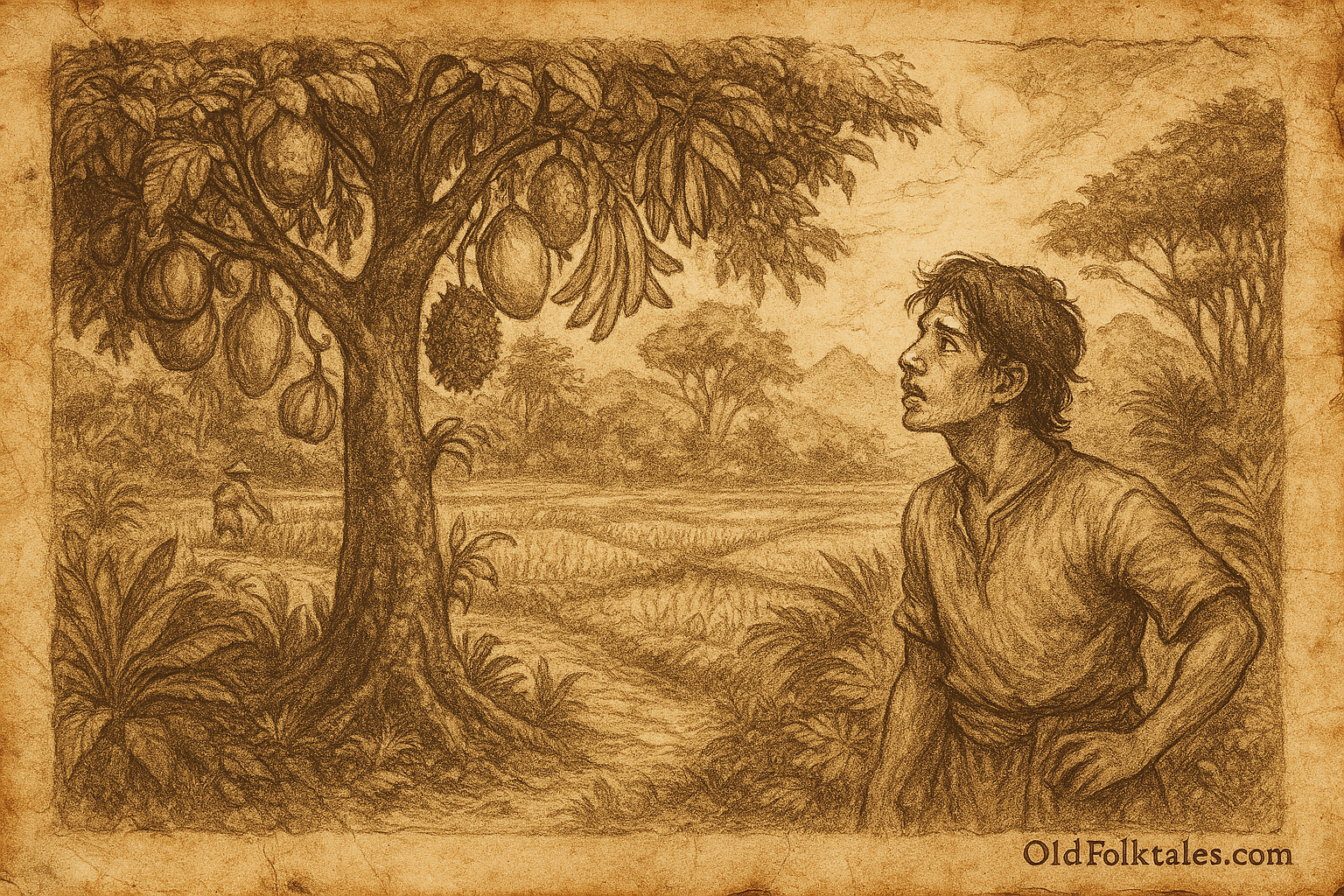
One sweltering afternoon, while wandering aimlessly through the jungle to avoid his mother’s requests for help, Si Tugal stumbled upon a clearing he had never seen before. In the center stood a magnificent tree unlike any he had encountered. Its trunk was smooth as polished wood, its branches spread wide like welcoming arms, and its leaves shimmered with an almost ethereal glow in the dappled sunlight. Most remarkably, hanging from every branch were the most beautiful fruits he had ever seen: mangoes golden as sunrise, rambutans red as rubies, durians with spikes that gleamed like treasure, and bananas so perfectly ripe they seemed to glow.
Si Tugal’s eyes widened with amazement and hunger. He approached the tree cautiously, half expecting it to vanish like a mirage. When it remained solid and real before him, he reached up and plucked a mango. The fruit came away easily, fitting perfectly in his palm. He bit into it, and the taste was beyond anything he had ever experienced: sweet, rich, and utterly satisfying. Within moments, he had devoured three more fruits, his belly finally full without having worked for a single bite.
As he wiped the juice from his chin, Si Tugal noticed something extraordinary. Where he had picked the fruits, new ones were already growing, swelling from buds to full ripeness before his astonished eyes. This was no ordinary tree. This was magic.
“Thank you, magnificent tree,” Si Tugal whispered, bowing slightly. Whether from genuine gratitude or simple reflex, the words came naturally. The tree seemed to shimmer in response, its leaves rustling despite the still air, and Si Tugal felt a warm contentment wash over him.
For several days, Si Tugal returned to the magical tree. Each time, he approached with a measure of respect, speaking words of thanks before taking fruit. He never took more than he needed for that moment, and he always bowed before leaving. The tree provided generously, and Si Tugal, for perhaps the first time in his life, felt genuine appreciation for a gift freely given.
But as the days passed, Si Tugal’s gratitude began to erode, replaced by a familiar sense of entitlement. Why should he continue working at all when this tree could provide everything? Why should he bother with his mother’s chores or help in his father’s small plot when unlimited bounty hung from these branches?
He began taking more fruit than he needed, stuffing his pockets and filling baskets to hoard at home. He stopped saying thank you, stopped bowing, stopped treating the tree with any reverence at all. In his mind, he had discovered a resource, nothing more, and resources were meant to be exploited.
“This tree exists for me,” he muttered one day, shaking branches roughly to make fruit fall faster. “Why should I waste time being polite to a plant?”
He began visiting multiple times a day, taking armloads of fruit. He ate until he was sick, gave fruit away carelessly to impress others, and let perfectly good food rot because he could always get more. The magical tree had become not a blessing but an expectation, not a gift but an entitlement.
Then Si Tugal had an idea that seemed brilliant in his greedy mind. Why keep this secret? He could sell the fruit at the market, charge whatever he wanted, and become rich without lifting a finger beyond picking and carrying. He could finally have the wealth he had always craved, all thanks to this stupid tree that existed solely for his benefit.
The next morning, Si Tugal arrived at the clearing with empty baskets, ready to harvest everything he could carry to market. But when he reached the spot where the magnificent tree had stood, he stopped short, his baskets falling from his hands.
The tree was dying.
Its once smooth trunk was now twisted and grey, covered in patches of decay. The shimmering leaves had turned brown and brittle, falling in sad drifts around the roots. The magical fruits that had hung so abundantly were now shriveled and blackened, dropping to the ground where they dissolved into foul smelling puddles. The tree that had seemed so full of life now looked ancient and withered, as if centuries had passed in mere days.
“No, no, no!” Si Tugal cried, rushing forward. He touched the trunk, and the bark crumbled under his fingers. “Please, I need you! Come back!”
But even as he pleaded, the tree continued to fade. Its branches began to crack and fall, its trunk split with a sound like a sigh of resignation. Si Tugal fell to his knees, watching in horror as his source of effortless abundance disintegrated before his eyes.
Within minutes, nothing remained but a pile of ash and a small cleared space in the jungle where something magical had once existed. Even the ash seemed to sink into the earth and vanish, leaving no trace that the tree had ever been there at all.
Si Tugal knelt in the empty clearing for a long time, his mind reeling. The magical tree was gone, taken by his own greed and disrespect. He had been given an incredible gift, one that had asked only for basic gratitude and restraint, and he had destroyed it through thoughtless exploitation.
His stomach growled. For the first time in weeks, he was truly hungry again, and there was no magical solution waiting to feed him. He would have to return to the village, face his disappointed family, and somehow find a way to survive through his own efforts.
The walk back to the village felt longer than ever before. When he arrived home, his mother looked at him with a mixture of concern and hope. “Si Tugal, your father needs help repairing the roof before the rains come. Will you help him?”
For a moment, Si Tugal almost refused out of habit. But then he remembered the empty clearing, the withered tree, and the bitter lesson it had taught him. He thought about how he had taken and taken without giving anything back, without earning his blessings, without respecting the source of his good fortune.
“Yes, Mother,” he said quietly. “I will help.”
The work was hard. His muscles, soft from weeks of idleness, ached with every movement. His hands, unused to labor, grew sore and blistered. But as he worked alongside his father, learning to measure and cut and tie, Si Tugal felt something he had not experienced before: the satisfaction of earning his place in the world.
In the weeks and months that followed, Si Tugal slowly transformed. He learned to farm, to fish, to build and mend and create with his own hands. He discovered that food tasted sweeter when you had grown it yourself, that rest felt deeper after honest labor, and that respect from others had to be earned through character and effort.
Sometimes, when he passed near that part of the jungle, he would pause and remember the magical tree. The memory brought a pang of regret, but also gratitude for the harsh lesson it had taught him. He had learned that nature’s gifts require respect, that abundance taken for granted will disappear, and that true wealth comes not from exploitation but from balance, gratitude, and self reliance.
Si Tugal never found another magical tree, but he no longer needed one. He had discovered something more valuable: the magic of his own capability, and the peace that comes from living in harmony with the world rather than simply taking from it.
Click to read all Southeast Asian Folktales — featuring legends from Thailand, Indonesia, Vietnam, and the Philippines.
The Moral Lesson
The tale of Si Tugal and the Magical Tree teaches us that natural resources and blessings, no matter how abundant they seem, will disappear when treated with disrespect and greed. Gratitude and restraint are essential when receiving gifts from nature, and taking more than we need or exploiting resources thoughtlessly leads to their destruction. The story emphasizes that true security and satisfaction come from self reliance and honest work rather than from effortless exploitation. When we fail to appreciate what we have and treat abundance as an entitlement rather than a privilege, we lose not only the resource but also the opportunity to develop our own capabilities and character.
Knowledge Check
Q1: Who is Si Tugal in this Malaysian folk tale? A: Si Tugal is a lazy young man who avoids work and dreams of wealth without effort. He represents people who seek rewards without responsibility and take blessings for granted. His character arc shows transformation from entitlement and laziness to understanding the value of self reliance and honest labor through the harsh lesson taught by the magical tree.
Q2: What makes the tree in this story magical? A: The magical tree provides abundant fruit that regenerates immediately after being picked, offering unlimited food without any labor required. It represents nature’s generosity and the abundance that can be found when we approach natural resources with respect. The tree’s magic works only when treated properly, demonstrating that nature’s gifts are conditional upon our behavior and attitude.
Q3: How does Si Tugal’s treatment of the tree change over time? A: Initially, Si Tugal treats the tree with respect, offering thanks and taking only what he needs. As time passes, his gratitude turns to entitlement, and he begins taking excessive amounts without appreciation, shaking branches roughly and viewing the tree as a resource to exploit rather than a gift to honor. This progression from gratitude to greed directly causes the tree’s destruction.
Q4: Why does the magical tree wither and disappear? A: The tree withers and dies because Si Tugal’s greed, disrespect, and exploitation violate the unspoken covenant between humans and nature. His refusal to show gratitude, his excessive taking, and his plans to commercialize the tree’s gifts demonstrate a fundamental disrespect for natural magic. The tree’s disappearance represents how unsustainable practices and lack of appreciation destroy the very resources we depend upon.
Q5: What does Si Tugal learn by the end of the story? A: Si Tugal learns that true wealth and security come from self reliance and honest work rather than effortless exploitation. He discovers the satisfaction of earning his place through labor, the importance of respecting natural gifts, and the value of gratitude and restraint. The loss of the magical tree forces him to develop his own capabilities and find fulfillment in personal growth rather than external abundance.
Q6: What is the cultural significance of magical trees in Malaysian folklore? A: In Malaysian folklore, magical trees often represent the spiritual dimension of nature and the covenant between humans and the natural world. They symbolize abundance that is available when approached with proper respect and the consequences of breaking spiritual and environmental balance. Such stories teach traditional values of gratitude, sustainable resource use, and the understanding that nature’s generosity is a privilege that must be honored, not a right to be exploited.
Source: Adapted from Malaysian oral folklore traditions
Cultural Origin: Malaysia, Southeast Asia.








