Across the wide Kazakh steppe, where the land stretches farther than memory and the wind carries voices of the past, elders say that a person does not walk alone. Every step is accompanied by the unseen presence of ancestors, whose lives shape the path of those who follow. From this belief emerged the teaching known as Jety Atan, the wisdom of knowing one’s seven generations.
In one village lived a young man whose strength was matched only by his recklessness. He spoke sharply to elders, ignored communal responsibilities, and acted as though his choices affected no one but himself. Though his family name was respected, he carried it lightly, without thought for the meaning behind it. His behavior troubled the community, for in Kazakh tradition, such conduct threatened harmony.
Explore timeless legends from China, Japan, and Korea in our East Asian Folktales collection.
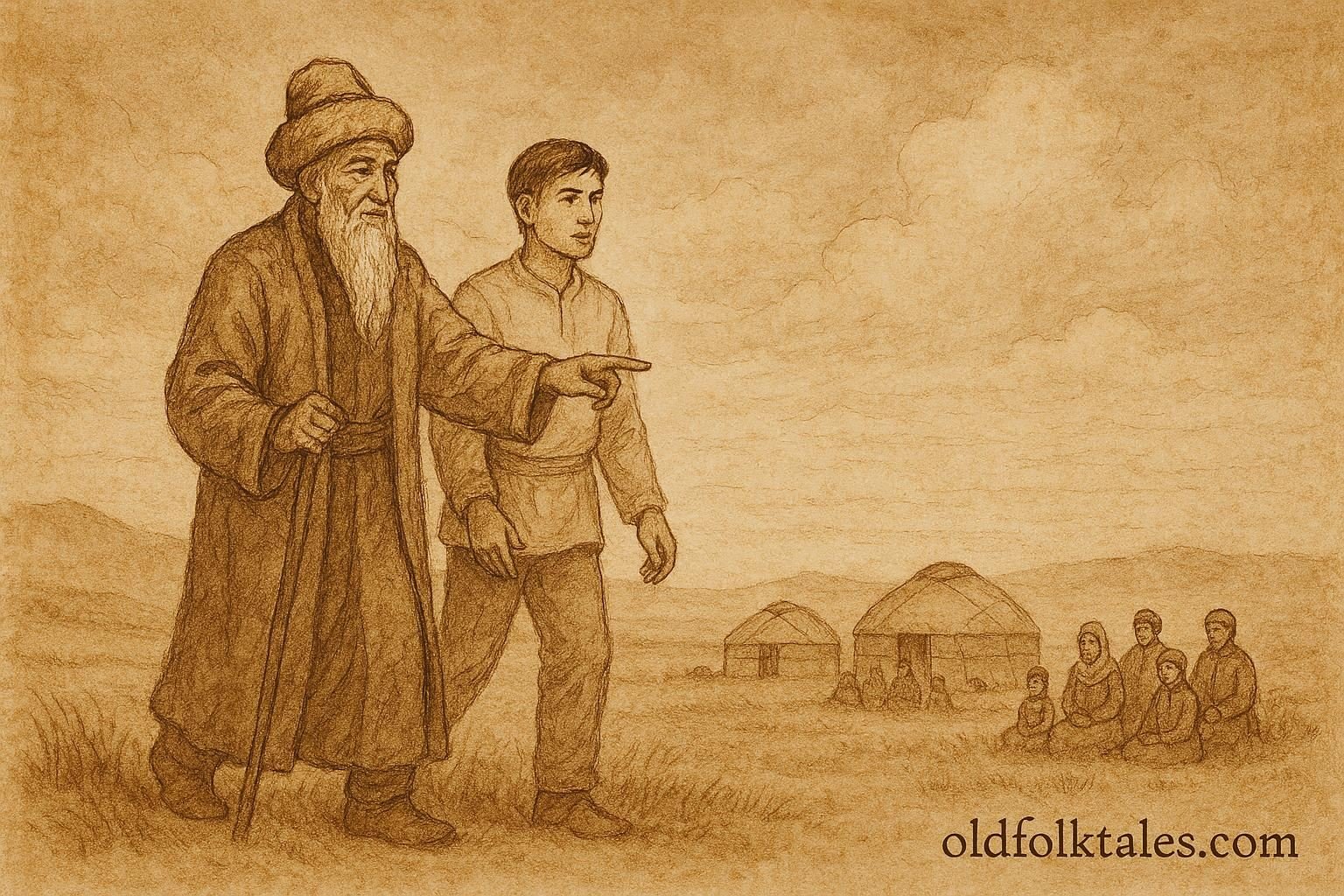
Seeing this, a respected village elder called the young man to him. The elder did not scold or punish. Instead, he proposed a journey across the steppe. “Come with me,” he said, “and you will learn what it means to stand upright among your people.”
They traveled together from one settlement to another, moving beneath the vast sky, stopping at yurts scattered across the plains. At each home, the elder asked the family to recite their jetı ata, their lineage reaching back seven generations. Fathers spoke names with care, mothers listened with pride, and children repeated what they had been taught since their earliest years.
The young man observed closely. He noticed how these families welcomed guests with respect, even strangers. Disputes were settled calmly, words chosen with restraint. No one acted carelessly, for each knew that their actions reflected not only themselves, but those whose blood they carried.
At one yurt, the elder explained, “When a person knows who they come from, they understand who they must be.” He told the young man that remembering seven generations was not a matter of pride or status, but of responsibility. A person who knows their lineage understands that their conduct honors, or dishonors, not only themselves, but their ancestors and descendants alike.
As they continued, the young man began to feel the weight of this truth. He realized that his reckless behavior had not been his alone. Each careless word had echoed backward and forward through time. The strength he once used without thought now felt hollow without purpose.
At another home, an old woman spoke of her forefathers who had endured hardship with dignity. She said that their memory guided her choices each day. “I do not act only for myself,” she said. “I act so their sacrifices are not wasted.”
The journey ended as the sun lowered over the steppe, casting long shadows across the land. The elder turned to the young man and asked him to name his own ancestors. The young man stood silent. For the first time, he felt shame—not because he was weak, but because he had neglected what mattered most.
Returning to the village, the young man began to learn his lineage. He listened carefully, memorizing names and stories, understanding the values each generation had upheld. With this knowledge came change. He spoke with humility, served the community, and carried himself with dignity. His strength remained, but it was now guided by awareness.
Through Jety Atan, the people say, one learns that life is not lived in isolation. Each generation is a link in a chain, shaped by the past and responsible for the future.
Explore ancient tales from Thailand, Cambodia, and the Philippines in Southeast Asian Folktales.
Moral Lesson
This folktale teaches that knowing one’s ancestry builds ethical responsibility, that respect for elders fosters social harmony, and that true integrity comes from understanding the legacy one carries.
Knowledge Check
1. What is Jety Atan in Kazakh culture?
It is the tradition of knowing one’s lineage up to seven generations.
2. Why is ancestry important in this folktale?
Because it encourages ethical behavior and accountability.
3. Who guides the young man in the story?
A wise village elder.
4. What lesson does the journey across the steppe teach?
That behavior reflects both ancestors and future generations.
5. How does the young man change by the end?
He becomes respectful, responsible, and mindful of his actions.
6. What cultural value does Jety Atan reinforce?
Community harmony through ancestral awareness.
Source: Kazakh ethical folktale tradition; recorded in cultural anthropology and folklore studies
Cultural Origin: Kazakhstan (Kazakh moral folklore)