
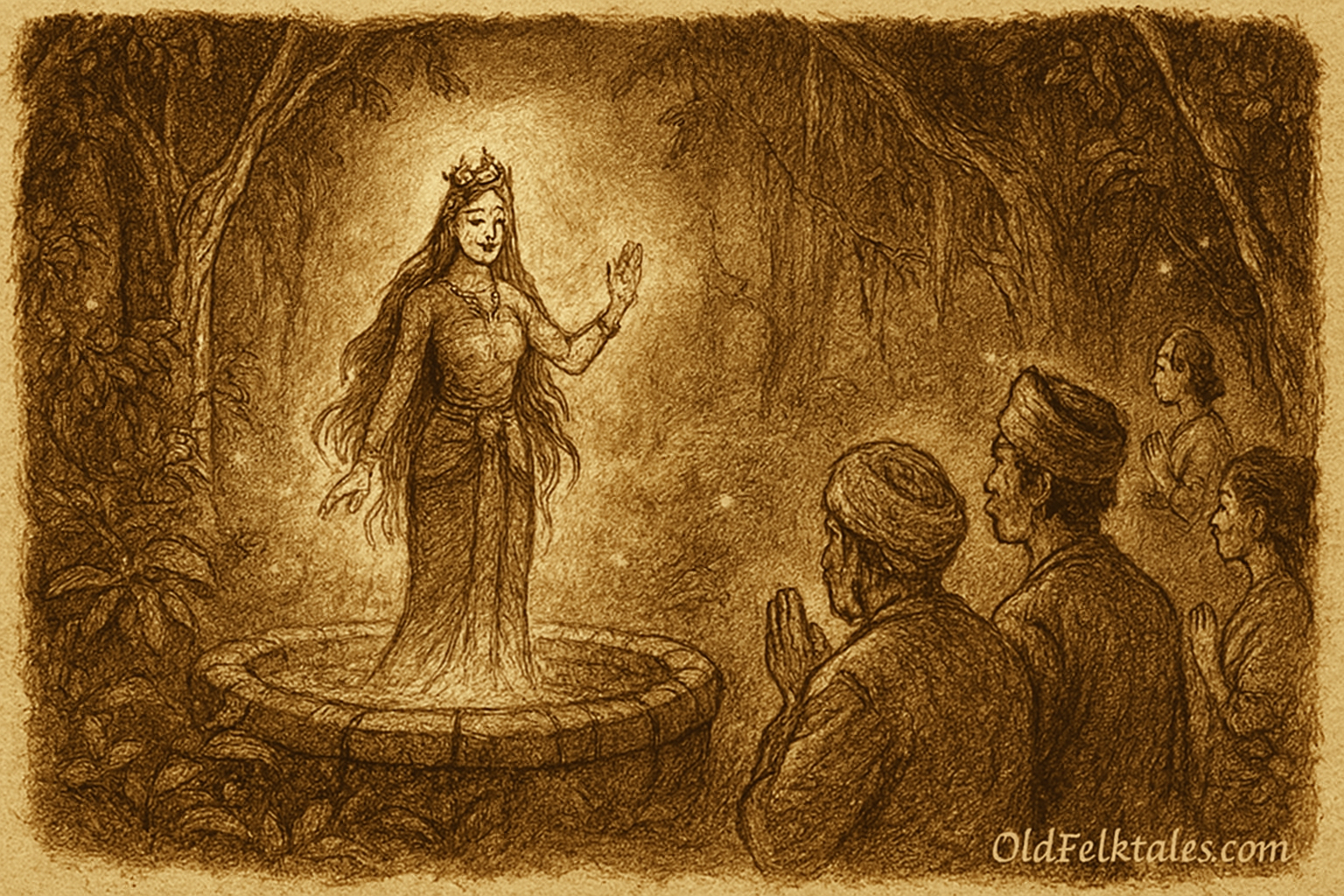
Deep in the forest where ancient trees filtered sunlight into golden threads and birdsong echoed through the canopy, there existed a well known as Telaga Sunyi, the Silent Well. It was called silent not because no sounds reached it, but because those who approached it felt compelled to quiet their voices and still their hearts, as if the place itself demanded reverence. The water in this well was clearer than any stream, cooler than any spring, and the villagers who knew of its location considered it a sacred gift from the forest itself.
The well had been there longer than anyone could remember, carved by nature into a depression of smooth stone, fed by an underground spring that never failed even in the driest seasons. Around it grew wild orchids and ferns, and the moss that carpeted the surrounding rocks was soft as silk beneath bare feet. But what made Telaga Sunyi truly special was not just its beauty or its unfailing water, but the mysterious maiden who appeared there.
Click to read all East Asian Folktales — including beloved stories from China, Japan, Korea, and Mongolia.
The first person to see her was an elderly woman named Mak Limah, who had gone to the well to fetch water for her ailing grandson. As she approached through the forest path, she heard the sound of singing, a voice so pure and lovely it seemed to harmonize with the wind itself. Peering through the foliage, Mak Limah saw a young woman of extraordinary beauty sitting by the well’s edge.
The maiden’s hair cascaded down her back like a waterfall of midnight silk. Her skin glowed with an otherworldly luminescence, as if moonlight had been captured beneath its surface. She wore a sarong of fabric so fine it seemed woven from mist and starlight, and around her neck hung a pendant that sparkled with inner light. But what struck Mak Limah most was not the maiden’s beauty but the aura of peace and kindness that surrounded her.
The maiden looked up and smiled, and Mak Limah found herself stepping forward without fear, drawn by that gentle expression.
“You have come for water for your sick grandson,” the maiden said, though Mak Limah had not spoken. Her voice was like water flowing over smooth stones, melodious and calming. “Take this water, and add three drops of dew from the ferns that grow here. His fever will break by morning.”
Mak Limah did as instructed, and true to the maiden’s words, her grandson’s fever broke before dawn. Word of this miracle spread through the village, and soon others began visiting Telaga Sunyi, hoping to encounter the mysterious helper.
The maiden appeared to those with genuine need and pure hearts. To a farmer whose crops were failing, she taught a new method of cultivation using forest mulch. To a woman whose child would not stop crying, she revealed that the baby was sensitive to a certain herb in the mother’s cooking. To those suffering ailments, she provided remedies made from plants that grew near the well. Her knowledge seemed limitless, her compassion boundless.
The villagers came to call her Puteri, which means princess, though no one knew if she truly was royalty or simply possessed a bearing so graceful that the title felt appropriate. She never spoke of where she came from or why she dwelt by the well. When asked, she would smile and deflect the question, focusing instead on how she could help her visitor.
But the Puteri had clear rules that she made known to all who sought her aid.
“I will help you freely,” she would say, “but you must promise me three things. First, never try to follow me when I depart. Second, never speak of me with boastfulness or use my help to claim superiority over others. Third, and most important, never spy upon my private moments. Respect these boundaries, and I will remain to help your village for as long as I am needed.”
The villagers agreed readily to these simple terms. They were grateful for her presence and saw no reason to violate her privacy or disrespect her wishes. Life in the village improved dramatically. Crops grew more abundant, illnesses that had once been fatal were now cured, and disputes that might have torn the community apart were resolved through the Puteri’s wise counsel.
But in every community, there lives at least one person whose curiosity overrides their wisdom.
Pak Rashid was a man whose greatest weakness was his inability to leave mysteries unsolved. He was not a bad person, not cruel or deliberately harmful, but he lacked the restraint that wisdom requires. The more he thought about the Puteri, the more questions consumed him. Who was she really? Where did she go when she vanished from the well? What did she do when no one was watching?
“She is helping us,” his wife would say when he spoke of his curiosity. “Why does it matter where she comes from or what she does in private? We promised to respect her boundaries.”
But Pak Rashid could not let it go. The questions buzzed in his mind like persistent insects, growing louder each day. Finally, consumed by curiosity he could no longer contain, he made a terrible decision.
One evening, he followed the forest path to Telaga Sunyi and hid himself in the dense undergrowth near the well, settling in to watch and wait. As twilight deepened into dusk, the Puteri appeared as she often did at this hour. But this time, believing herself alone and unobserved, she began to disrobe, preparing to bathe in the sacred waters of the well.
Pak Rashid watched from his hiding place, his heart pounding with a mixture of guilt and stubborn determination to satisfy his curiosity. He saw the Puteri remove the pendant from around her neck and place it carefully on a flat stone beside the well. The moment the pendant left her body, her form began to shimmer and change.
Before his astonished eyes, the beautiful maiden transformed. Her human form dissolved, revealing her true nature: she was a spirit of the water, a guardian being who had taken human shape to help the villagers. In her true form, she was composed of light and mist, barely solid, more suggestion than substance. She slipped into the well’s waters, and the water itself began to glow with the same luminescence that had radiated from her skin.
Pak Rashid gasped, unable to contain his amazement at what he had witnessed. The sound, though small, echoed in the quiet of the sacred space.
The Puteri’s head emerged from the water instantly, her eyes finding Pak Rashid’s hiding spot with unerring accuracy. Her expression was one of profound sadness rather than anger, and somehow that made it worse.
“You have broken your promise,” she said quietly, her voice heavy with disappointment. “I asked so little: only respect for boundaries, only trust, only the privacy that all beings deserve. But curiosity proved stronger than honor, and a promise made was a promise broken.”
Pak Rashid scrambled from his hiding place, falling to his knees. “Puteri, please! Forgive me! I meant no harm! I was only curious!”
“Curiosity without respect is violation,” she replied, already beginning to fade. “Trust, once broken, cannot be easily restored. You have seen what I wished to keep private, not out of vanity but because some truths are not meant for human eyes. The sacred requires boundaries, and you have trampled them.”
She reached for her pendant, and as she placed it around her neck, her form solidified briefly back into the beautiful maiden the villagers had known. But her eyes held an immense sorrow.
“I cannot remain where trust has been betrayed,” she said. “Your village has been good to me, and I wished to help longer. But the covenant is broken, and I must depart. Tell them I am sorry to leave, but tell them also why I must go. Let this be a lesson about the price of broken promises and violated privacy.”
With those words, she stepped backward into the well and vanished beneath the surface. The water rippled once, twice, and then grew still. But as Pak Rashid watched in growing horror, the water level began to drop. The spring that had fed the well for countless years suddenly ceased its flow. Within minutes, the clear, cool water that had never failed was gone, leaving only damp stones and the bitter smell of loss.
Pak Rashid returned to the village and confessed what he had done. The community was devastated. They had lost not just a helper but a friend, not just access to healing waters but a connection to something sacred. Some villagers were angry with Pak Rashid, others simply heartbroken.
In the days that followed, several people ventured to Telaga Sunyi, hoping the Puteri might return. But the well remained dry, its stones exposed to sun and air, its magic departed. The ferns around it began to wither, the orchids ceased blooming, and the place that had once hummed with peaceful energy now felt hollow and abandoned.
An elder of the village, a woman who had lived long enough to understand the ways of spirits and humans, gathered the community to speak about what had happened.
“The Puteri was a gift,” she said, her voice carrying the weight of experience, “and like all gifts from the spiritual realm, she required respect. She did not demand payment or sacrifice, only the simple courtesy of privacy and kept promises. We could not give her even that small thing, and so we have lost everything she offered.”
“It was only one man’s fault,” someone protested.
“Was it?” the elder challenged. “We are a community. When one among us breaks a sacred trust, we all bear the consequence. This is the nature of spiritual covenants. The bonds that connect us to the sacred are delicate threads, easily broken, difficult to repair.”
The well never flowed again. Over time, forest slowly reclaimed the area, and eventually only the oldest villagers remembered the exact location of Telaga Sunyi. But the story of the Puteri and her departure was told and retold, passed down through generations as a cautionary tale about trust, boundaries, and the terrible consequences of broken promises.
Parents would tell their children: “Remember the Puteri from the Silent Well. Remember that sacred helpers ask little but require absolute respect. Remember that curiosity without boundaries destroys the very thing it seeks to understand. And remember that privacy is not suspicious secrecy but necessary sanctuary, and violating it breaks bonds that can never fully heal.”
The lesson lived on, carried in story and song, a reminder that some mysteries should remain mysteries, that trust is more valuable than knowledge, and that the price of satisfying idle curiosity can be the loss of something infinitely more precious than the answers we sought.
Click to read all Southeast Asian Folktales — featuring legends from Thailand, Indonesia, Vietnam, and the Philippines.
The Moral Lesson
The legend of Puteri dari Telaga Sunyi teaches us that trust and respect for boundaries are essential to maintaining relationships with both people and spiritual forces. Privacy is not something to be violated out of curiosity, no matter how innocent that curiosity seems. The story emphasizes that broken promises have consequences that extend beyond the promise breaker to affect entire communities. Sacred relationships require simple courtesies, and when we cannot provide even basic respect for privacy and boundaries, we lose access to blessings that might have sustained us. Most importantly, the tale reminds us that satisfying curiosity at the expense of trust destroys the very connections we value most.
Knowledge Check
Q1: Who is the Puteri from Telaga Sunyi in this Malaysian legend? A: The Puteri is a beautiful maiden who appears at the Silent Well to help villagers with healing, farming advice, and wise counsel. She is revealed to be a water spirit or guardian being who has taken human form out of compassion. Her character represents the sacred helpers that traditional cultures believe inhabit natural places, offering aid to those who approach with respect and genuine need.
Q2: What does Telaga Sunyi mean and why is the well significant? A: Telaga Sunyi means “Silent Well,” named not for absence of sound but because the place inspires reverence and quiet reflection in those who approach it. The well is significant as a sacred liminal space where the human and spiritual worlds meet, providing both physical water and spiritual blessing. It represents how natural features like wells can serve as connection points between ordinary life and divine assistance.
Q3: What three rules does the Puteri establish for the villagers? A: The Puteri’s three rules are: never try to follow her when she departs, never speak of her with boastfulness or use her help to claim superiority over others, and never spy upon her private moments. These simple boundaries represent the minimal respect required to maintain sacred relationships, emphasizing that spiritual helpers ask little but require absolute adherence to agreed terms.
Q4: Why does Pak Rashid break his promise to the Puteri? A: Pak Rashid breaks his promise because his curiosity overrides his wisdom and self restraint. He becomes consumed with questions about the Puteri’s true identity and private activities, eventually convincing himself that satisfying this curiosity justifies violating her privacy. His character represents how intellectual curiosity without ethical boundaries can lead to destructive choices that harm everyone.
Q5: What happens when Pak Rashid spies on the Puteri? A: When Pak Rashid spies on the Puteri during her private bathing, he witnesses her true form as a water spirit and breaks the sacred trust she required. As a consequence, the Puteri departs forever and the well’s spring ceases flowing, leaving the once sacred site dry and lifeless. This demonstrates how violation of spiritual boundaries results in permanent loss of blessings that entire communities depend upon.
Q6: What does this story teach about wells and sacred spaces in Malaysian culture? A: This Malaysian legend teaches that wells and natural water sources are often considered sacred spaces that may be inhabited by guardian spirits who can help humans if approached with proper respect. The story emphasizes that these places require acknowledgment of boundaries, keeping of promises, and respect for privacy. It reflects traditional Southeast Asian beliefs about the spiritual dimension of nature and how maintaining proper relationships with place spirits ensures continued access to both physical and spiritual resources.
Source: Adapted from Malaysian oral folklore traditions.
Cultural Origin: Malaysia, Southeast Asia.








