In a village nestled between the winding Brunei River and the ancient rainforest, there lived a family blessed with seven sons. The father had passed away when the youngest was still a child, leaving their mother to raise them all. The six elder brothers grew into strong, capable young men, each skilled in different trades: one was a talented fisherman, another a skilled woodcarver, the third excelled at weaving, and so on. They were admired throughout the village for their abilities and confident bearing.
But the youngest son, known simply as Si Bungsu (which means “the youngest”), seemed to possess none of his brothers’ obvious talents. He was smaller in stature, quieter in manner, and slower to master the skills his brothers had learned with apparent ease. Where his brothers were bold and assertive, Si Bungsu was gentle and thoughtful. Where they commanded attention, he preferred to listen and observe.
Click to read all East Asian Folktales — including beloved stories from China, Japan, Korea, and Mongolia.
His elder brothers treated him with a mixture of pity and contempt. They would laugh at his clumsy attempts to match their accomplishments, mock his soft heart when he showed compassion to animals or beggars, and regularly assign him the most menial tasks in the household.
“Si Bungsu, fetch water from the river,” they would command.
“Si Bungsu, clean the fishing nets while we go to market.”
“Si Bungsu, prepare our meals and wash our clothes.”
The youngest brother accepted these tasks without complaint, performing them with care and diligence despite the dismissive way his brothers treated him. His mother would sometimes watch with sadness in her eyes, seeing how her youngest son was undervalued, but she was old and weary, and the household depended on the elder brothers’ earnings.
“Do not let their words harden your heart,” she would whisper to Si Bungsu when his brothers were out of earshot. “Kindness is its own strength, and humility its own wisdom. These qualities are not visible like muscle or skill, but they are more valuable in the end.”
Si Bungsu would smile and kiss his mother’s weathered hand. “I know, Ibu. I do not mind their treatment. They are my brothers, and I love them despite everything.”
One day, the Sultan announced a challenge that stirred the entire kingdom. A great task needed to be accomplished: a precious heirloom, a kris blade that had been passed down through generations of rulers, had been lost in the depths of the enchanted forest. The kris was not merely valuable but sacred, blessed by ancient spirits, and essential for certain royal ceremonies. Whoever could retrieve it would be granted a position of honor in the court, along with wealth and the Sultan’s gratitude.
Warriors and adventurers from across Brunei began preparing to seek the lost kris. Among them were Si Bungsu’s six elder brothers, who saw this as their opportunity for advancement and recognition.
“We will succeed where others fail,” the eldest declared confidently. “With our combined skills and strength, that kris will be ours.”
They spent days preparing: sharpening weapons, gathering supplies, consulting maps and village elders about the forest’s dangers. Si Bungsu helped with all these preparations, fetching items, packing provisions, and ensuring everything was ready for their journey.
On the morning of their departure, Si Bungsu approached his brothers. “May I come with you?” he asked quietly. “Perhaps I could be of help.”
His brothers burst into mocking laughter.
“You?” the second eldest sneered. “What use would you be in the enchanted forest? You can barely lift a full water bucket, let alone defend yourself against the spirits and creatures that dwell there.”
“Stay home and look after our mother,” the third brother added dismissively. “Leave the heroic deeds to those capable of performing them.”
Si Bungsu said nothing more, simply bowing his head in acceptance. He watched his brothers march off toward the forest, their backs straight with confidence and pride. When they had disappeared from view, he returned to the house to tend to his daily chores and care for his elderly mother.
Days passed, then weeks. The brothers did not return, and no word came of their progress. Other seekers began trickling back to the village, reporting that the enchanted forest was far more dangerous than anyone had anticipated. The spirits that guarded it were powerful and hostile to those who entered with arrogance or greed in their hearts. Many had turned back rather than face the forest’s trials.
Si Bungsu’s mother grew increasingly worried about her elder sons. “Someone must go look for them,” she said, her voice trembling with maternal fear.
“Then I will go, Ibu,” Si Bungsu said gently.
His mother looked at him with a mixture of concern and something else, perhaps a recognition that her youngest possessed qualities his brothers lacked. “Be careful, my son. The forest is dangerous, and you are still young.”
“I will be careful,” Si Bungsu promised. “But I cannot abandon my brothers, no matter how they have treated me.”
He prepared for his journey simply, taking only basic supplies: a small knife, some rice wrapped in banana leaves, a bamboo container of water, and a handful of betel nuts that had belonged to his late father. He did not arm himself with weapons as his brothers had done, nor did he approach the journey with their swagger and confidence. Instead, he walked toward the enchanted forest with humility and respect, aware of his own limitations and the magnitude of what he faced.
As he entered the forest, the ancient trees seemed to close around him like a living wall. The air grew thick and heavy, and sounds echoed strangely among the massive trunks. Si Bungsu walked carefully, speaking soft words of respect to the forest itself.
“I mean no disrespect to this sacred place,” he said aloud. “I seek only to find my brothers and, if possible, to retrieve what has been lost. I come not with pride but with humility.”
Deep in the forest, he came upon an old woman sitting beside a small fire. She was hunched and withered, her clothes tattered, and she appeared to be struggling to gather firewood with her frail arms.
Si Bungsu immediately approached her. “Grandmother, please, let me help you,” he said, setting down his pack and gathering wood for her fire.
The old woman watched him with bright, intelligent eyes. “You are kind, young one. Many have passed this way recently, but none stopped to help an old woman. Tell me, what brings you into this dangerous forest?”
Si Bungsu explained about his brothers and the lost kris, speaking with honesty and concern for his siblings despite how they had treated him.
The old woman nodded slowly. “Your brothers passed by here. They saw me struggling, and they laughed. They mocked my weakness and told me to get out of their way. They were so focused on their quest for glory that they could not spare a moment’s kindness for one in need.”
“I am sorry for their behavior,” Si Bungsu said sincerely. “They are not bad men, only proud ones. I hope they are safe.”
The old woman smiled, and suddenly her appearance began to shimmer and change. The hunched figure straightened, the wrinkled skin smoothed, and before Si Bungsu stood a beautiful spirit, radiant with otherworldly light.
“I am the guardian of this forest,” she said in a voice like wind through leaves. “I test all who enter, and few pass. Your brothers failed because they possessed skill without compassion, strength without humility. But you, youngest child, have shown the qualities that truly matter.”
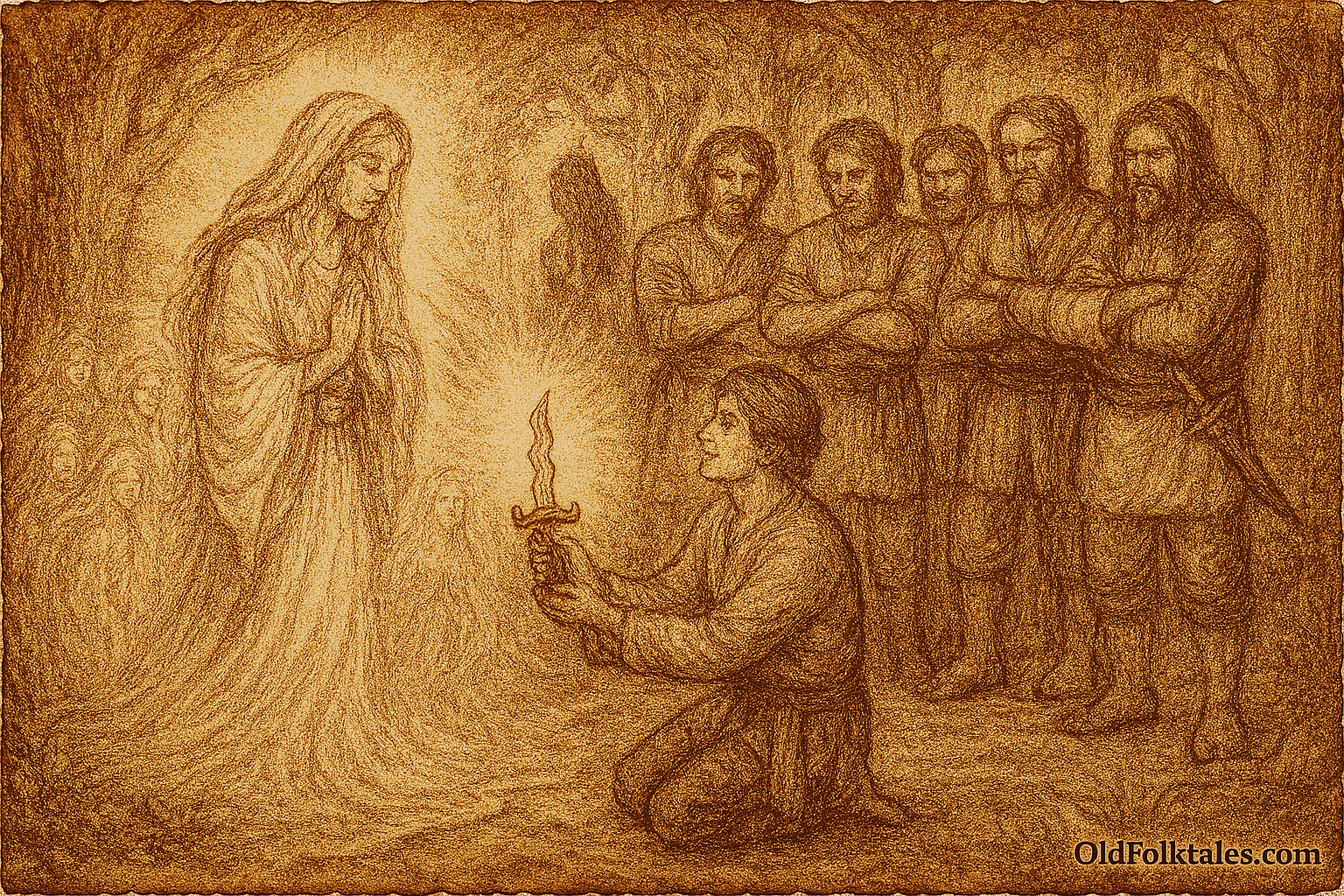
She reached into the folds of her garment and produced the sacred kris, its blade gleaming with an inner light.
“This is what you seek,” she said, placing it in Si Bungsu’s hands. “Take it to your Sultan with my blessing. As for your brothers, they are not harmed, only humbled. They sit trapped in a clearing not far from here, bound not by ropes but by their own pride. Only one who loves them despite their flaws can free them.”
The forest spirit led Si Bungsu to a clearing where his six brothers sat in a circle, unable to move or speak, frozen in place by invisible bonds. The moment Si Bungsu entered the clearing, the spell broke.
His brothers stumbled to their feet, shame written across their faces. They had spent days trapped in that spot, forced to reflect on their behavior and witness their youngest brother’s kindness rewarded while their arrogance was punished.
“Si Bungsu,” the eldest said, his voice thick with emotion. “We have been terrible to you. You had every reason to leave us here, to take the kris and the glory for yourself. Yet you came to free us.”
Si Bungsu smiled gently. “You are my brothers. How could I not?”
Together, the seven brothers made their way out of the enchanted forest. When they reached the Sultan’s palace, Si Bungsu presented the sacred kris and told the story of what had happened, giving credit to the forest spirit’s guidance rather than claiming heroism for himself.
The Sultan, impressed not only by Si Bungsu’s success but by his humility and compassion, granted him the promised reward. But Si Bungsu asked that the position and wealth be shared among all seven brothers, for they were family and should prosper together.
From that day forward, the elder brothers treated Si Bungsu with the respect and love he had always deserved. They had learned that true strength comes not from physical prowess or technical skill alone, but from qualities of heart and character. And Si Bungsu, despite now having every reason to lord his success over his brothers, continued to treat them with the same kindness and forgiveness he had always shown.
The family prospered, serving the Sultan with distinction. And the story of Si Bungsu became a beloved tale told throughout Brunei, reminding listeners that those who seem weakest may possess the greatest strength, and that kindness and humility ultimately triumph over pride and arrogance.
Click to read all Southeast Asian Folktales — featuring legends from Thailand, Indonesia, Vietnam, and the Philippines.
The Moral Lesson
The legend of Si Bungsu teaches us that true worth is found not in obvious talents or physical strength, but in qualities of character such as kindness, humility, and compassion. Those who are underestimated or mistreated should not become bitter but should maintain their integrity, for these inner qualities often prove more valuable than superficial abilities. The story emphasizes that supernatural and divine assistance comes to those with pure hearts rather than those with pride and skill alone.
Knowledge Check
Q1: Who is Si Bungsu in this Bruneian folk tale? A: Si Bungsu, meaning “the youngest,” is the seventh and youngest brother in a family of seven sons. He is smaller, gentler, and less obviously talented than his elder brothers, who mistreat and underestimate him. His character represents those who are overlooked and dismissed by society, yet possess inner qualities of kindness, humility, and compassion that prove more valuable than external accomplishments.
Q2: How do Si Bungsu’s elder brothers treat him? A: The six elder brothers treat Si Bungsu with contempt and pity, mocking his gentleness, assigning him menial household tasks, laughing at his attempts to learn their skills, and dismissing his offers to help. They view him as weak and useless compared to their own obvious talents. Their treatment represents how societies often devalue those who do not conform to conventional standards of strength and achievement.
Q3: What is the Sultan’s challenge in the story? A: The Sultan challenges people throughout the kingdom to retrieve a sacred kris blade that has been lost in the enchanted forest. This precious heirloom is essential for royal ceremonies, and whoever recovers it will receive a position of honor in the court along with wealth. The challenge serves as the catalyst that reveals the true character of the brothers and tests their different approaches to achievement.
Q4: Who is the old woman in the enchanted forest? A: The old woman is actually the guardian spirit of the enchanted forest in disguise, testing all who enter by appearing as someone in need of help. She reveals her true form to Si Bungsu after he stops to help her, unlike his brothers who mocked and ignored her. This spirit represents how supernatural forces often test character through humble encounters rather than obvious trials of strength.
Q5: Why does Si Bungsu succeed where his brothers fail? A: Si Bungsu succeeds because he possesses humility, compassion, and respect that his more skilled brothers lack. He treats the forest with reverence, stops to help someone in need without expectation of reward, and approaches challenges without arrogance. The forest spirit rewards these character qualities over the brothers’ physical skills and proud confidence, demonstrating that spiritual tests measure inner virtue rather than external capability.
Q6: What does this story teach about family relationships in Bruneian culture? A: This Bruneian tale teaches that family bonds should transcend mistreatment and that forgiveness is essential for familial harmony. Despite being undervalued by his brothers, Si Bungsu continues to love them and even shares his rewards with them. The story emphasizes traditional Southeast Asian values of maintaining family unity, showing compassion even to those who wrong us, and using success to elevate others rather than seeking revenge or personal glory.
Cultural Origin: Brunei Darussalam, Southeast Asia.