At the edge of a wide and winding river, where tall grasses bent with the breeze and water lilies drifted lazily on the surface, lived a small hare known throughout the countryside for his alert eyes and restless mind. Though his body was slight and his legs thin, his thoughts moved swiftly, and his ears were always tuned to the sounds of danger and opportunity. The river beside his home was both a source of life and a place of fear. Fish were plentiful, and the soil nearby was rich, yet the waters hid many crocodiles whose jaws could snap a creature’s life away in a heartbeat.
The hare survived by observing carefully. He never rushed toward food without scanning his surroundings. He listened to the wind, watched the reflections on the water, and trusted his instincts. Other animals often mocked him for his caution, saying he worried too much. The hare paid them no mind. He had learned that wisdom was not loud and that survival favored those who thought before they leapt.
One morning, the sun rose bright and warm, and the hare noticed that the grass on his side of the river had grown sparse. Across the water, however, green shoots and tender roots were abundant. The hare felt hunger gnaw at his belly. He knew crossing the river was dangerous, yet he also knew that staying where he was would soon lead to starvation. He sat quietly beneath a tree and thought carefully, turning the problem over in his mind.
Explore timeless legends from China, Japan, and Korea in our East Asian Folktales collection.
As he pondered, a large crocodile surfaced nearby, its eyes just above the waterline. The crocodile had been watching the hare for some time, waiting patiently. It believed that strength and patience would secure its meal. The hare noticed the crocodile but showed no fear. Instead, he greeted it politely, as though speaking to an old acquaintance.
The crocodile, surprised by the hare’s calmness, responded. The hare spoke of the lush grass across the river and pretended to lament that he could not cross safely. The crocodile smiled inwardly, certain that the hare would soon fall into its trap. It suggested that the hare swim across, offering false reassurance of safety.
The hare shook his head gently and spoke with great seriousness. He claimed that he had been sent by the forest spirits to count all the crocodiles in the river. According to the hare, the spirits wished to reward the river’s rulers with blessings if their numbers were sufficient. The crocodile, flattered and curious, listened closely.
The hare explained that the only way to count them properly was for all the crocodiles to line up from one riverbank to the other. This would allow him to step carefully across their backs while counting each one aloud. The crocodile hesitated, unsure whether to believe such a strange request. However, pride swelled in its chest. The idea of being recognized by forest spirits appealed to it greatly.
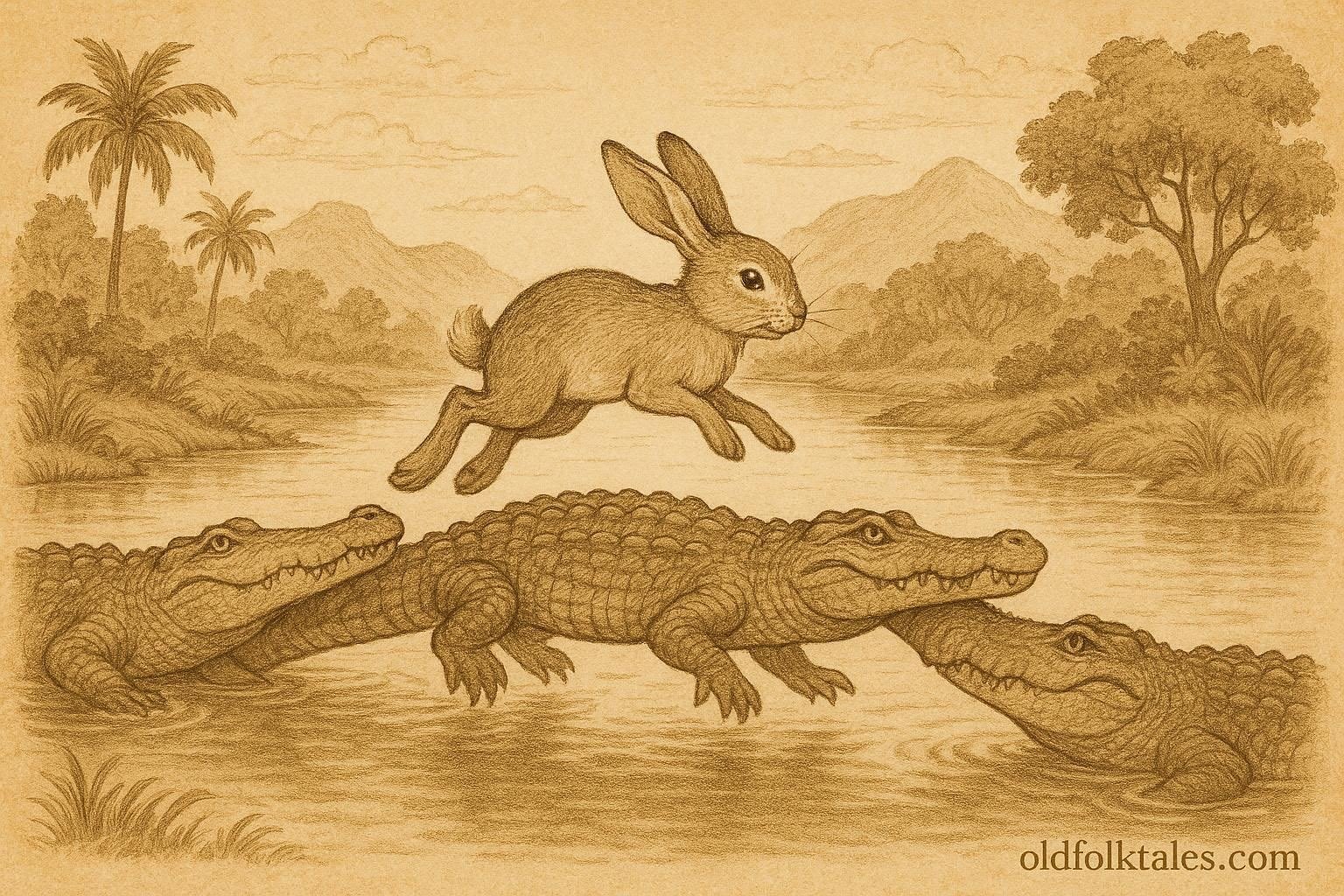
The crocodile agreed and summoned the others with low rumbling calls. One by one, crocodiles emerged and positioned themselves across the river, forming a living bridge. Their rough backs rose above the water, creating a narrow but continuous path. The hare waited patiently, pretending to inspect the arrangement.
When all was ready, the hare stepped lightly onto the first crocodile’s back. He counted aloud with clear confidence, hopping from one to the next. The crocodiles remained still, pleased by the attention and believing they were moments away from receiving divine favor.
With each leap, the hare drew closer to the far bank. As he reached the final crocodile, he laughed softly and bounded onto solid ground. From the safety of the opposite shore, he turned back and thanked the crocodiles for their cooperation. Only then did the truth dawn upon them. They had been tricked by a creature far smaller and weaker than themselves.
The crocodiles thrashed angrily, splashing water and snapping their jaws, but it was too late. The hare disappeared into the tall grass, unharmed and victorious. He fed well that day, savoring the tender shoots and reflecting on the narrow escape.
Word of the hare’s cleverness spread quickly among the animals. Some praised him, others warned that trickery could bring trouble. The hare listened to all but held firmly to his belief that intelligence must sometimes outpace strength. He did not use his wit to harm unnecessarily, only to protect himself when danger loomed.
The crocodiles, humbled by the experience, became more cautious. They learned that power alone did not guarantee success and that underestimating others could lead to failure. The river returned to its quiet rhythm, carrying with it the lesson of that day.
In the seasons that followed, the hare continued to live by the river, always alert and thoughtful. He taught younger animals to observe before acting and to value the strength of the mind. Though small in body, he became large in reputation, remembered not for his speed alone but for his wisdom.
To this day, elders tell the story of the clever hare to remind listeners that survival depends not on size or force but on intelligence, patience, and the ability to think clearly in moments of danger.
Moral Lesson:
True strength is found in wisdom and careful thought. When faced with danger, intelligence and calm reasoning can overcome even the most powerful threats. Pride and brute force, when unbalanced by wisdom, often lead to downfall.
Knowledge Check:
- Where did the hare live?
Answer: Near a wide river inhabited by crocodiles. - Why did the hare need to cross the river?
Answer: Food on his side had become scarce. - How did the hare trick the crocodiles?
Answer: He claimed to count them for forest spirits and used their backs as a bridge. - Why did the crocodiles believe the hare?
Answer: Their pride made them eager for recognition and reward. - What saved the hare from danger?
Answer: His intelligence and calm planning. - What lesson did the crocodiles learn?
Answer: Strength without wisdom can lead to failure.
Source:
Adapted from Myanmar Folk Literature Preservation Project Animal Tales Archive, 2011.
Cultural Origin:
Rural Burmese animal fable tradition.