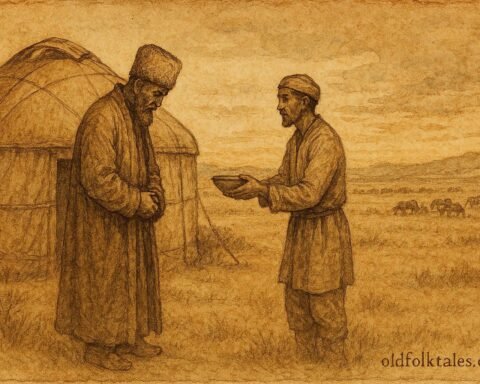
Long ago, beneath the vast skies of the Kazakh steppe, there lived two men bound by deep friendship and mutual trust. They shared meals, journeys, and dreams, and their bond was so strong that they made a solemn vow: if one were blessed with a son and the other with a daughter, the two children would one day be united in marriage. Their promise was not made lightly, for among the steppe people, a spoken oath carried the weight of destiny itself.
Fate honored their words. In time, one friend welcomed a son, Kozy Korpesh, while the other was granted a daughter, Bayan Sulu, renowned from childhood for her intelligence and beauty. Though the children grew up apart, the vow bound their lives together before they ever met. Songs were sung of their betrothal, and elders spoke of the union as one guided by destiny and honor.
Discover the wisdom of Persian poets and Arabian storytellers in Western Asian Folktales.
Tragedy struck when Kozy’s father died, leaving the boy vulnerable in a world where protection often depended on power and wealth. Meanwhile, Bayan grew into a young woman admired by many. Among her suitors were men driven not by love but by ambition and greed. One rival in particular, jealous of Kozy’s rightful claim, sought to win Bayan through deception and force.
When Kozy learned that Bayan was of age and that danger surrounded her, he set out across the steppe to claim his promised bride. His journey was long and filled with hardship. The open land tested his endurance, while rumors and lies planted by his rivals clouded the path ahead. Still, Kozy pressed on, guided by loyalty and the belief that true love must be defended, no matter the distance or danger.
At home, Bayan remained steadfast. Though pressured to accept a forced marriage, she refused every demand that betrayed her vow. She resisted threats and manipulation with courage and resolve, holding fast to the promise made before her birth. Bayan’s loyalty was not passive; she actively opposed injustice, using wisdom and determination to delay her enemies while waiting for Kozy’s return.
When Kozy finally reached Bayan’s land, their reunion was filled with both joy and sorrow. Their love, long promised and patiently guarded, burned brightly—but only briefly. The rival’s jealousy reached its peak, and betrayal followed. Through treachery and violence, Kozy was killed, his life taken before the lovers could fulfill their union.
Bayan’s grief was immeasurable. Yet even in despair, she did not surrender her honor. She mourned Kozy openly, refusing consolation or compromise. In many tellings of the epic, her loyalty continues beyond death itself, transforming her sorrow into an enduring symbol of devotion. Her steadfast love elevates her beyond tragedy, securing her place in legend.
The tale of Kozy Korpesh and Bayan Sulu spread across the steppe through song and poetry. It became a cornerstone of Kazakh oral tradition, retold by poets as a warning against envy and ambition, and as a tribute to love grounded in honor. Their story does not promise happiness, but it affirms the sacredness of vows and the enduring power of loyalty, even when fate proves cruel.
Discover the wisdom of ancient India and the Silk Road in South & Central Asian Folktales.
Moral Lesson
This epic teaches that love bound by honor and loyalty is sacred, and that jealousy and greed can destroy even the purest bonds. True devotion remains meaningful, even when it ends in tragedy.
Knowledge Check
1. Who are Kozy Korpesh and Bayan Sulu?
They are legendary lovers bound by a vow made by their fathers before their birth.
2. What promise shapes their destiny?
A sworn agreement that Kozy and Bayan would marry if one was born a son and the other a daughter.
3. What obstacles stand between the lovers?
Jealous rivals, betrayal, greed, and manipulation.
4. How does Bayan demonstrate loyalty?
She resists forced marriage and remains faithful to Kozy despite threats and pressure.
5. How does the story end?
Their reunion is brief and ends tragically with Kozy’s death through betrayal.
6. What cultural values does the epic highlight?
Honor, loyalty, the sanctity of vows, and the dangers of envy.
Source: Lyrical-epic poem Kozy Korpesh – Bayan Sulu, recorded by scholars including Chokan Valikhanov
Cultural Origin: Kazakhstan (Kazakh love epic tradition)