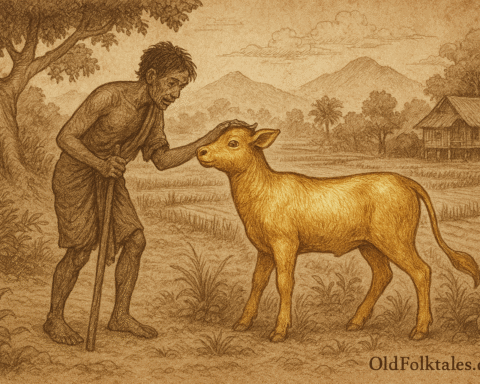
In the time when the boundary between animal and human was not yet firmly drawn, when the forest spirits still walked openly among the villages, a doe wandered through the dense jungles of Java. She was no ordinary deer, her eyes held an intelligence that seemed to pierce beyond the veil of the natural world, and her movements carried a grace that suggested something more than mere animal instinct.
Deep in a grove where sunlight filtered through the canopy in golden threads, beneath the protective embrace of ancient trees, the doe gave birth. But what emerged from her was not a fawn with spotted coat and trembling legs. Instead, she bore a human child: a baby boy with skin smooth as polished teak and eyes that held the same liquid depth as his mother’s.
Click to read all East Asian Folktales — including beloved stories from China, Japan, Korea, and Mongolia.
The doe gazed upon her offspring with a love that transcended species. She knew, with the wisdom that dwells in the hearts of all mothers, that this child belonged to two worlds. She nursed him in secret, hidden from both the hunters who roamed the forest and the villagers who tended their fields at the forest’s edge. The child grew quickly, drinking the doe’s milk and learning the ways of the deer: how to move silently through the undergrowth, how to read the wind for danger, how to find the sweetest grasses and the clearest water.
But as the child grew, the doe understood that he could not remain in the forest forever. His human form would never truly belong among the deer, and his need for human companionship would only deepen with time. With a mother’s heartbreak and a mother’s wisdom, she made a decision that would change both their fates.
One morning, as mist still clung to the rice paddies like gossamer veils, the doe carried her child to the edge of a village. She placed him gently at the threshold of a childless couple’s home: a farmer and his wife who had long prayed to the ancestors for a son. Then, with one last lingering look, she bounded back into the forest’s embrace, her heart splitting between two worlds.
The couple discovered the child as the first rooster crowed. They saw no deer, no mother, only a beautiful boy who seemed to have appeared like an answered prayer. They named him Kancil, after the clever mouse-deer of legend, and raised him as their own.
Kancil grew into a striking youth, but he was never quite like the other children. There was a wildness about him that couldn’t be tamed, a restlessness that made him pace the village borders as twilight fell. He would startle at sudden sounds, his head jerking with the alertness of prey. He preferred to eat vegetables and fruits, turning away from meat with an instinctive revulsion that puzzled his adoptive parents.
When the other boys learned to hunt, Kancil would grow agitated, his breathing rapid and shallow. He moved with unusual grace, almost seeming to glide across the ground rather than walk. At night, he would slip from his sleeping mat and stand in the doorway, gazing toward the forest with an expression of such longing that his mother would weep to see it.
The villagers began to whisper. There was something uncanny about the boy, they said. Something not quite human. He was too fast, too aware, too connected to the forest. When deer came near the village fields, they never fled from Kancil but would stand watching him with what seemed like recognition.
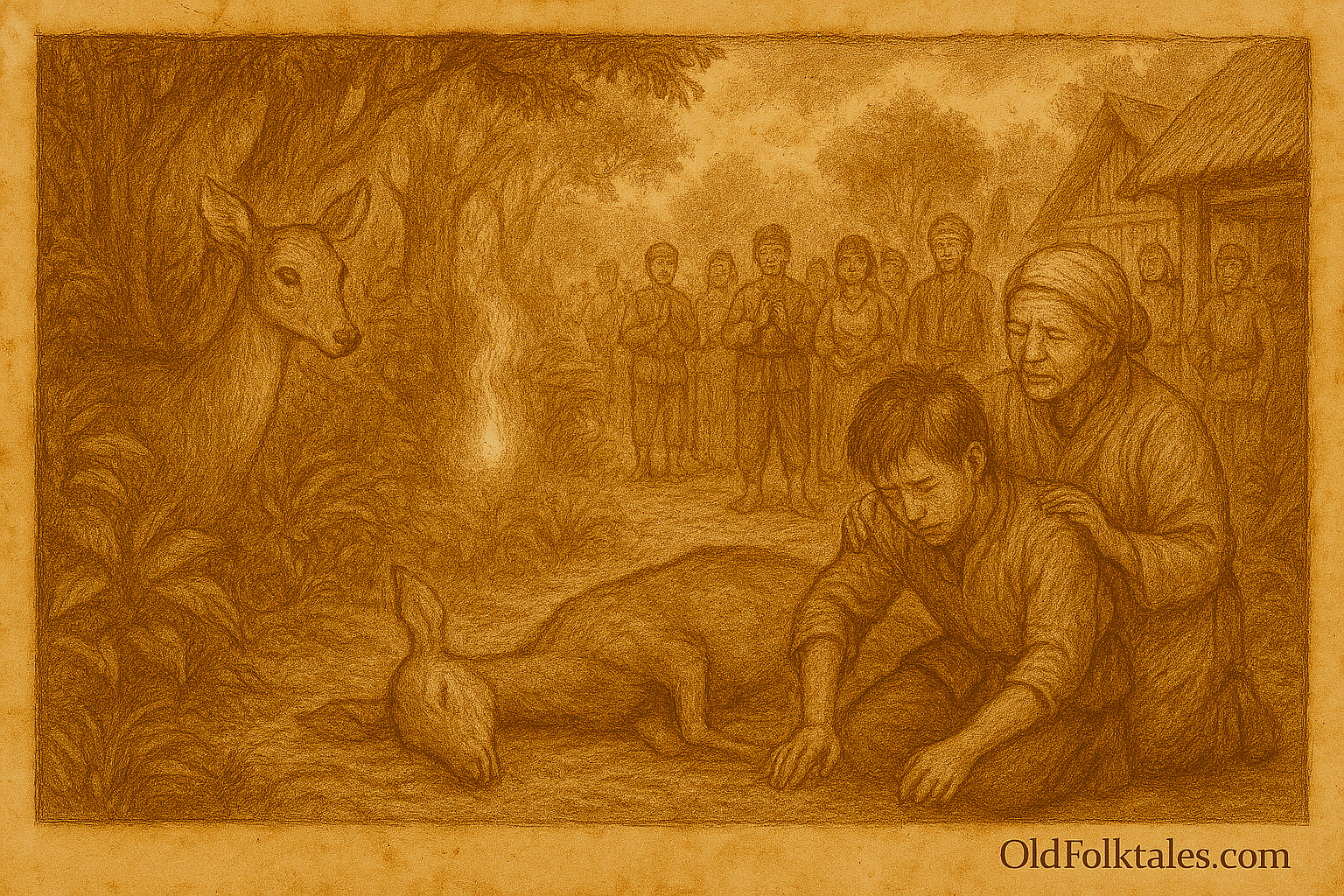
The truth emerged one evening during the harvest festival. As drums echoed through the village and dancers moved around the bonfire, a group of hunters returned with their prize: a doe they had tracked for hours. They laid the deer’s body in the center of the village for all to admire their skill.
Kancil approached the gathering, drawn by some impulse he couldn’t name. When his eyes fell upon the doe, something within him shattered. He recognized her: not with his mind, but with a deeper knowing that resonated in his very bones. This was his mother, the one who had given him life and then given him up so he might live among his own kind.
A cry tore from Kancil’s throat, not quite human, not quite animal: a sound of grief that seemed to come from the earth itself. He fell to his knees beside the doe, and as his tears fell upon her still warm body, the truth spilled from his lips. He told them everything: of his birth in the forest, of his mother’s sacrifice, of the dual nature that had always made him feel split between two worlds.
The villagers stood in stunned silence. Some felt shame for the deer they had killed. Others felt wonder at the mystery that had lived among them. The couple who had raised Kancil embraced him, their love unchanged by the revelation, but Kancil knew he could not stay.
“I am neither fully human nor fully deer,” he said, his voice carrying the weight of acceptance. “I cannot belong completely to either world, and my presence here will only bring confusion and pain. I must return to the forest, to honor my mother and to live as she intended: between both worlds, belonging to neither.”
That night, Kancil walked back into the forest from which he had come. Some say he became a forest guardian, protecting both deer and humans, teaching hunters to respect their prey and reminding deer to avoid human settlements. Others say he found peace in solitude, living as a bridge between species, understanding both but claimed by neither.
From that day forward, deer in that region would avoid the village, as if carrying the memory of Kancil’s grief in their blood. And the villagers would tell their children the story of the deer child, reminding them that all creatures share a common spirit, and that the boundaries between human and animal are thinner than we imagine.
Click to read all Southeast Asian Folktales — featuring legends from Thailand, Indonesia, Vietnam, and the Philippines.
The Moral Lesson
This folktale embodies the animistic beliefs central to Indonesian spiritual tradition, teaching that humans and animals share deep kinship and spiritual connection. It reminds us that our relationship with nature is not one of separation but of profound interconnection. The story also explores the painful beauty of living between worlds, honoring both our wild origins and our social nature. It calls for respect toward all living beings, acknowledging that what we hunt and consume carries spirit and sacrifice, and that we must approach the natural world with reverence rather than dominance.
Knowledge Check
Q1: Who is Kancil and what makes his birth unusual in this Indonesian folktale?
A: Kancil is a human child born to a deer mother in the forests of Java. His unusual birth, a doe giving birth to a human baby rather than a fawn, represents the thin boundary between human and animal in traditional Indonesian animistic belief systems.
Q2: Why does the deer mother leave her human child at the village?
A: The deer mother recognizes that her human child cannot truly belong in the forest despite his deer origins. Out of maternal love and wisdom, she leaves him with a childless couple so he can grow up among his own kind and learn human ways, even though it breaks her heart.
Q3: What behaviors and characteristics reveal Kancil’s dual nature?
A: Kancil displays deer like traits including startling easily at sounds, preferring vegetables over meat, moving with unusual grace and speed, feeling agitated around hunting, experiencing deep longing for the forest, and having a special connection with deer who don’t flee from him.
Q4: How is Kancil’s true origin revealed to the villagers?
A: During a harvest festival, hunters return with a doe they’ve killed. When Kancil sees the deer’s body, he recognizes her as his mother through deep instinctive knowing. His grief stricken cry and confession reveal the truth of his birth and dual nature to the entire village.
Q5: Why does Kancil return to the forest at the end of the story?
A: Kancil recognizes that he belongs fully to neither the human world nor the animal world. To honor his mother’s sacrifice and accept his unique nature, he chooses to return to the forest, living as a bridge between both worlds rather than causing confusion by staying in the village.
Q6: What does this tale teach about Indonesian animistic beliefs and human animal relationships?
A: The story reflects Indonesian animistic beliefs that spirits inhabit all living things and that humans and animals share deep spiritual kinship. It teaches that the boundaries between species are fluid, that animals possess intelligence and emotion, and that humans must approach nature with respect and reverence, remembering our interconnection with all creatures.
Source: Adapted from traditional Javanese oral folklore, with elements found in Indonesian Legends and Folk Tales by Adèle de Leeuw.
Cultural Origin: Javanese tradition, Indonesia (Southeast Asia)