
In a village where the morning call to prayer echoed across terraced rice fields and roosters announced each dawn with faithful regularity, there lived a young man named Raden. He possessed all the gifts that should have made him a valuable member of his community: strong limbs, quick wit, and a family willing to teach him their trade. Yet Raden squandered these blessings in the most peculiar way, through an insatiable love of sleep.
While other young men rose before sunrise to tend the fields, Raden remained curled beneath his sarong, deaf to his mother’s calls. While his peers gathered to repair the village irrigation channels or help neighbors raise new homes, Raden could be found napping under the shade of a mango tree, his face peaceful as a Buddha statue. While evening came and families shared meals and stories, Raden would already be drifting back to sleep, claiming exhaustion though he had done nothing to warrant it.
Click to read all East Asian Folktales — including beloved stories from China, Japan, Korea, and Mongolia.
“Just a few more minutes,” became his constant refrain, stretching into hours, then entire days lost to slumber.
His parents watched with growing despair. “Son,” his father would plead, “life is short and the work is plenty. Each day you sleep away is a day you cannot reclaim. How will you support a family? How will you contribute to our community?”
But Raden would simply yawn, stretch like a contented cat, and mumble something about resting just a bit longer. He saw no urgency in life, no reason to rush. Tomorrow would always come, he reasoned, and there would always be time to start living purposefully. Today, however, his sleeping mat called to him with irresistible sweetness.
The village elders shook their heads. His friends gradually stopped inviting him to join their activities, tired of his constant refusals and broken promises. Even the young women who might have once found him handsome began to look elsewhere for potential husbands, seeking men who understood the value of industry and commitment.
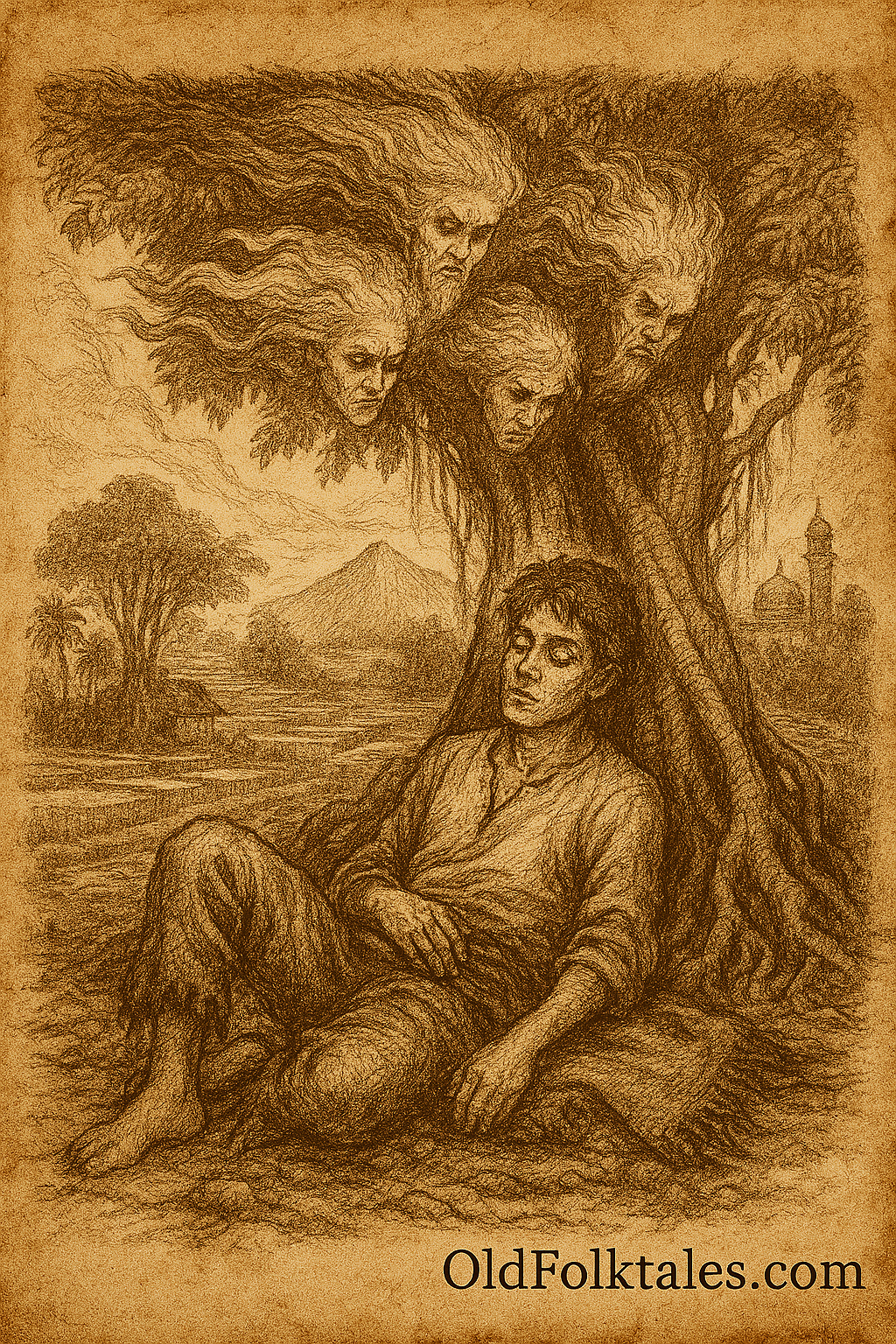
One afternoon, as the tropical sun hung heavy in the sky and heat shimmered off the dirt paths, Raden lay down for what he thought would be a brief nap beneath a banyan tree at the edge of the village. This tree was ancient, its aerial roots creating curtains that touched the earth, forming a natural chamber. The spot was cool and inviting, and Raden had often slept there, despite whispered warnings that old trees sometimes housed spirits.
As he drifted into sleep, Raden entered a dream more vivid than any he had experienced before. He found himself in a world that seemed identical to his village, yet subtly different. The colors were more vibrant, the sounds more melodious, and everything moved with a dreamlike fluidity that felt perfectly natural within the logic of sleep.
In this dream world, time behaved strangely. What felt like minutes would stretch into hours, and hours would compress into moments. Raden wandered through this realm, always on the verge of waking but never quite breaking through to consciousness. Whenever he thought to rise, gentle voices would whisper, “Rest a little longer. There is no hurry. Sleep is sweet, and waking is harsh.”
These were the spirits of the banyan tree, ancient entities who fed on human vitality and time. They had recognized in Raden a soul already inclined toward wasting his existence, and they drew him deeper into their realm, where they could feast on the years he so carelessly threw away.
In the dream world, Raden continued his habits, sleeping and drifting, always promising himself he would wake soon and return to the real world. But “soon” in the spirit realm bore no relation to time in the mortal world. The spirits wove dreams within dreams, creating layers of false awakenings where Raden would think he had risen, only to find himself still trapped in slumber.
Meanwhile, in the waking world, Raden’s body lay beneath the banyan tree, breathing but not waking. His family searched frantically, finding him there on the second day. They tried to rouse him, but though his chest rose and fell, his eyes would not open. Medicine men came with herbs and prayers. The imam recited verses over him. His mother wept and pleaded, but Raden remained locked in his supernatural slumber.
Days became weeks. Weeks became months. The village gradually accepted that Raden would never wake, that he had been claimed by spirits or struck by some mysterious curse. His family kept him comfortable, turning his body to prevent sores, dripping water into his mouth to keep him alive, but slowly, they too began to lose hope.
In the dream world, Raden finally began to feel something was wrong. The whispers that had seemed so soothing now sounded sinister. He noticed that he could not remember when he had last seen his family’s real faces, could not recall the true taste of his mother’s cooking or the genuine warmth of the sun. Everything in the dream world was a copy, beautiful but hollow.
With tremendous effort, fighting against the spirits that tried to keep him submerged in sleep, Raden began to claw his way toward consciousness. It felt like swimming up through thick honey, every movement exhausting, the voices urging him to give up and sink back down. But for the first time in his life, Raden found within himself a desperate determination, a recognition that he had wasted too much already and could not afford to lose more.
Finally, after a struggle that felt like years within the dream, Raden’s eyes opened.
The shock of what he saw nearly stopped his heart. The faces gathered around him were familiar but aged. His mother’s hair had gone completely gray. His father’s back was bent. His younger sister, who had been a girl when he fell asleep, was now a woman with a child of her own. The banyan tree under which he had lain had grown thicker, its roots spreading further.
“How long?” he whispered through cracked lips.
“Seven years,” his mother sobbed, hardly believing he had finally woken. “You have been asleep for seven years.”
Seven years. Seven years of his youth, gone like morning mist. Seven years he could never reclaim, never relive. His friends had married, built homes, become skilled in their trades. The village had changed and grown, and he had missed it all, trapped in a sleep of his own making, seized upon by spirits who recognized a willing victim.
Raden wept then, not from self-pity but from genuine understanding of what he had lost. The years that should have been filled with learning, loving, building, and growing had been stolen because he had never valued them in the first place. The spirits had simply taken what he was already throwing away.
From that day forward, Raden lived differently. He rose early, worked diligently, and cherished each waking moment. He could never recover the seven lost years, but he could ensure that no more days slipped through his fingers like sand. He married, raised children, and became known for his industry and wisdom. And whenever young people in the village showed signs of laziness or spoke of putting off until tomorrow what should be done today, Raden would tell them his story, his voice carrying the weight of hard-won truth.
“Time,” he would say, “is the one treasure we cannot earn back once spent. The spirits are always waiting for those who waste it, ready to claim what we do not value. Wake up, live fully, and never sleep through the precious gift of life.”
Click to read all Southeast Asian Folktales — featuring legends from Thailand, Indonesia, Vietnam, and the Philippines.
The Moral Lesson
This folktale delivers a powerful message about the irreplaceable value of time and the dangers of procrastination and laziness. It teaches that avoiding responsibility and constantly postponing action leads to genuine loss that cannot be recovered. The supernatural element of the spirits represents how wasted time truly does vanish as if stolen, leaving us older but no wiser or more accomplished. The story emphasizes that diligence, mindfulness, and active engagement with life are essential, warning that those who drift through life in a metaphorical sleep will wake one day to find their youth and opportunities gone.
Knowledge Check
Q1: Who is Raden and what is his main character flaw in this Indonesian folktale?
A: Raden is a young man from an Indonesian village who possesses physical strength and intelligence but wastes his potential through excessive sleeping and avoiding responsibility. Despite having supportive family and opportunities, he constantly postpones action and values sleep over productivity, refusing to contribute to his community or prepare for his future.
Q2: What warnings does Raden ignore before falling into his supernatural sleep?
A: Raden ignores multiple warnings including his parents’ pleas about life being short and needing to contribute, the village elders shaking their heads at his behavior, his friends gradually abandoning him, and whispered warnings about the ancient banyan tree housing spirits. He dismisses all concerns, believing he always has more time.
Q3: How do the spirits trap Raden in the dream world?
A: The spirits of the banyan tree recognize Raden’s tendency to waste time and draw him into a vivid dream world where time behaves strangely. They create dreams within dreams, whisper soothing encouragement to keep sleeping, and construct false awakenings so he believes he has woken when he is still trapped. They feed on his wasted years and vitality.
Q4: What makes Raden finally fight to wake up from his supernatural sleep?
A: Raden begins to notice that everything in the dream world feels hollow and copied rather than real. He realizes he cannot remember genuine experiences with his family or the true sensations of life. This recognition, combined with the sinister tone of the spirits’ whispers, sparks his first real determination to fight his way back to consciousness.
Q5: What shocking discovery does Raden make when he finally awakens?
A: When Raden wakes, he discovers that seven years have passed in the real world. His mother’s hair is gray, his father is bent with age, his younger sister is now a woman with a child, and the entire village has changed and grown. He has lost seven years of his youth that can never be recovered.
Q6: What cultural and moral lessons does this tale teach about time and responsibility?
A: The story teaches that time is an irreplaceable treasure that cannot be recovered once lost, emphasizing Indonesian values of diligence, community contribution, and family responsibility. It warns that procrastination and laziness lead to genuine loss, that life’s fleeting nature demands intentional living, and that those who waste opportunities will find themselves left behind while life moves forward without them.
Source: Adapted from Indonesian oral folklore traditions, with elements found in Indonesian Folktales by Murti Bunanta .
Cultural Origin: Javanese and Malay traditions, Indonesia (Southeast Asia)








