Smoke rose slowly from cooking fires across the village as dawn settled over the rice fields. In one modest house at the edge of the settlement lived twin brothers whose lives had been shaped by hardship since childhood. Their parents had passed away during a harsh season of illness, leaving the brothers to depend on one another for survival. Though they shared the same face and voice, their thoughts moved in different directions.
The elder brother believed that food gained meaning only when it was shared. He often recalled his mother saying that a bowl of rice eaten alone could never satisfy the spirit. The younger brother listened to those same words but remembered something else instead. He remembered hunger. He remembered nights when the pot was empty. To him, survival meant holding tightly to what little they had.
The brothers worked the fields together, planting and harvesting side by side. Yet when the harvest was good, the elder brother invited neighbors to eat with them. When it was poor, the younger brother quietly reduced portions, fearing the return of famine.
Explore timeless legends from China, Japan, and Korea in our East Asian Folktales collection.
One dry afternoon, while returning from the fields, they noticed an elderly woman resting by the roadside. Her back was bent, and her voice was weak when she asked for food. The younger brother hesitated. He calculated the remaining rice at home and worried about the coming days. The elder brother knelt and offered the woman their meal without question.
She ate slowly, with care and gratitude, as if each grain mattered. When she finished, she reached into her bundle and brought out a small rice pot made of clay. It was plain and unadorned, yet warm to the touch. She told them that the pot would provide rice as long as it was used to feed the hungry with honest intent. Before they could ask anything more, she continued down the road and disappeared from sight.
That evening, curiosity overcame doubt. The brothers placed the pot over the fire. Soon the scent of fresh rice filled the room. They ate until satisfied, and the pot remained full. The younger brother smiled for the first time in weeks.
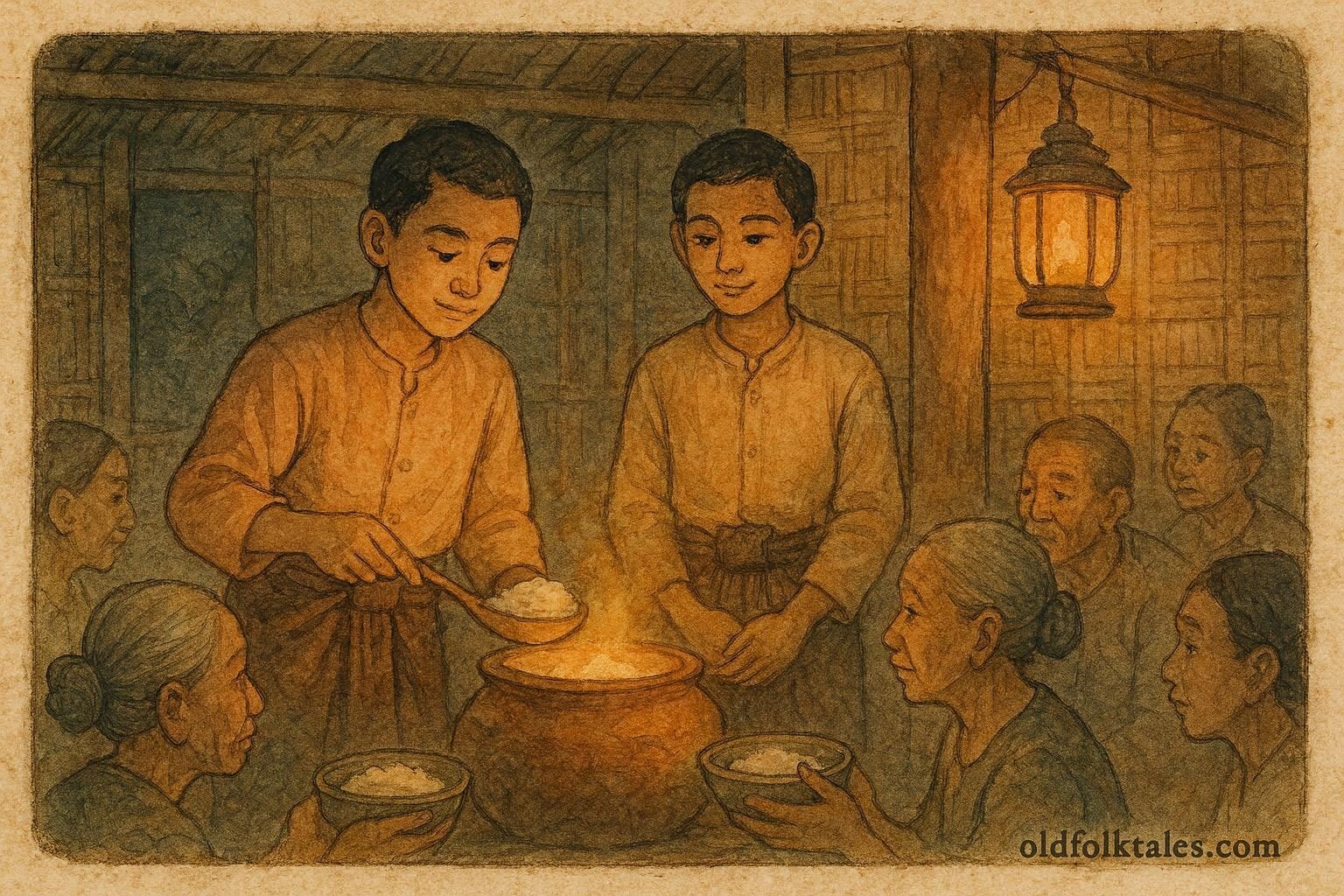
The next day, neighbors noticed the smell of cooking rice and came to inquire. The elder brother welcomed them. He placed the pot in the center of the room and served rice generously. The pot continued to refill, no matter how many bowls were taken.
Soon the house became known as a place where hunger was eased. Travelers stopped to rest. Widows and orphans came quietly at first, then openly. The elder brother found joy in seeing others fed. The younger brother watched with growing unease.
Though the pot never emptied, fear settled in his heart. He wondered what would happen if the pot stopped working. He imagined scarcity returning. He began to resent every bowl given away.
One evening, when the elder brother was away, the younger brother decided to test the pot. He cooked rice for himself alone and ate more than usual. Nothing happened. Encouraged, he began filling containers to store rice for the future.
As he scooped the rice, the pot grew heavy. The rice hardened and turned tasteless. When he reached inside again, the pot tipped over, spilling ash onto the floor. The room filled with smoke, and the rice vanished.
Terrified, the younger brother fell to his knees. When the elder brother returned and saw what had happened, he did not scold him. Instead, he gathered the scattered ash and cleaned the pot.
The next morning, villagers gathered again. The elder brother apologized for the interruption in sharing and explained what had happened. The younger brother stood beside him, ashamed but honest. When the pot was placed back on the fire and rice was offered freely once more, its warmth returned.
From that day on, the younger brother changed. He learned that fear had blinded him to abundance. He took part in feeding others and found that the pot worked best when trust replaced anxiety.
Years passed. Eventually, the pot cracked and could no longer be used. Yet by then, the village had changed. Neighbors shared harvests freely. No one feared hunger alone anymore. The lesson of the pot lived on in daily practice, long after the magic itself had faded.
Moral Lesson
True provision does not come from possession alone but from trust, sharing, and restraint. When people allow fear to guide their actions, even abundance turns hollow. When generosity leads, communities grow strong enough to thrive without magic.
Knowledge Check
- Why did the twin brothers think differently despite growing up together?
Answer: They experienced hardship differently and developed contrasting views on sharing and security. - How did the brothers receive the magic rice pot?
Answer: An elderly woman gave it to them after being fed with kindness. - When did the rice pot continue to provide food?
Answer: When the rice was shared sincerely with others. - What caused the rice to turn into ash?
Answer: The younger brother tried to hoard rice out of greed and fear. - How was the pot’s power restored?
Answer: By returning to honest sharing and communal use. - What lesson remained after the pot stopped working?
Answer: The village learned to sustain itself through mutual generosity.
Source
Adapted from Myanmar Folk Literature Preservation Project Rural Narratives Archive, 2014.
Cultural Origin
Central Burmese Household Folklore.