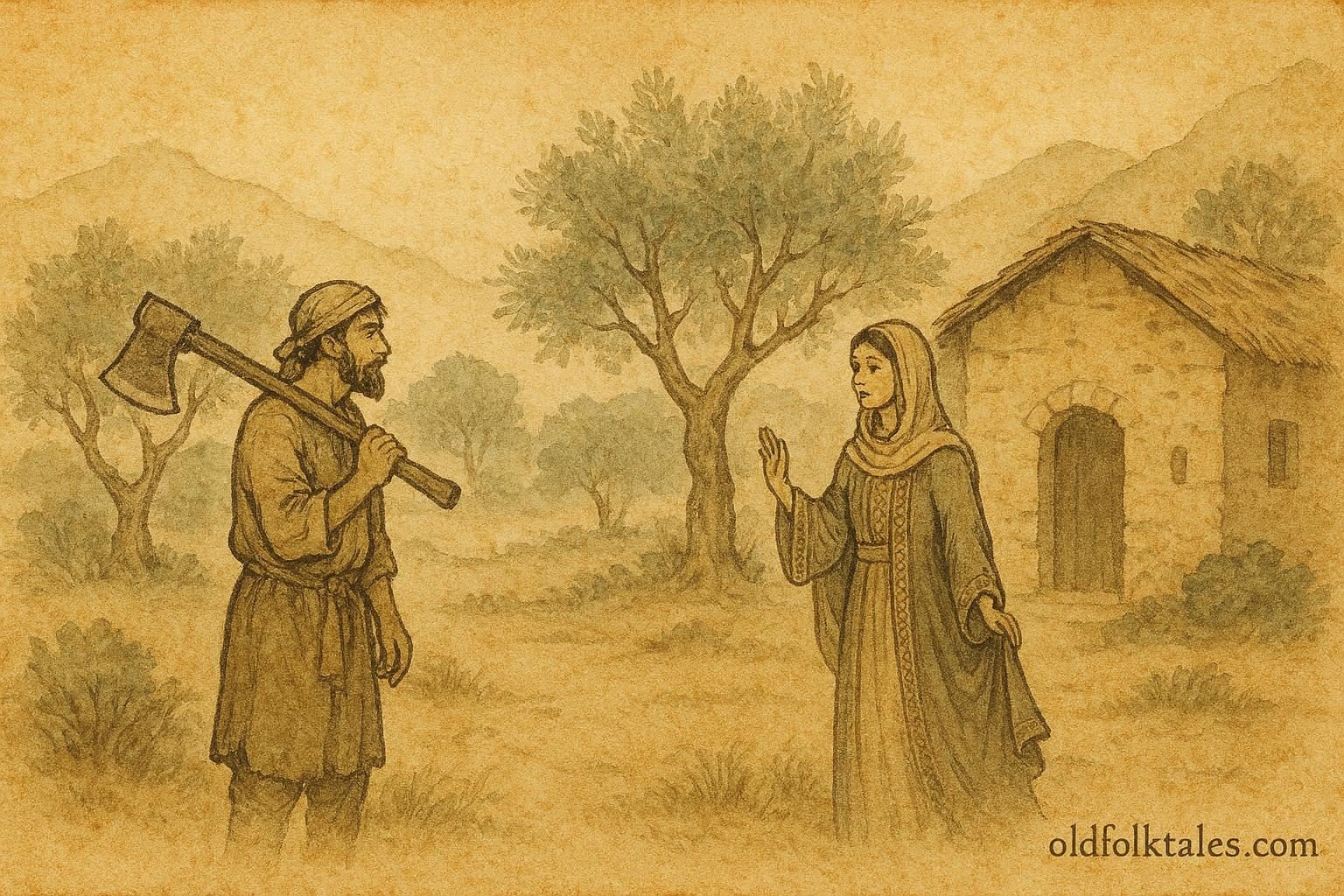
In a Syrian countryside shaped by hills, olive groves, and narrow paths worn smooth by generations of footsteps, there lived a humble woodcutter. His days began before sunrise, when the air was cool and the land quiet. With an axe balanced on his shoulder, he walked into the hills to gather firewood, trusting that honest labor would provide enough to sustain him. He did not expect abundance, only fairness, and he measured wealth not in coins but in steady bread and peace of mind.
The woodcutter had a sister from whom he had long been separated by circumstance. Life had carried them in different directions, as it often does in villages where necessity governs movement more than desire. He knew little of her fate, only that she no longer lived as she once had. Time passed, seasons turned, and the matter rested quietly in his thoughts.
One day, through ordinary conversation rather than deliberate search, the woodcutter learned that his sister had become wealthy. The news reached him without embellishment, yet it struck him with surprise. Those who spoke of her did so with certainty: she lived in comfort, possessed resources beyond daily need, and was regarded with a measure of respect. The woodcutter listened in silence, neither rejoicing nor resenting the change, but wondering how such a reversal had come to pass.
Compelled not by envy but by curiosity and kinship, he resolved to see his sister for himself. Leaving his tools behind for a time, he followed the familiar roads toward the place where she now lived. Along the way, he reflected on the uncertainty of fortune. He had known hardship and contentment in equal measure, and he understood that fate often moves without explanation.
When the siblings were reunited, the contrast between their circumstances was plain. The sister received him without hesitation, acknowledging their shared blood and shared past. Her manner was composed, shaped by experience, yet she did not deny the simplicity from which they both had come. They spoke of their lives, of the choices made and the chances encountered, and of how paths that begin together may diverge widely.
As their conversation unfolded, the truth of her wealth became clear. It had not come through deceit or injustice, but through a chain of events guided by fate, inheritance, opportunity, or rightful claim, as such tales are often told. What mattered was not the means alone, but the recognition that fortune, once unevenly distributed, carried responsibilities along with comfort.
The woodcutter did not ask for what was not his, nor did he deny the bond that connected them. Yet the imbalance between their lives stood as a question that demanded resolution. In keeping with the values of the community, matters of family and fairness could not be ignored. What one possessed in excess while another lacked in necessity invited reflection, not accusation.
The resolution came not through conflict, but through acknowledgment. The sister recognized that wealth gained through fate must be aligned with justice. She understood that prosperity loses its meaning when it isolates rather than restores balance. Through her actions, measured, deliberate, and consistent with custom, the disparity between them was addressed. The woodcutter did not become rich beyond measure, but his burdens were eased, and his standing within the community was affirmed.
When he returned to his village, he did so changed, not in character, but in circumstance. He resumed his work with the same diligence, now supported by the knowledge that fairness had been restored. The community observed this quiet correction of fortune and accepted it as rightful. No resentment lingered, for the outcome reflected shared values rather than personal gain.
The story endured because it spoke to a truth familiar to all who heard it: that wealth and poverty are not fixed states, and that fate, when guided by justice and kinship, can correct its own imbalances. The woodcutter’s sister remained prosperous, and the woodcutter remained humble, yet neither stood apart from the other. In their reconciliation, the community found reassurance that fortune, however unpredictable, need not undermine moral order.
Moral Lesson
This folktale teaches that wealth and fate must be tempered by justice and responsibility, and that true prosperity lies in restoring balance within family and community.
Knowledge Check
1. Who is the central figure of the story?
A humble Syrian woodcutter whose life contrasts with his sister’s fortune.
2. What discovery sets the story in motion?
The woodcutter learns that his sister has become unexpectedly wealthy.
3. Does the story portray wealth as unjustly gained?
No, the sister’s wealth is presented as the result of fate and rightful circumstance.
4. How is the imbalance between the siblings resolved?
Through acknowledgment of kinship and the restoration of social and moral balance.
5. What cultural value does the story emphasize?
Community justice and familial responsibility within Arab tradition.
6. Why does the community accept the outcome?
Because it aligns with shared values of fairness and social harmony.
Source
Adapted from Syrian-attributed variants in Arab Folktales by Inea Bushnaq, documenting regional narratives of fortune, inheritance, and social balance. Internet Archive.