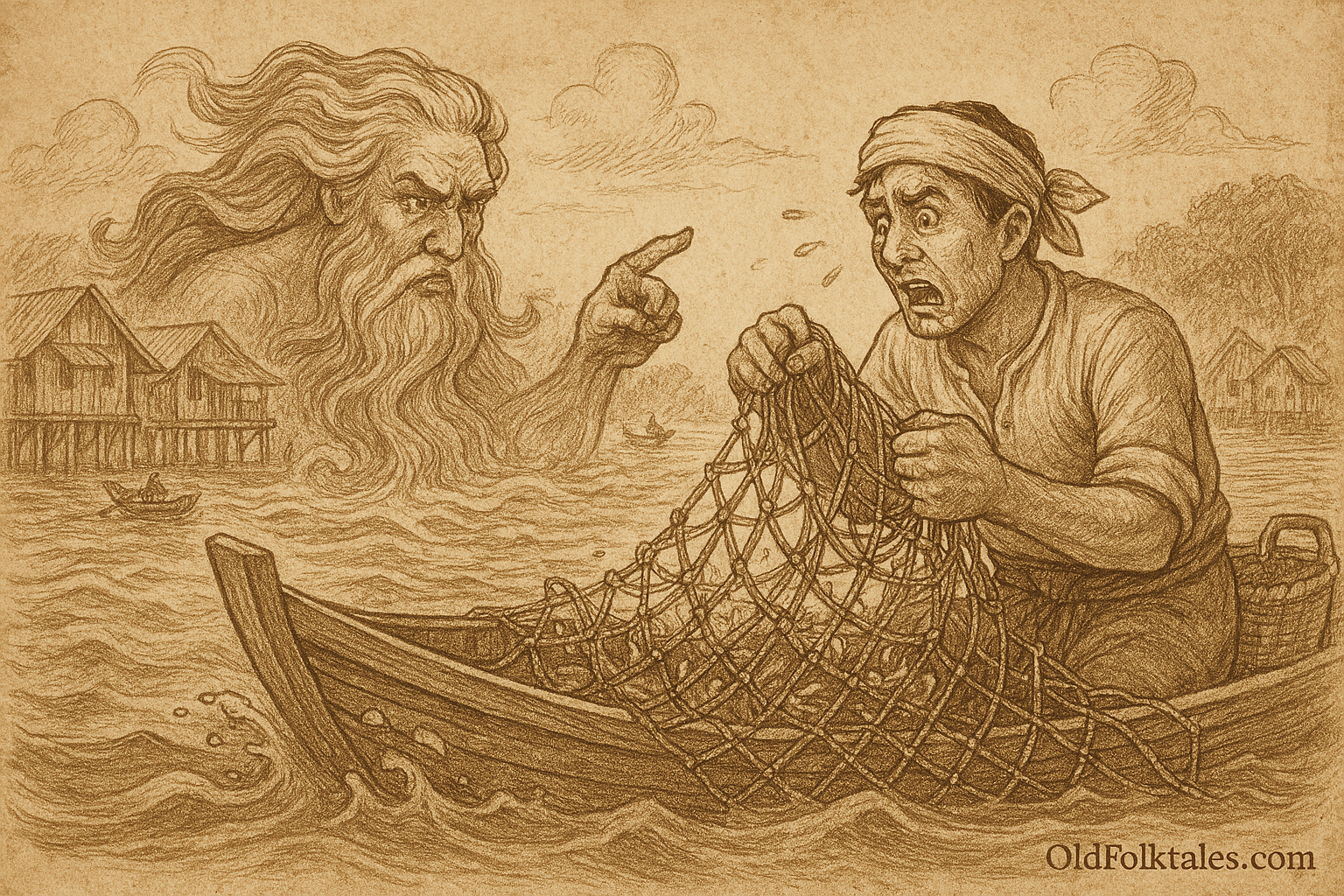
In the water villages of Brunei, where homes stood on stilts above the South China Sea and life moved with the rhythm of tides, there lived a fisherman named Ismail. His house, like all the others in Kampong Ayer, was connected to its neighbors by wooden walkways that swayed gently with the waves. From his veranda, he could lower his nets directly into the water, and his boat was always ready, tied to a post beneath his dwelling.
Ismail was known for two things: his considerable skill at fishing and his troubling habit of dishonesty. While other fishermen in the community would share their catches honestly, dividing the haul fairly among those who worked together, Ismail had developed a reputation for deception that cast a shadow over his otherwise capable work.
Click to read all East Asian Folktales — including beloved stories from China, Japan, Korea, and Mongolia.
When fishermen worked together, as was the custom in Kampong Ayer, they would pool their resources, share their boats and nets, and divide the catch according to agreed upon portions. But Ismail would hide the best fish in a separate basket, claiming the day’s catch was smaller than it truly was. When he sold fish at the market, he would tell buyers one price while telling his fishing partners another, pocketing the difference. He would borrow equipment from neighbors, promising to return it promptly, then claim he had already given it back.
His lies were not always large, but they were constant, like barnacles accumulating on a boat’s hull. Each small deception added to the next until trust between Ismail and his community had eroded almost completely.
“Ismail,” his fellow fisherman Abdul would say, shaking his head in frustration, “why do you do this? We are all trying to survive. When you cheat us, you hurt your own neighbors, your own community.”
But Ismail would simply shrug, offering more lies to cover the previous ones. “I don’t know what you mean,” he would say with false innocence. “You must be mistaken. Perhaps you miscounted the fish. Perhaps you misremembered our agreement.”
The other fishermen grew tired of his deceptions. One by one, they stopped inviting him to join their collective fishing expeditions. They stopped lending him equipment. They stopped sharing information about where the fish were running thick. Ismail found himself increasingly isolated, fishing alone while others worked in cooperative groups.
But Ismail convinced himself this was better. Fishing alone meant he didn’t have to share with anyone. All the catch would be his, and there would be no one to witness his deceptions. He told himself he was clever, that he had outsmarted his neighbors, that their traditional ways of cooperation and honesty were for fools.
What Ismail did not understand was that the sea was always watching. In Bruneian tradition, the waters were not merely liquid and salt but alive with spirits, entities who observed human behavior and maintained the ancient balance between take and give, between respect and punishment. These sea spirits, known to the old people, paid particular attention to those who made their living from the ocean’s bounty.
One morning, Ismail prepared for his daily fishing expedition. The sun was just rising, painting the water in shades of gold and pink. He loaded his boat with his nets, carefully prepared and mended, and pushed off from his house platform. The sea was calm, promising a good day for fishing.
He cast his nets in a spot he knew was rich with fish, feeling the familiar weight as the net sank. Hours passed. When he began to pull the net up, he felt unusual resistance. The net seemed heavier than it should be, tangled in ways that made no sense. He pulled harder, his muscles straining, but the net would not come free.
After much effort, he finally managed to haul it aboard, only to find it impossibly snarled. The mesh was twisted and knotted in patterns that defied explanation, as if invisible hands had deliberately woven chaos into every fiber. There were no fish, only tangles.
“No matter,” Ismail muttered, trying to work out the knots. “I will untangle it and cast again.”
But the knots would not yield. The more he tried to separate the strands, the more tangled they became, as if the net itself was alive and fighting him. After hours of frustrating work, he finally managed to prepare the net again and cast it once more.
The same thing happened. When he pulled it up, it was hopelessly tangled, twisted into impossible knots. Not a single fish, only chaos.
This pattern continued day after day. Every time Ismail cast his net, it returned tangled beyond use, empty of catch. He tried different locations, different times of day, different nets. The result was always the same: knots, tangles, and no fish. His careful preparations each evening would dissolve into chaos each morning. It was as if the sea itself had declared war on his livelihood.
Meanwhile, other fishermen continued to have successful catches. Their nets worked perfectly, pulling up abundant fish. They would return to the village with boats full of the sea’s bounty, while Ismail’s boat remained stubbornly empty.
Desperation crept into Ismail’s heart. His savings dwindled. His stomach grew empty. His house needed repairs he could not afford. The isolation he had once thought clever now felt like a prison. He had no cooperative relationships to fall back on, no community goodwill he could draw upon, because he had spent years eroding trust with his constant lies and deceptions.
One evening, an old fisherman named Haji Karim came to Ismail’s house. His face was lined with age and wisdom, and his eyes held the knowing look of someone who had seen many tides come and go.
“The sea spirits have judged you,” Haji Karim said simply. “They have watched you lie and cheat, taking from others without giving fairly in return. Your nets tangle because your life has become tangled with dishonesty. The spirits will not allow you to take from the sea when you have shown you cannot be trusted with what you take.”
Ismail felt shame wash over him like a wave. For the first time, he truly understood what he had done. His lies had not made him clever; they had made him a thief. His deceptions had not brought him advantage; they had brought him isolation and poverty.
“What can I do?” Ismail asked, his voice breaking with genuine remorse.
“You must go to each person you have wronged,” Haji Karim said. “Confess your lies. Make restitution where you can. Ask forgiveness. And you must learn to work honestly within the community, giving fairly and receiving fairly. The sea spirits may relent if they see genuine change.”
Over the following weeks, Ismail did as Haji Karim advised. He went to each neighbor he had cheated, confessing his deceptions and offering what restitution he could manage from his meager remaining resources. Many were angry. Some refused to forgive immediately. But slowly, as they saw his genuine efforts to change, doors began to reopen.
Abdul was the first to invite Ismail to join a fishing expedition. “You will receive your fair share,” Abdul said firmly. “Nothing more, nothing less. And we expect the same honesty from you.”
Ismail agreed, and for the first time in months, he cast his net with others. The net fell smooth and clean. When they pulled it up, it was full of fish, untangled and functional. Ismail felt tears sting his eyes at the sight.
From that day forward, Ismail became known for something new: his scrupulous honesty. He shared catches fairly, told the truth about prices, and returned borrowed items promptly. His nets never tangled again. And when young fishermen in the community showed signs of dishonesty, others would tell them about Ismail, about how the sea spirits watch, and about how truth and cooperation are not just moral choices but practical necessities for those who depend on the ocean’s gifts.
“The sea provides for those who respect it and work honestly with their community,” Ismail would say, his voice carrying hard won wisdom. “Lies may seem to bring advantage, but they bring only tangles. Truth may seem difficult, but it brings a catch you can keep.”
Click to read all Southeast Asian Folktales — featuring legends from Thailand, Indonesia, Vietnam, and the Philippines.
The Moral Lesson
This Bruneian folktale teaches that dishonesty and cheating ultimately harm the deceiver as much as the deceived, especially in close knit communities dependent on cooperation and shared resources. The story emphasizes that trust is the foundation of communal living, particularly in sea and river based societies where survival often depends on collective effort and mutual support. The supernatural punishment of the tangled nets represents how lies create chaos in one’s own life, making it impossible to benefit even from one’s legitimate skills.
Knowledge Check
Q1: Who is Ismail and what is his character flaw in this Bruneian folktale?
A: Ismail is a skilled fisherman living in Kampong Ayer, Brunei’s water village, who is known for his considerable fishing ability but also for his constant dishonesty. He habitually cheats his fishing companions by hiding the best fish, lying about prices, keeping borrowed equipment, and always seeking unfair advantage through deception rather than honest cooperation.
Q2: How do Ismail’s lies affect his relationships with other fishermen?
A: The other fishermen gradually stop working with Ismail due to his repeated deceptions. They stop inviting him to join collective fishing expeditions, stop lending him equipment, and stop sharing valuable information about fishing locations. His dishonesty isolates him from the cooperative community that sustains water village life.
Q3: What supernatural punishment do the sea spirits inflict on Ismail?
A: The sea spirits cause Ismail’s fishing nets to become impossibly tangled every time he casts them, no matter the location, time, or net he uses. The nets return twisted in patterns that defy explanation and contain no fish. The more he tries to untangle them, the worse the knots become, making it impossible for him to earn his livelihood.
Q4: What does Haji Karim explain about why the sea spirits are punishing Ismail?
A: Haji Karim, an old and wise fisherman, explains that the sea spirits have been watching Ismail lie and cheat, taking from others without giving fairly. He tells Ismail that his nets tangle because his life has become tangled with dishonesty, and the spirits will not allow him to take from the sea when he has proven untrustworthy with what he takes.
Q5: What must Ismail do to end his punishment and fish successfully again?
A: Ismail must confess his lies to each person he has wronged, make restitution where possible, ask for forgiveness, and learn to work honestly within the community by giving and receiving fairly. He must demonstrate genuine change and remorse, rebuilding trust through consistent honest behavior and participating in cooperative fishing with truthfulness.
Q6: What cultural values about community and honesty does this tale reflect in Bruneian society?
A: The story reflects core Bruneian values central to water village life including the necessity of honesty in trade and cooperation, the importance of trust in close knit communities dependent on shared resources, the belief that sea spirits watch and judge human behavior, and the understanding that individual success is meaningless without community support. It emphasizes that survival in sea and river-based societies requires collective effort built on mutual trust and fair dealing.
Cultural Origin: Bruneian Malay tradition, Brunei Darussalam (Southeast Asia)