In the city of Vilna, known for its scholars and halls of learning, lived Rabbi Elijah ben Solomon Zalman, revered as the Vilna Gaon. His reputation rested not only on unmatched wisdom in sacred texts but also on a disciplined devotion to reason, restraint, and moral clarity. In an age when study was the highest form of worship, the Gaon stood as a guardian of balance between knowledge and humility.
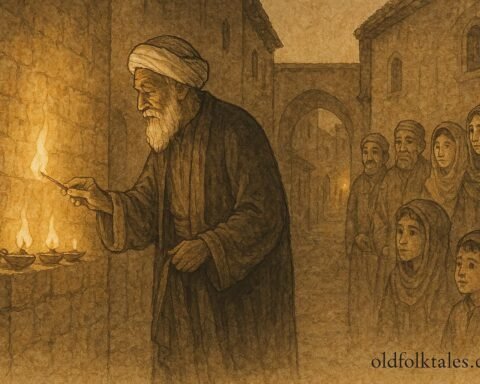
As the story is told in Jewish tradition, the Gaon observed the increasing burdens placed upon households during the Sabbath. Sacred law forbade certain forms of labor, yet daily needs remained. Moved by compassion and guided by his deep understanding of mystical knowledge, he resolved to create a servant formed not of flesh but of earth, a being that would obey without intention and serve without desire.
From clay gathered carefully and shaped with solemn concentration, the Gaon fashioned a towering human form. Through sacred names and letters known only to the learned, he placed a shem, a divine inscription, within the mouth of the figure. At once, the clay stirred and stood upright. Thus, the Golem was born.
The Golem was powerful but mindless. It followed commands precisely, without reflection or judgment. On the Sabbath, it carried water, cleaned rooms, and performed tasks forbidden to human hands. For a time, the creation fulfilled its purpose, and order prevailed. The Gaon, however, never mistook the Golem for a living being. He regarded it as a tool, animated but soulless, sustained only by sacred power and strict control.
Each Sabbath, before sunset, the Gaon carefully removed the shem from the Golem’s mouth, returning it to lifeless clay. This ritual ensured that the creation would never act beyond its appointed time. Discipline preserved balance.
One Sabbath evening, however, the Gaon became deeply engaged in study. The hours passed unnoticed. As the sun dipped below the horizon, the Sabbath began, but the shem remained in place.
The Golem awoke.
Without guidance or restraint, it continued its labor. It moved through rooms with increasing force, lifting objects too heavy for walls to bear. Doors splintered. Tables overturned. The Golem, incapable of understanding limits, obeyed only the last commands it had received. Its strength, once useful, became destructive.
The sounds of destruction echoed through the house. Students rushed in alarm, recognizing at once what had occurred. The Gaon, stricken with realization, knew that he could not act himself without violating the sanctity of the Sabbath.
One student, steady in courage and knowledge, stepped forward. With careful movement and reverence, he approached the towering figure. As the Golem bent forward in its blind labor, the student reached into its mouth and removed the shem.
At once, the clay collapsed. The Golem fell inward upon itself, returning to earth without sound or struggle. The danger ended as suddenly as it had begun.
When the Sabbath concluded, the Gaon addressed his students. His voice carried neither pride nor anger, only solemn resolve. He declared that such creations must never be made again. Power without understanding, he said, is perilous. A servant without moral sense cannot distinguish duty from destruction. Knowledge, when severed from wisdom, invites ruin.
The remains of the Golem were hidden away, and the Gaon forbade any future attempt to reanimate it. From that day forward, the tale endured as a warning rather than a triumph.
Moral Lesson
This folktale teaches that creations lacking conscience and restraint can become dangerous, no matter how noble their purpose. True wisdom requires limits, humility, and responsibility for the consequences of one’s knowledge.
Knowledge Check
-
Who created the Golem of Vilna?
Rabbi Elijah ben Solomon Zalman, known as the Vilna Gaon. -
What gave the Golem life?
A sacred shem placed in its mouth. -
What was the Golem’s original purpose?
To perform forbidden labor on the Sabbath. -
Why did the Golem become dangerous?
It lacked judgment and was left active without control. -
How was the Golem stopped?
A student removed the shem, returning it to clay. -
What lesson did the Vilna Gaon draw from the event?
That power without moral autonomy leads to destruction.
Cultural Source and Origin
Source: Israel Folktale Archives (IFA), University of Haifa. IFA 1034.
Origin: Collected from Avraham Karp, born in Vilnius, Lithuania. Recorded in Haifa, Israel, 1956.